Why Are CS2 Knives and Rare Skins Still Getting More Expensive?
Why Are CS2 Knives and Rare Skins Still Getting More Expensive?
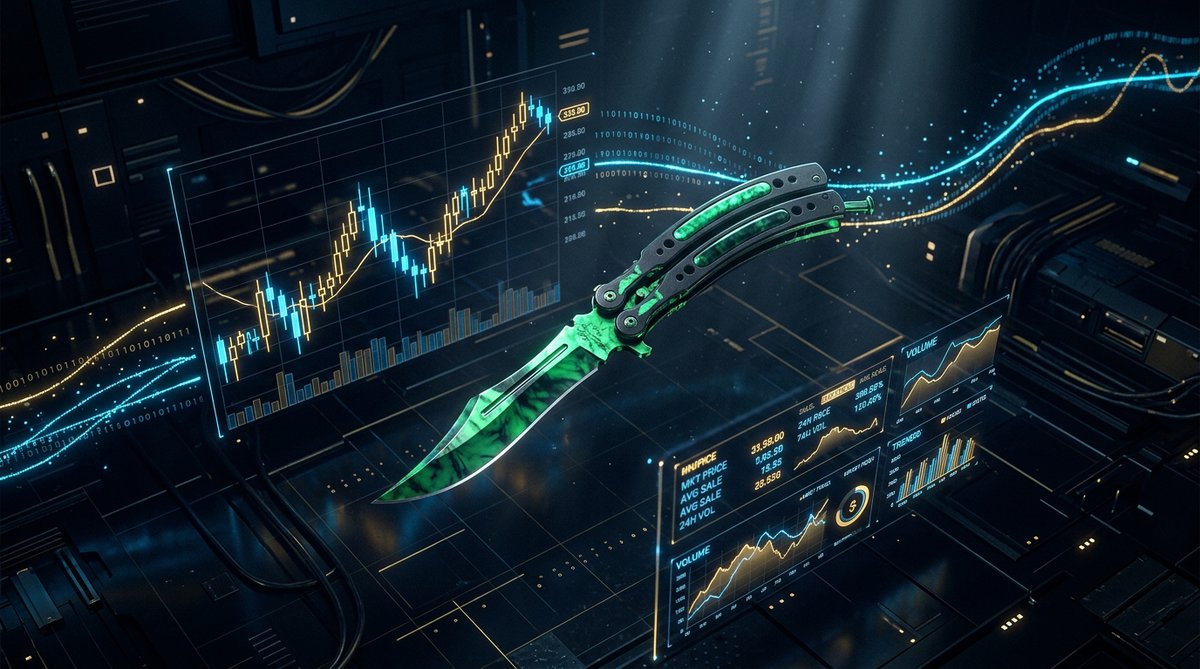
A single Butterfly Knife Gamma Doppler in Factory New condition is listed at $1,795 right now, and a Karambit Doppler is holding above $1,261. Meanwhile an AK-47 Wild Lotus in Factory New sits at roughly $14,350. Those are not typos — they are live market prices, and they point at the same question a lot of players keep asking: after all this time, why do the top CS2 items keep climbing instead of cooling off?
The answer is not one thing. It is a stack of four forces — supply mechanics, tournament demand, trading volume, and plain old scarcity — and once you see how they fit together, the prices stop looking random.
The Numbers Behind the Climb
Let us anchor this with real figures. According to market trackers, the liquid CS2 skin market has been moving up steadily through 2026, with popular rifle and knife categories up between 12% and 18% over the last twelve months. Peer-to-peer trading volume grew roughly 40% year over year as more players moved off the Steam Community Market and its fees onto direct-trade platforms.
The high end tells an even sharper story. Rare pattern skins — Case Hardened blue gems, Doppler phases, and similar low-probability finishes — outperformed the broader market by about 3x in 2025, according to one market report. When a finish only appears on a tiny fraction of drops, its price is set by the handful of collectors who absolutely must have it, and that group does not bargain the way casual buyers do.
Look at the concrete items and the pattern is obvious. The Butterfly Knife Gamma Doppler and Karambit Doppler are not rare because of their float alone — they are rare because the Doppler finish has specific phases and patterns that collectors grade individually, which splits an already-small supply into even smaller, more expensive tiers.
Supply That Only Moves One Way
Here is the mechanic most people miss. CS2 skins are not printed — they are dropped, and the drop pool is tightly controlled by Valve. When a case leaves the active drop rotation, its supply is frozen forever. When an update touches drop rates, billions of dollars of inventory reprice within days.
The Armory Pass economy made this worse in the most counterintuitive way. It injected an estimated 2.5 million new skins into circulation, which pushed down prices on common Mil-Spec items as expected. But the rare Covert and Classified skins from the Armory collection did the opposite — they appreciated between 25% and 40% because their drop rates stayed so low that the new supply barely moved the needle on the high end.
More supply at the bottom, barely any at the top: that is exactly the recipe for a market where the cheap stuff gets cheaper and the expensive stuff keeps getting more expensive.
Where the Demand Actually Comes From
The demand side is just as important as the supply side. CS2 routinely sits above 20 million active players, and the Majors keep pulling in waves of new buyers and collectors. Tournament-driven demand is cyclical and predictable — every Major mints souvenir drops, refreshes sticker lines, and sends a fresh batch of viewers looking to own a piece of what they just watched.
On top of that, a growing share of the market now treats skins as an alternative asset rather than a cosmetic. Since roughly 2024, more traders have approached blue-chip items — high-tier knives, rare gloves, iconic rifles — the way people treat collectibles in other markets: buy scarce, hold, and let a fixed supply do the work. That shift in mindset is a big part of why the top of the market keeps grinding upward even when the rest of the economy wobbles.
Gloves tell the same story as knives. A pair of Sport Gloves Pandora's Box in Field-Tested condition is listed around $3,475, and the higher-tier glove finishes have been among the strongest performers on the whole board. Gloves are the hardest slot to fill cheaply, which makes their top finishes even more contested than knives.
The Case Odds That Set the Ceiling
Every one of these prices traces back to the same place: the drop table inside a case. When you open a case, the overwhelming majority of outcomes land in the common blue Mil-Spec tier — roughly 79.92% of all results. The golden prize at the top, a knife or a pair of gloves, shows up about 0.26% of the time.
That is the engine that makes knives and gloves expensive in the first place. A finish that appears in fewer than three out of every thousand openings will always be scarce, no matter how many cases are opened overall. And because the market as a whole has kept growing — total value crossed $4.2 billion in early 2026, up from around $3.8 billion the year before — there is simply more money chasing the same thin supply of top-tier drops.
Wear adds one more layer on top of all of it. Every skin carries a float value that maps to five wear tiers, from Factory New down to Battle-Scarred, and the lower the float, the rarer and more expensive the copy. Two identical-looking knives can sit hundreds of dollars apart purely on float, which is why serious buyers check wear before anything else.
What It Means If You Are Buying Now
None of this is a guarantee that prices only go up — the market has had sharp corrections before, and the October 2025 update was a reminder that a single Valve change can reprice everything overnight. What the data does show is which side of the market has momentum: rare, low-drop finishes with a real collector base, rather than common items that flood the market every time a new case arrives.
If you are buying, the smart play is to understand the drop mechanic behind the item before you spend. A knife is not just a knife — the finish, phase, and float all matter, and a $1,261 Karambit Doppler and a $1,795 Butterfly Knife Gamma Doppler are priced the way they are for reasons you can actually look up.
That is exactly why having real prices in front of you matters. If you want to see what the high end of the market is doing today — knives, gloves, and the cases that still drop them — you can browse the full case lineup, starting with the Golden Decree case page.