I Lost $200 on My First CS2 Skin Trade: 5 Lessons Every Beginner Should Learn

I Lost $200 on My First CS2 Skin Trade: 5 Lessons Every Beginner Should Learn
It was 2 AM on a Tuesday. I had just unboxed my first knife — a Flip Knife Urban Masked, worth about $280 at the time — after two years of casual case openings. I was ecstatic. I was also about to make every rookie mistake in the book.
Within 72 hours, I had turned that $280 knife into a $75 AWP skin and a collection of stickers I'd never use. I didn't get scammed. I didn't get hacked. I just didn't know what I was doing. Here are the five lessons that $200 loss taught me — so you don't have to pay the same tuition.
Lesson 1: Never Accept the First Steam Offer You Get
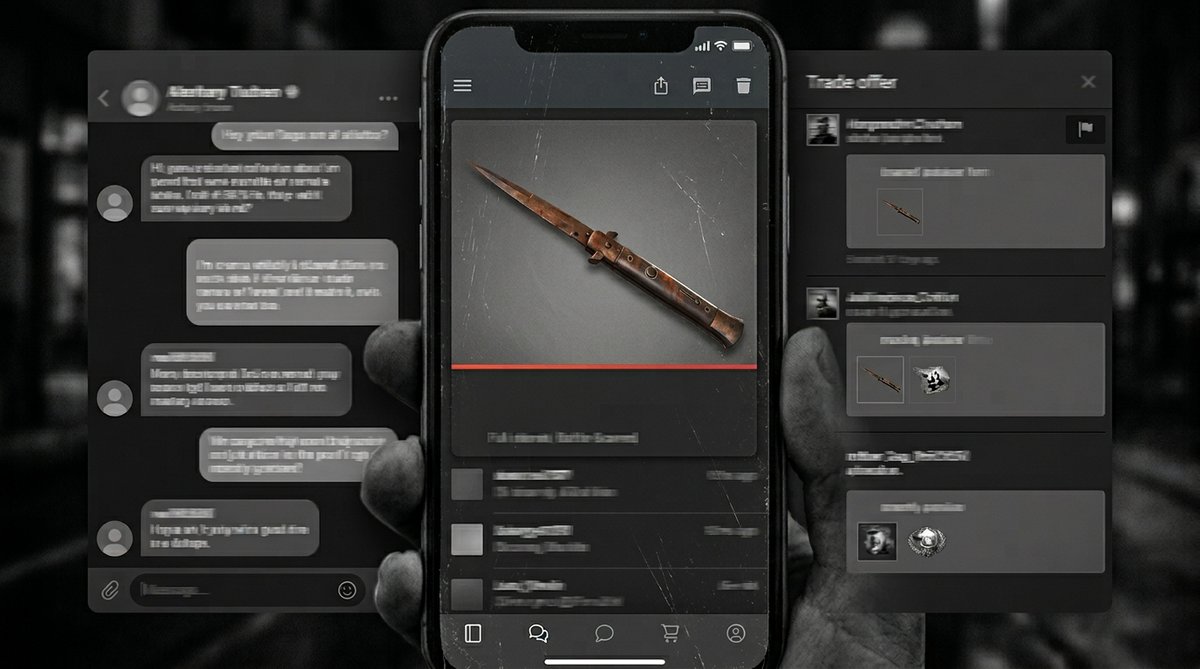
Within minutes of unboxing my knife, the Steam trade offers started rolling in. One guy offered me an AK-47 Redline with four matching stickers — it looked incredible in the inventory preview. I accepted without checking prices.
What I didn't know: stickers lose 90-95% of their value once applied. Those four $15 stickers were now worth maybe $2 total on that Redline. The skin itself was worth about $30. I had traded a $280 knife for a $30 skin with $2 worth of applied stickers. That's a $248 loss in one click.
The fix: Before accepting any trade, open a browser tab and check the Steam Market price of every item you're receiving — ignoring sticker value entirely. If the numbers don't add up within 10-15%, decline. Real traders won't be offended; scammers will move on to the next target.
Lesson 2: "Overpay" Is Almost Always a Trap
A week later, I was trying to trade up. A guy messaged me on Steam: "I'll overpay by $50, your knife for my AWP Asiimov + adds." The Asiimov was worth about $80, and the "adds" were a bunch of random cases and low-tier skins.
Turns out the Asiimov was Battle-Scarred with a 0.78 float — practically unrecognizable compared to the clean Field-Tested versions I'd seen in screenshots. Worth maybe $35, not $80. The "adds" were cases worth $0.03 each. Total value: maybe $40. My knife was still worth $280.
The fix: Always check float values, not just the skin name. A 0.06 AWP Asiimov and a 0.78 AWP Asiimov are the same item on paper but can differ in price by 2-3x. Use csfloat.com or the Steam API to verify before trading.
Lesson 3: The Market Doesn't Care About Your Sentimental Attachment
After the Asiimov disaster, I was holding onto my remaining skins waiting for prices to "go back up." I had convinced myself my Gut Knife Safari Mesh was going to be worth $200 "soon" because a YouTuber said Safari Mesh was undervalued.
Three months later, it was worth $85 — down from $110. I had lost another $25 just by holding onto a declining asset while telling myself a story about it.
The fix: Set a price floor when you buy. If it drops below that floor, sell. No exceptions. Sentimental attachment is the enemy of smart trading. The market moves on whether you're ready or not.
Lesson 4: Your First Big Trade Should Not Be Your First Trade
Looking back, every mistake I made traces back to one root cause: I jumped straight into high-value trades with zero experience. It's like learning to drive in a Ferrari — you're going to crash, and it's going to be expensive.
Here's what I should have done: start with $5-10 skins. Make 10-15 small trades. Learn how the trade window works, how to inspect items, how to check float, how to spot sticker scams, how to identify market manipulation. All of these skills cost nothing to learn on cheap skins. On a $280 knife, each mistake costs real money.
The fix: Spend your first week trading only sub-$20 skins. Track every trade in a spreadsheet. Review what worked and what didn't. Graduate to higher-value items only when you can explain why a trade is fair in under 30 seconds — without looking anything up.
Lesson 5: Liquidity Is Everything — A Skin You Can't Sell Is Worth $0
The final lesson took me the longest to learn. I had worked my way back up to about $150 in skins and decided to "invest" in a Sticker Capsule from a 2024 Major. It was rare, supply was limited, and I was convinced it would go up.
Six months later, it was still listed. I had priced it at $180. Nobody bought it. I dropped to $150 — still nothing. $120 — finally sold. After Steam's 15% transaction fee, I got $102. My $150 "investment" had returned $102 after half a year of waiting.
Compare that to an AK-47 Redline Field-Tested: worth about $45, but there are literally thousands listed and bought every single day. I can sell a Redline in 15 minutes. I couldn't sell that capsule in 6 months.
The fix: Before buying any skin as an investment, check the Steam Market graph. Look at "Number of sales in the last 24 hours." If it's under 20, you're not investing — you're collecting. Which is fine, but call it what it is. Liquid skins (50+ daily sales) may have lower upside, but they also have a much lower chance of becoming dead money.
The $200 I'm Glad I Lost
That first terrible week of trading cost me $200 and a Flip Knife I'll never get back. But those lessons — check prices before accepting, ignore sticker value, verify floats, start small, prioritize liquidity — have saved me thousands since.
The CS2 skin market in 2026 is more liquid and accessible than ever. You don't need to make the same mistakes I did. Start small, check everything twice, and never accept the first offer.
If you're looking for a safer way to get started with CS2 skins, opening cases through a platform that shows you real-time prices is a good first step. Check out the Phantom Cache — it drops some solid starter skins: