Two Drop Slots, One Decision: What Your Weekly CS2 Drop Is Really Worth
Two Drop Slots, One Decision: What Your Weekly CS2 Drop Is Really Worth
Every week, CS2 hands Prime players a package with two picks in it, and most players spend it in about four seconds. That is fine — right up until you notice the gap between the best and worst answer, and realise that what you do with the item afterwards decides whether it was worth anything at all.
This is the whole decision in five steps, using published odds and live prices rather than vibes.
Step 1: Find Out What Is Actually in Your Pool
Your weekly care package does not pull from every case in the game. It draws from the active pool — currently Kilowatt, Revolution and Dreams & Nightmares, alongside the newer Genesis and Dead Hand terminals. Older containers sit in a rare pool with roughly a 1% chance, and the Armory cases (Fever, Gallery) do not drop from play at all — they cost stars from a paid pass, and then still need a key.
That distinction matters because the same physical slot can be worth very different money. Dreams & Nightmares trades around $1.11 at the low ask. Kilowatt trades near $0.13. Same category, same gold-tier odds, roughly an 8.5x difference in what the slot hands you.
Terminals are the other shape to understand, because they are not cases. Instead of one roll against a fixed odds table, a terminal shows you an offer you can accept or decline a limited number of times. Different psychology, different maths, and worth treating as a separate decision from a classic case.
Step 2: Read the Book Before You Sell
Before you list anything, look at who you are standing behind. Skinport's public catalogue was sampled on September 3 and the picture was blunt: 25,164 distinct items, 3.69 million live listings, and a cheapest ask sitting well under the middle of the book.
- Under $1: cheapest ask is 41% below the book median, with about 49 competing listings
- $1–$5: 28% below, roughly 13 competing listings
- $5–$20: 20% below, 8 competing listings
- $20–$100: 16% below, 6 competing listings
- $100–$500: 10% below, 4 competing listings
- $500 and up: 4% below, 2 competing listings
Two things fall out of that table. First, on cheap items you are joining a very long queue — the sub-$1 bucket alone contained more than 8,600 items. Second, the discount you have to accept to sell next shrinks as price rises, because the queue does. Across the whole catalogue, 42.9% of items had a cheapest listing more than 30% under their own median.
Cases are the extreme case of this. The Recoil Case had 50,385 live listings with a $0.30 cheapest ask against a $0.72 median — a 58% gap. Fever sat at 36,598 listings and a 52% gap, Kilowatt at 12,210 listings and 57%. If your plan is "just list it", that is the queue you are joining.
Then compare marketplaces before you commit, because the same item is not one price. A September 8 study of 12 Factory New skins across 29 marketplaces found a median quote gap of 6.2% — and the extremes were far wider. The cheapest AWP | Dragon Lore in Factory New was $11,065.64; the highest quote for the identical variant was $16,648.71. That is a 50% spread on the same item, same wear, same day.
Step 3: Do the Fee Math First
The Steam Market takes about 15%, and keys bought after October 2019 cannot be traded at all. So a $1.11 case is really about $0.94 in your wallet, and a $0.30 case about $0.26. Small, but the fee is not small on a hundred of them.
Opening has the harsher maths. Valve publishes one odds table for every standard case: 79.92% Mil-Spec, 15.98% Restricted, 3.2% Classified, 0.64% Covert, and 0.26% for a knife or gloves, with roughly a 10% StatTrak chance folded on top. Because selling your pull costs 15% again, a case has to return about 118% of its open cost in raw market value just to break even in cash.
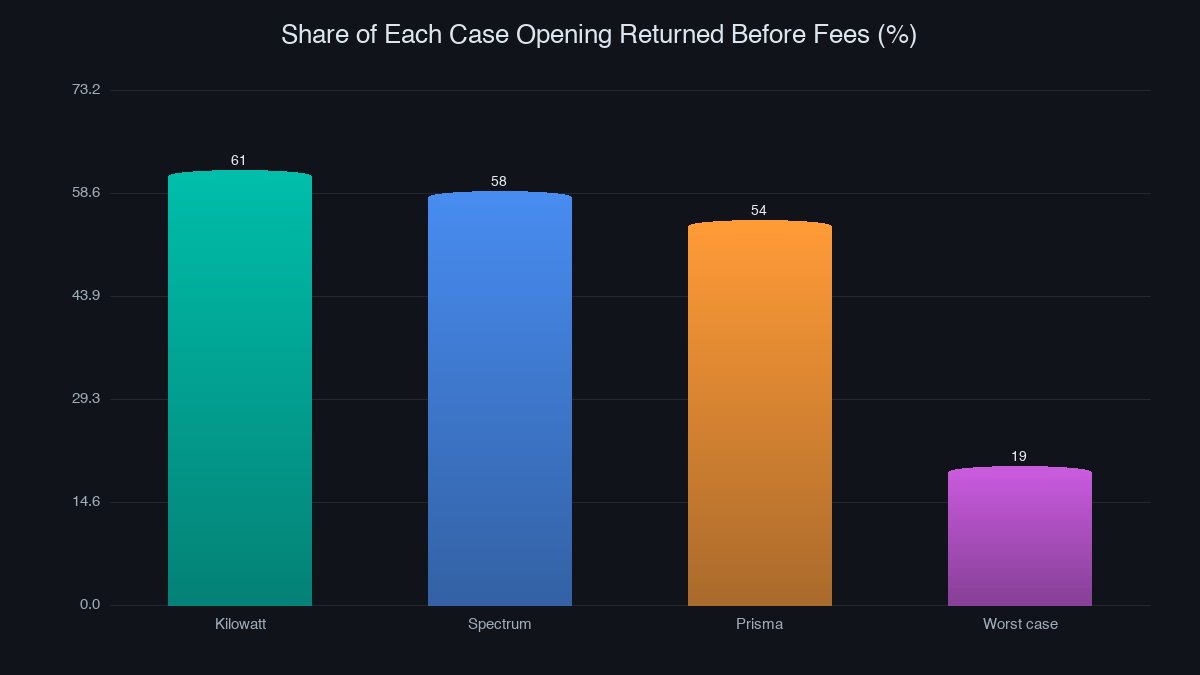
None of them reach that. The best-performing case in a live August sample — Kilowatt, at $2.62 to open with the key — returned about $1.60, roughly 61% of the money in. Spectrum came back at 58%, Prisma at 54%, and the worst case in the sample at about 19%. That is the house edge on this table, and it does not care how lucky you feel.
Step 4: Hold, Sell, or Open — Pick One on Purpose
Every drop ends in one of three places, and each has a rule.
Sell if you want the money now. Price against the cheapest ask in your bracket, not the median — the median is where the patient sellers sit. On low-value cases, expect the buyer to be a volume trader paying a few cents over nothing.
Hold if the container is out of the drop pool. Supply only ever drops as cases get opened, and a container that no longer enters the game has no replacement tap. This is the patient play, and it needs years, not weeks.
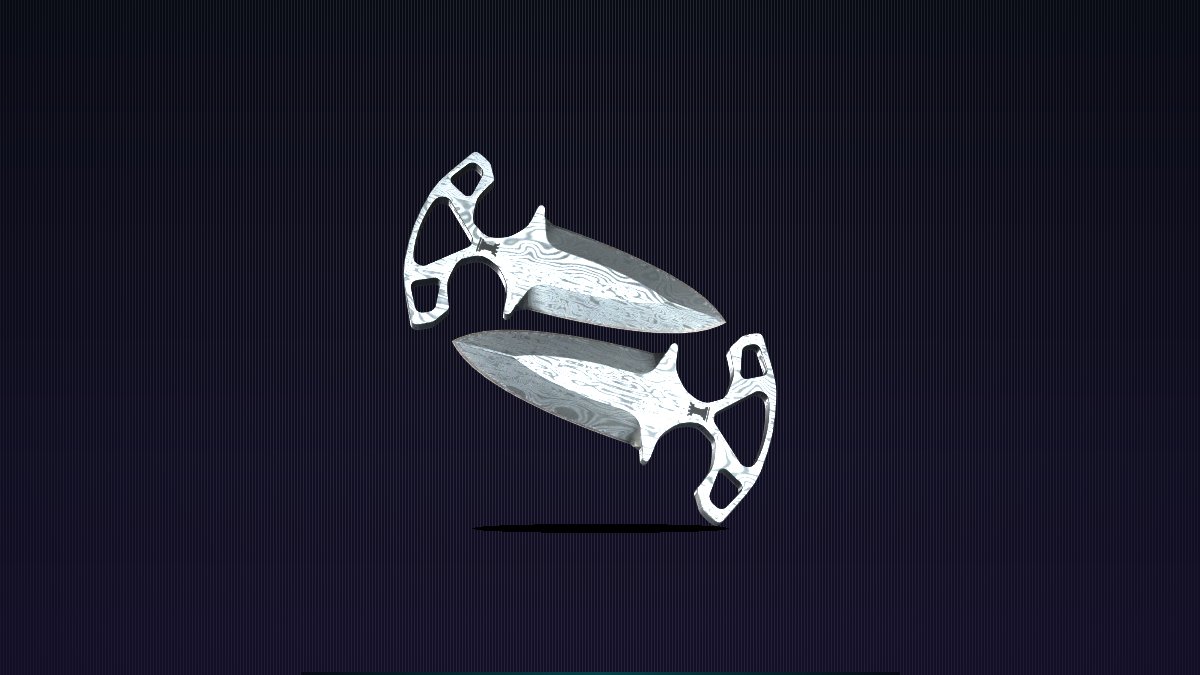
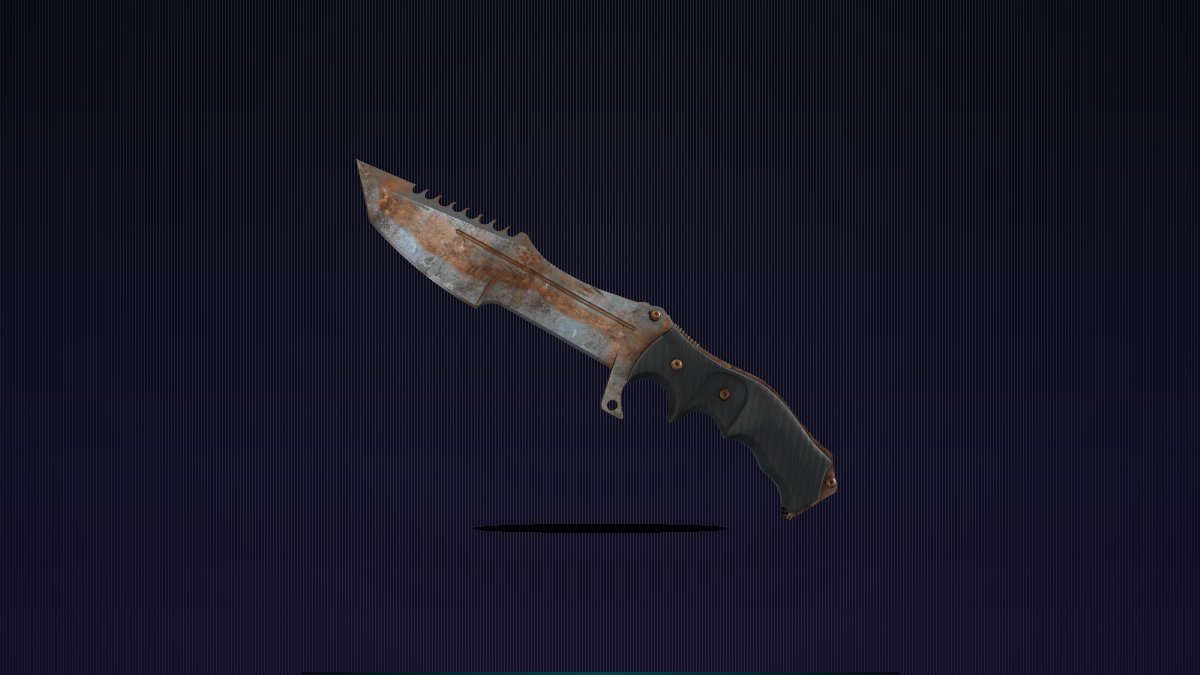
Open if you are paying for entertainment and you have already decided the money is gone. The gold tier is a 0.26% outcome — about one in 385 — so chase the case whose gold pool you would actually keep. That is why pool contents beat case price: the Dreams & Nightmares gold tier carries Butterfly, Bowie, Falchion, Huntsman and Shadow Daggers knives, which is precisely the finish family below.
If you want one specific skin, buying it directly beats chasing it — every time, at any budget. Opening is only the right call when the opening itself is the purchase.
Step 5: The New Wildcard in the Package
The September 22 Rush Hour update added something to your weekly package that is not an item at all. A pet egg can now be taken as your drop reward, and it consumes both slots. The egg never enters your inventory, the pet cannot be traded or sold, and it grows through four stages — egg, chick, pullet, adult — with feed coming from future drops. The game files contain 34 variants across three breeds, distributed much like skin rarities.
If you trade at all, the maths from Steps 1 to 3 already answers it: the egg costs you two marketable pickups a week against a soulbound reward worth nothing on any market.
One more thing to keep straight while you read the patch notes. Dataminers found an early version of an M14 sniper rifle in the game files — 115 damage, a 4x headshot multiplier, a five-round magazine, .338 calibre. That is a leak, not a release, and a datamined weapon has never once been worth buying ahead of. Treat it as a signal that new catalogues may come, not as a trade.
So take the case, take the skin, and decide where each one goes before you open anything. Sell the cheap ones into the queue, hold the discontinued ones, and if you are going to spend the $2.49 anyway, spend it inside a pool you like — a Frost Vault run costs the same key as a $0.13 case and gives you something to actually want at the end of it.