40 CS2 Cases Stopped Dropping. The Price Ladder Now Runs to 1,500x.
40 CS2 Cases Stopped Dropping. The Price Ladder Now Runs to 1,500x.
On 18 December 2025, Valve pulled more than 35 legacy cases out of the drop pool in a single pass. Nobody held a press conference. The cases just stopped appearing in weekly care packages, and the only remaining supply became whatever was already sitting in inventories and on the Steam Community Market.
Eleven months later, two cases that were retired on that exact same day sell for wildly different money. The Clutch Case is worth $0.30. The CS:GO Weapon Case 2 is worth $16.12. That is a 54x gap between two items that received identical treatment from Valve on the identical date.
As of 9 November 2026, community drop-pool trackers count 40 cases that no longer drop and five containers that still do. The active pool is thin: Dreams & Nightmares at $0.72, Revolution at $0.11, Kilowatt at $0.06, Sealed Genesis Terminal at $0.03 and Sealed Dead Hand Terminal at $0.14. Everything else has to be bought, traded or held.
The Ladder, Sorted
This is the part most "retired cases are the best investment" posts skip. Here is the actual ladder for the top of the market, priced in USD on 9 November 2026:
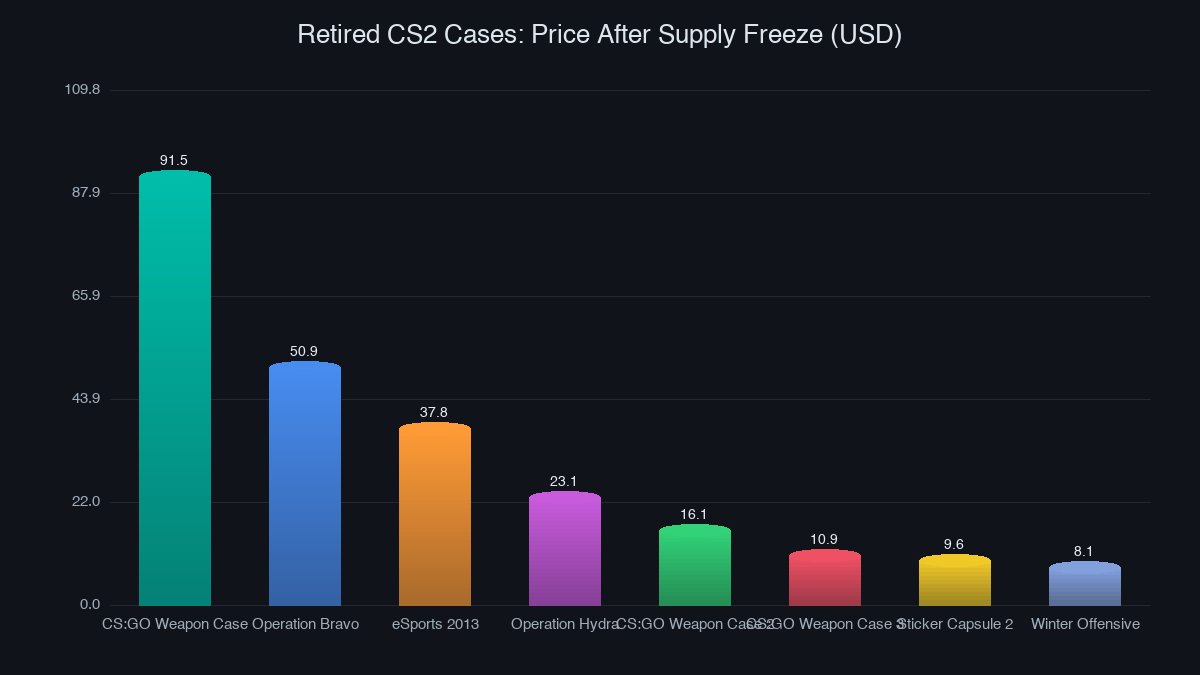
The CS:GO Weapon Case — the original 2013 container — sits at $91.53. Operation Bravo is at $50.94. The 2013 eSports Case, which stopped dropping on 18 December 2013, is at $37.78. Then Operation Hydra at $23.06, CS:GO Weapon Case 2 at $16.12, CS:GO Weapon Case 3 at $10.87.
Now compare any of those against the cheapest thing you can still get for free in a weekly package. Kilowatt Case: $0.06. Sealed Genesis Terminal: $0.03. The CS:GO Weapon Case is 1,526x the price of the Kilowatt Case, and roughly 3,051x the price of a Genesis Terminal.
That number is not the point by itself. The point is what sits in the middle of the ladder, because that is where most retired cases actually live.
Same Removal Date, 300x Apart
Take the 33 cases that trackers date to the 18 December 2025 removal. Their median price today is $2.41. The average is $8.22, dragged upward by the handful of ancient containers at the top. Strip out the noise and you have a cohort where 8 of 33 cases still trade under $1.00.
Look at the bottom of that same cohort. Clutch Case: $0.30. Fracture Case: $0.30. Snakebite Case: $0.25. Prisma Case: $0.78. Danger Zone: $0.79. CS20: $0.62. These are not cases from last week. They are cases that have been out of the drop pool for nearly a year, whose supply has been frozen for nearly a year, and whose price is still less than a third of a key.
So scarcity alone did nothing. Something else has to be doing the work.
And the top of that same cohort proves it from the other direction. Operation Hydra — retired on the same 18 December 2025 date, like everything else here — trades at $23.06, roughly 77x the Clutch Case. Nothing about Hydra's removal was special. What was special is that it is an operation case from 2017 with a knife pool and a skin list that people still open for fun, and the sealed supply was never large.
Two cases off the same shelf on the same day. One is lunch money, one is a decent pair of gloves. That gap is the entire story of this market.
What Actually Sets the Price
Three things separate a $16 case from a $0.30 case that died on the same day.
One: what the gold tier is worth. A case's price is anchored to the expected value of its contents, and the contents are anchored to the knife and glove finishes inside it. The Glove Case trades at $7.73, roughly 26x the Clutch Case, and the difference is not romance — it is a rare special item pool people still want. When the top of a case's item list is dead weight, the case is dead weight too, however long it has been retired.
Two: how much was printed before the tap closed. Removal freezes supply, but it does not shrink it. Cases that were opened in enormous numbers during 2015-2019 have a huge surviving population sitting in dormant accounts and storage units. Cases from short windows, or from eras when fewer people played, have a much thinner float. The CS:GO Weapon Case is expensive partly because it is old, and partly because the number of sealed copies that have not been opened is small enough that buyers fight over them.
Three: Steam is now the entire market. Retired cases cannot drop, so the Steam Community Market becomes the supply curve. That means every purchase pays Steam's fee stack, and every seller competes against a visible order book instead of a random drop. For a $0.30 case, the spread and fees eat the trade alive. For a $91.53 case, the same percentage is trivial next to the price movement.
The mechanical consequence: illiquid retired cases are not investments, they are inventory. You can be right about the direction and still lose money getting out.
The Trap In "Retired Cases Only Go Up"
There is a version of this argument that sounds airtight. Supply is fixed, players keep opening cases, eventually the float clears, price goes up. It has been broadly true for the 2013-2015 cohort and broadly false for the 2020-2023 cohort.
Case in point: the Recoil Case left the drop pool on 12 March 2026 and trades at $0.18 — cheaper than the Snakebite, which left three months earlier. A fresh removal date is not a catalyst. If nobody wants the contents, sealing the supply just makes a fixed amount of unwanted cardboard.
There is also a structural change working against the older model. Terminals now take two of the five weekly drop slots, and terminals do not need keys. The Armory pass sells 40 credits for $15.99, with cases at 2 credits each when one is in rotation. Valve has spent two years routing players away from "pay $2.49 for a random item" toward "look at the item, then decide". That changes what a sealed case is competing against.
Where This Leaves You This Week
If your goal is to actually open something rather than warehouse it, the cheap end of the ladder is where the maths gets interesting, not the expensive end. A $0.06 Kilowatt Case plus a key is a low-stakes roll with a real knife pool. A $91.53 CS:GO Weapon Case plus a key is a $94 bet on a 2013 item pool that most players have never seen drop.
The retired cases worth holding are the ones where both conditions hold: a contents pool people still chase, and a supply that was thin before the tap closed. If only one of those is true, you are holding a number that looks good on a chart and dies at the sell button.
Everything above is priced off community trackers, so treat the exact figures as a snapshot of one morning rather than gospel — different trackers value illiquid items differently, and a $0.30 case with three sales a week has a price the way a puddle has a shape. If you want to see what the live market looks like right now, the fastest route is to browse the actual listings: Phantom Cache and the rest of the case lineup on SkinVS, where prices update against real inventory instead of a scraped median.
The one habit worth taking from all of this: before you buy any retired case, check what is inside it and how many people are actually buying it this week. The removal date is the least interesting number on the page.