Why Gloves Are the Weakest Link in the CS2 Market Right Now

Why Gloves Are the Weakest Link in the CS2 Market Right Now
Across 34,412 matched market listings tracked between September 11 and September 18, the median CS2 item moved 0.00%. Flat. Nothing happened.
Now look at one category inside that flat market. Gloves — 470 matched references — posted a median move of −1.83%, with 296 references falling against only 143 rising. No other large group came close. Knives, tracked across 5,773 references, drifted just −0.11%. Stickers and charms didn't move at all.
So the broad market is calm and the glove shelf specifically is bleeding. That gap is worth understanding, because the reason gloves behave differently is structural, not seasonal.
The Puzzle: A Flat Market With One Falling Category
The headline number hides a tilted middle. Of those 34,412 references, 15,069 moved lower and only 9,459 moved higher, while 9,884 sat inside a ±0.25% noise band. A flat median with negative breadth means the typical item held, but more items weakened than strengthened.
Gloves were the cleanest negative signal in the dataset. A −1.83% weekly median on 470 references is not one bad listing, it is a whole category leaning the same way — and it follows the prior week, when gloves printed −1.55% while the broader weapon-skin groups were the ones getting hit (−4.66% for standard weapon skins, −5.00% for StatTrak variants).
Two weeks in a row at the bottom of the large groups is a pattern worth naming. And it matters more than usual right now, because the broader market is not in a downtrend. The nightly breadth reading from September 17 into September 18 showed 1,250 of 2,048 tracked items rising (61%), a typical item up 0.17%, and the combined value of the sample ticking from $537,757 to $539,540. On a night when most of the market was green, gloves were the category with the most sellers.
Why Gloves Specifically
Gloves are the only top-tier cosmetic type whose supply Valve made manufacturable. The October 2025 trade-up change let players exchange five Covert items for one regular knife or one regular pair of gloves from a matching collection. Before that patch, gloves entered the economy almost entirely through case unboxings. After it, they enter through existing Covert inventory that players already hold.
That single line of patch notes did two things at once. It created a floor under Covert skins, because five of them now buy a guaranteed high-rarity item — and it put a ceiling over mid-tier gloves, because every Covert stack in the game became potential glove supply. The market's headline reaction was covered heavily: estimates of the overnight loss ran from $1 billion upward, total market capitalisation dropped from around $6 billion toward a low near $3.5 billion, and it has since held above $5 billion for months.
The important part is the permanent half of the change. Standard Dopplers, Fades and vanilla blades can now be crafted. Analyst consensus has been steady on this: the items that trade-ups can produce are unlikely to revisit their old peaks, and capital has rotated into things trade-ups cannot manufacture — old collection skins, discontinued cases, rare patterns.
Gloves sit squarely in the craftable bucket. A Field-Tested Specialist Gloves | Fade is a good example of the archetype: a genuinely desirable finish, a well-known glove model, and now a supply line that no longer depends on somebody opening the right case at the right time.
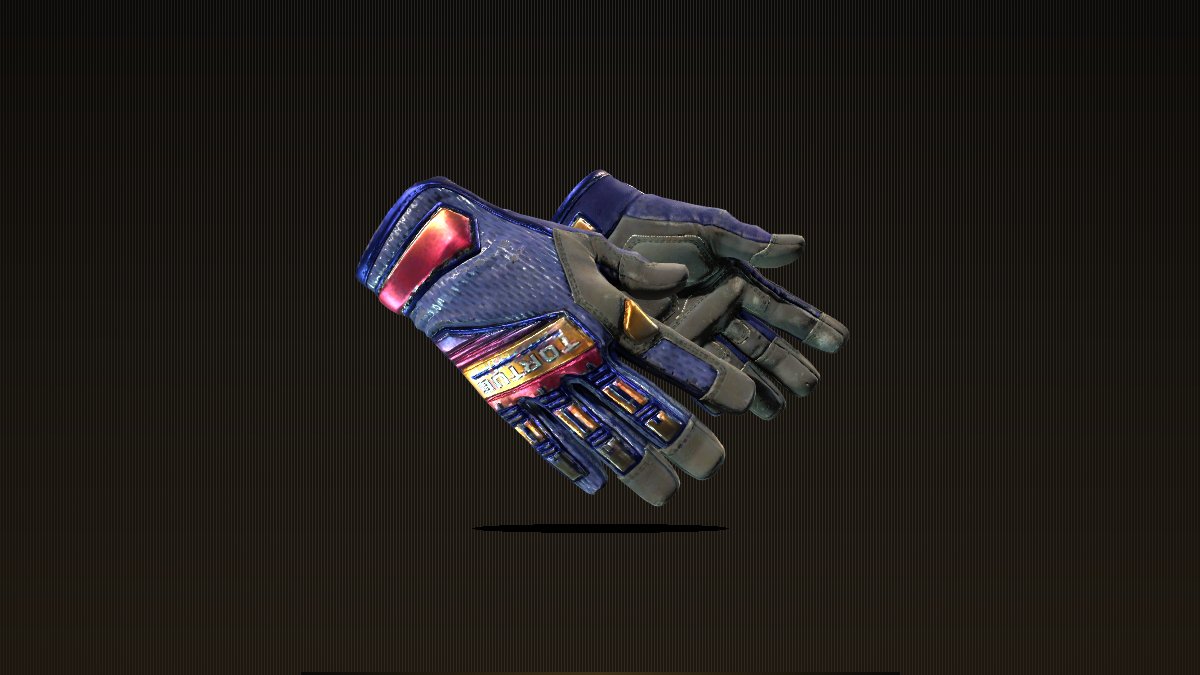
On top of that supply mechanics problem, gloves have no consumption sink. A glove, once bought, stays in the economy forever. Nobody feeds gloves into a trade-up contract, and no game mechanic removes them from circulation. Knives at least get consumed in StatTrak trade-ups and destroyed in some upgrade flows. Gloves just accumulate — and as the pool deepens, every seller has to compete on price.
The Counter-Evidence: 300% Moves in the Same Category
If gloves were simply decaying, the category wouldn't need a whole article. The complication is that the same week produced the single largest verified move in the entire nightly dataset, and it was a pair of gloves.
Hand Wraps | Slaughter went from $236 to $958 between September 17 and September 18 — +306.5% overnight. Over the trailing seven days it ran from $219 to $958, roughly +338%. It was not alone: Hand Wraps | Badlands moved from $128 to $526 across the same week, about +312%.
Those two prints are the reason you cannot read a category median as a verdict on individual items. A median of −1.83% describes the middle of the glove market. It does not describe the tail, and in CS2 the tail is where the money actually moves.
Both Hand Wraps prints have the signature of thin order books rather than broad demand. When an item has few live asks, a couple of purchases against a stale reference price can reset the quoted level by hundreds of percent. The same dynamic runs in reverse, which is why percentage leaderboards in this market are a starting point for investigation, never a conclusion. The useful test is always whether the new price survives a week of actual selling.
What the Numbers Actually Support
Zoom out and the glove category's weakness stops looking like a dip and starts looking like a repricing. Comparing a March 2 baseline to a September 15 snapshot across 1,185 skins with matched wear conditions, the median skin lost 33.4%, and roughly 97% of comparable skins were cheaper than at the baseline.
The category medians from that same window are the interesting part. Knives sat at −41.0% across 306 compared skins. Gloves were second at −38.2% across 72. Rifles came in at −31.3%, pistols at −29.4%, and heavy weapons at −26.3%.
So over seven months, gloves have not been the worst category — knives have. But knives hold a structural advantage that gloves don't: they are the headline prize of every case opening, they have the deepest collector base in the game, and their liquidity absorbs shock far better. Gloves are the smaller, less liquid cousin of the same supply shock, which is why they show up as the weak spot in weekly data even when their long window looks slightly better than knives.
Nothing in the game's fundamentals is pushing buyers into gloves either. Steam's 30-day average player count sits near 811,000, down about 1.73% on the measured window, and Valve's September 9 update shipped Cache fixes, map scripting and spectator tooling with no new item-supply mechanic. No new glove sink, no retired glove case, no reason for the category to find a fresh bid.
If You Own Gloves, Here's the Honest Read
The signal in the data is narrow and the temptation is to overread it. Gloves are the weakest large group in a flat market, two weeks running, with negative breadth in both periods. That is a real drift, and it is consistent with the supply line Valve opened in October 2025.
What the data does not support is the idea that gloves are falling apart. A −1.83% weekly median is a drift, not a collapse, and the Hand Wraps prints prove the category still has pockets of violent demand. What it does support is being selective about which gloves you hold: craftable mid-tier models compete directly against new trade-up supply, while older collection gloves and scarce patterns with no craftable equivalent do not. That distinction drove the market's rotation after October 2025, and nothing has changed it since.
If you are shopping the category, watch the spread before the price tag. The cases that feed glove supply are still the cheapest entry point into the tier — the Carnival Time case is the current example of what that looks like from the buyer's side, and comparing what it drops against what those items list for is the fastest way to see whether the shelf or the source is priced wrong. You can also pull up the full SkinVS marketplace to line up glove listings against their case-trade-up equivalents side by side.
The broad market is quiet, blue-chip knives are holding their spreads, and the one category leaning lower is the one whose supply Valve made renewable. Trade the item, not the category.