The Same Pair of Gloves Costs $102 or $1,782. Here's What Wear Actually Buys You
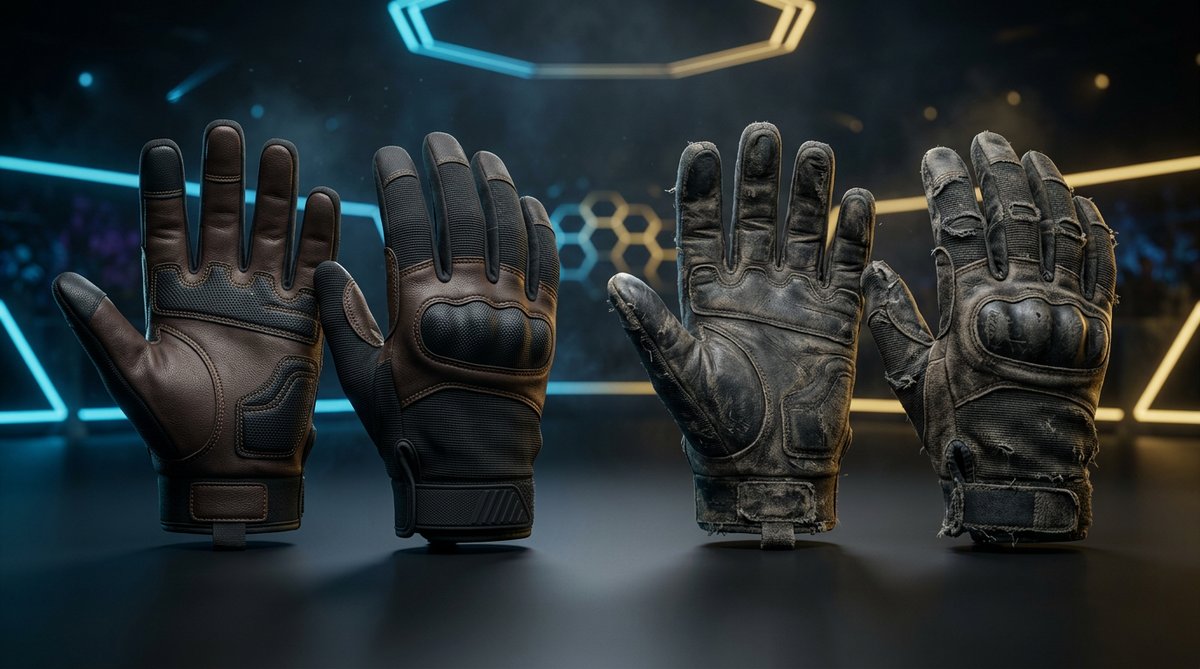
The Same Pair of Gloves Costs $102 or $1,782. Here's What Wear Actually Buys You
On September 14, the cheapest Battle-Scarred pair of ★ Driver Gloves | Brocade Flowers sitting on a marketplace asked $102.38. The cheapest Factory New pair of the exact same glove — same artwork, same pattern, same model — asked $1,714.96.
That is a 16.7x spread for an item where nothing changed except a number that never appears in the game UI: the float value. Nobody buys a skin and thinks about the float roll. But the float roll is the single biggest price lever in the CS2 market, and on gloves it is louder than on anything else.
Round 1: What the Float Roll Actually Decides
Every skin that drops gets a float — a hidden decimal between 0.00 and 1.00 that decides which wear tier it lands in. Factory New covers 0.00 to 0.07. Minimal Wear is 0.07 to 0.15. Field-Tested runs 0.15 to 0.38. Well-Worn is 0.38 to 0.45. Battle-Scarred is everything from 0.45 up.
The part most buyers never see is how the rolls are distributed. For a standard item with an unrestricted float range, the split is 7% Factory New, 8% Minimal Wear, 23% Field-Tested, 7% Well-Worn and 55% Battle-Scarred. More than half of every glove that has ever dropped is Battle-Scarred. Factory New is the smallest bucket in the entire ladder.
So the ladder isn't a quality ladder. It's a scarcity ladder, and it runs 55% to 7% from the bottom to the top. That single fact explains almost every price you will see on this page.
Gloves add a second constraint on top of the float roll. They don't drop from normal play — the only way one enters the market is through the rare special tier of a case, at a disclosed rate of 0.26%, roughly 1 in 385 openings. Then the float roll decides which tier that single gold pull lands in. So the supply of Factory New gloves isn't just "7% of gloves" — it's 7% of the 0.26% of openings that produce a glove at all. That compounding is why one tier of a single finish can be seven listings deep while another sits above a hundred.
Round 2: The Same Glove, Five Price Tags
Here is ★ Driver Gloves | Brocade Flowers, priced by wear on the same day:

- Factory New — $1,782
- Minimal Wear — $425
- Field-Tested — $163
- Well-Worn — $135
- Battle-Scarred — $102
Read those as a chain of multipliers. Minimal Wear costs 4.2x Battle-Scarred. Factory New costs 17.5x Battle-Scarred. The jump from Field-Tested to Minimal Wear alone is 2.6x, and it happens across a float range of 0.07.
The glove's median price sits around $162.86, which tells you something important: the median buyer is buying Field-Tested. That is where supply and demand actually meet. Everything above Field-Tested is a collector decision, not a wearing decision — the glove looks completely different in the inventory at 0.06 and at 0.09, and completely identical to anyone watching your screen.
There's a second-order effect that buyers forget until they sell. Fees don't scale with tier — they scale with price. Steam's Community Market takes about 15%, so a Factory New sale at $1,782 hands over roughly $267 to fees. That single fee is 2.6x the entire cost of the Battle-Scarred pair. The higher up the ladder you buy, the more of the ladder's premium you hand back on the way out.
Round 3: Supply Is Where the Argument Breaks
If scarcity drove price, the spread should mirror the 7/55 split exactly. It roughly does — but the listings show it even more brutally than the percentages.
On the largest third-party market, the same glove was listed like this: 7 Factory New pairs at $1,714.96, 38 Minimal Wear at $431.11, 63 Field-Tested at $152.29, 6 Well-Worn at $130.95, and 106 Battle-Scarred at $102.38.
Seven versus one hundred and six. That is the 7% and 55% buckets showing up in the real order book, and it is why a Factory New glove can sit for weeks at a four-figure ask while a Battle-Scarred pair sells the same afternoon. Brocade Flowers was stocked on 14 of 19 tracked marketplaces with just 67 live listings in total — a thin book for an item this widely known.
Thin supply also means fast moves. The glove is down 17.2% over 30 days but up 3.4% over the last week. On a four-figure Factory New ask, that week of recovery is worth more than the entire Battle-Scarred pair.
Flip that around and the risk becomes obvious. A 17.2% drawdown on the $1,782 tier is a $307 loss. The same percentage move on the Battle-Scarred tier is $17.60. Both are movers on the same item, driven by the same news, on the same day — but one of them costs you a pair of gloves and the other costs you lunch.
Round 4: Where Wear Isn't the Whole Story
Wear explains most of the spread, not all of it. Two things bend the rule.
The first is a float cap. Brocade Flowers only rolls between 0.06 and 0.80, which means its Factory New bucket is a slice of a slice — 0.06 to 0.07, a hundredth of the scale. Items with tighter caps get more extreme: the further a skin's floor sits above 0.00, the more genuinely rare Factory New becomes, and the price stops responding to wear at all and starts responding to how few of that tier exist.
The second is that at the very top of the market, wear is irrelevant next to pattern and finish. The most expensive single item in the September 14 snapshot was a ★ Bowie Knife | Crimson Web at $43,473.29, followed by ★ Sport Gloves | Hedge Maze at $26,827.07 and ★ Sport Gloves | Pandora's Box at $22,200. Those prices aren't being set by 0.01 of float. They're set by web density, pattern placement and the number of buyers who will never sell.
Gloves are the clearest case of this because there are only 72 glove finishes tracked in the same database, against 584 knives and 471 rifles. A small pool with five wear tiers each means every tier is a genuinely separate market with its own order book.
The Verdict
If you want the look and not the trophy, Battle-Scarred is where the value is. You are buying the artwork at roughly 6% of the Factory New ask, and the wear is only visible when you stop moving and inspect it — which is not what a match looks like.
If you want liquidity, Field-Tested is the answer. It's the median, it's the deepest part of the book, and it's the tier you can exit without waiting. Minimal Wear is the awkward middle: 2.6x the Field-Tested price for a float band that most traders can't tell apart on inspect.
Factory New is a different asset class. Seven listings is not a market, it's a queue. Buying there means accepting that your exit is as slow as your entry, and that a 17% drawdown in a month can wipe out more money than the entire Battle-Scarred pair cost. If you're chasing that tier, price it like a collectible, not like a skin.
The one thing all five tiers share: whoever holds them has to sell them somehow. Where you list decides whether the spread ends up in your pocket or someone else's — the same $1,782 glove is worth very different amounts depending on which order book you're standing in. If you are still deciding which finish to enter the category with, Fan Favorite is a reasonable place to start, and it costs a lot less than a Factory New pair to find out whether you actually like gloves.