43,000 Sales a Day: What CS2's Cheapest Cases Reveal About the Market
43,000 Sales a Day: What CS2's Cheapest Cases Reveal About the Market
A case that costs 14 cents moved 43,083 units in a single day. Not a knife. Not a Covert rifle. A cardboard box with a 0.26% chance at something interesting. Meanwhile, the skins people actually talk about on stream — the Fades, the Dopplers, the Gungnirs — trade a few dozen times a week at best.
That gap is the most useful thing in the CS2 market right now. Price tells you what something is worth. Volume tells you whether you can get out of it. Most people only watch the first number.
The Number That Sets the Floor
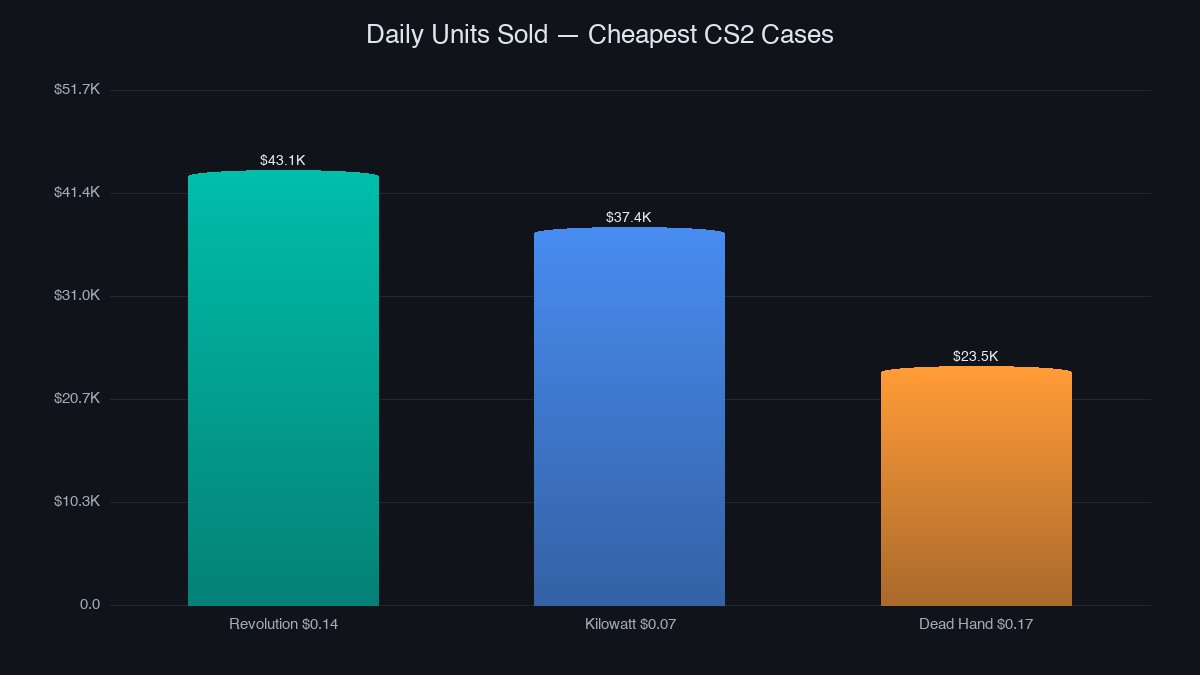
Across 36 marketplaces, the three most-traded containers in CS2 look like this: the Revolution Case at $0.14, 43,083 sales a day. The Kilowatt Case at $0.07, 37,412 a day. And the Sealed Dead Hand Terminal at $0.17, moving 23,465 a day.
Add those up and you get roughly 104,000 container sales in 24 hours — for a combined notional value of about $12,600. A million dollars of skins can change hands in a week without a single one of those transactions being about the skin inside the box. The box itself is the product.
This is where the market's real floor sits. Not at the cheapest knife, and not at the cheapest Covert. At the point where a container costs less than a can of soda and the buyer no longer asks whether it is worth the money. At 7 cents, a Kilowatt Case is not an investment decision. It is a coin flip with extra steps, and 37,000 people take it every day.
Compare that with the broader catalogue: 13,742 items priced across 36 venues, sitting under 58.8 million live listings with a combined floor value of just over $1 million. That last number is the one nobody quotes. Fifty-eight million listings, and the sum of every single lowest ask is about what one mid-tier apartment costs in a secondary city. Thin listings, thin floors, and it takes almost nothing to move a price on the majority of the catalogue.
Why a 14-Cent Case Clears 43,000 Times a Day
Three things drive that volume, and none of them is expected value.
First, the price floor does the marketing. A case that drops from matches and costs $0.14 has no downside worth calculating. Players do not compare a Revolution Case against a knife — they compare it against nothing, because it was free to begin with. The decision costs less attention than the price of the transaction.
Second, trade-up contracts turn low-tier cases into raw material. Ten consumer-grade skins go in, one higher-tier skin comes out. That mechanic means cheap skins inside cheap cases are never worthless — they are inputs. Every trade-up contract consumes ten items, and the supply has to come from somewhere. The volume you see on Revolution and Kilowatt is partly industrials feeding the trade-up machine, not people chasing a knife.
Third, the container list is long and the liquid end is short. SteamAnalyst tracks 48 cases. A handful of them account for the movement. The rest sit at the bottom of a browser tab with a price and no bidders. If you are holding a case that is not in the top few by volume, you are not holding a liquid asset — you are holding a rare item with a price tag someone else put there.
That distinction matters more than direction. A case can be up 20% on paper and completely unsellable at that price. One of the traps in this market is reading a price and assuming it is an exit.
Two Markets Wearing One Name
There are two numbers floating around that both get called "the CS2 market," and they differ by three orders of magnitude.
The first is aggregate catalogue value: 50,530 items across 131 collections, worth about $4.4 billion as of October 24. That figure is a valuation — every item multiplied by whatever the cheapest ask happens to be, including the ones with one listing from a seller who is not in a hurry.
The second is what actually clears. Those 13,742 priced items, 58.8 million listings, $1 million of combined floor. The Broad Market Index — a points scale that starts at 1000 in January 2024 — sits at 631.5, down 0.2% over seven days. So on paper, the market is worth billions and has drifted sideways for a week.
Both numbers are true. They answer different questions. Four point four billion is "what would it cost to buy the entire catalogue at ask." Six hundred and thirty-one points is "what is the trend doing." Neither tells you whether you can sell your item on a Tuesday.
For that you want the daily-sales column, and for the vast majority of the catalogue it reads zero or close to it. Roughly 27% of the tracked items carry a live price at all. The rest — the other 73% — are catalogued, described, and quietly not trading.
What Surprised Us in the Data
The index moved 0.2% in a week. Individual skins moved 44% and 75% in the same window.
Tec-9 | Tornado sat at $2.95, up 44%. MP9 | Dry Season sat at $2.80, down 75%. Both are cheap, both are Industrial-tier-adjacent filler, and neither move had anything to do with a patch, a case, or a meta shift worth writing about. A handful of sellers repriced, and on items with a thin order book, a handful of sellers is the market.
This is the honest read on volatility in CS2: at the top of the market, prices are sticky because supply is scarce and every seller knows what they have. At the bottom, prices are noise, because a single undercut can move a median 40 points. The cheapest items on the board are the least stable, not the safest — which is the opposite of how most people read "cheap."
Fees widen the same gap. Steam's Community Market charges 15% on the sale. Third-party venues run 2% to 10%. On a $400 knife, that difference is $20 to $52 — real money, worth the extra step. On a 7-cent case, it is a rounding error on a rounding error, and nobody is comparison-shopping venues for it. The fee wedge is the single best argument for keeping anything above $50 off Steam, and the single best reason cheap items stay cheap everywhere.
The Read If You're Holding Cases
Patch days are not market events, and this month proved it again. In the seven days after the October 5 build, prices across Buff, Skinport, CSFloat and Market.CSGO moved −1.7%. The week before had already been running at a pace that predicted −1.6%, so the patch's own contribution was about −0.1% — statistically flat. Cases and gloves both came in around −2.3%, weapon skins −2.8%.
The pattern is not new. Valve ships quality-of-life patches that touch crosshairs and animations; the market drifts on its own schedule. Anyone who bought on October 2 expecting the photobooth change to lift glove prices watched gloves fall 2.3% instead.
What to watch, in order of usefulness:
- Volume, not price. A case at 40,000 units a day will let you out. A case at 200 a day will not, regardless of the number on the card.
- Depth of the cheapest listing. One seller at a low ask is a price. Fifty sellers at that ask is a market.
- The fee you actually pay. 15% on Steam versus 2–10% elsewhere changes the break-even on every position above $50.
The cheap end of CS2 is a volume business, not a value business. The people making money there are not predicting which case doubles — they are moving thousands of units at a margin that looks like nothing per transaction and adds up because the containers never stop dropping.
If you want to see how that plays out at the bottom of the board, the Fablewing case sits at $6 — high enough to have an actual contents list, low enough that the fee question stops mattering. Open one, watch what comes out, then compare that against the 7-cent Kilowatt volume above. The gap between the two tells you more about this market than any index reading will.
Sources: cs2.io market statistics (Oct 21 and Oct 24 snapshots), cs2.sh market index, SteamAnalyst catalogue data, and post-patch price tracking across Buff, Skinport, CSFloat and Market.CSGO.