How to Hunt a CS2 Blue Gem: Reading Case Hardened Patterns Step by Step
How to Hunt a CS2 Blue Gem: Reading Case Hardened Patterns Step by Step
Two CS2 players buy the same AK-47 | Case Hardened. One pays about $162 for a StatTrak copy. The other pays thousands, for the same weapon, the same wear label, the same rarity tier — because his copy has pattern seed 661 and hers does not. Nothing about the item name tells you which one you are looking at.
That is the entire blue gem market in two sentences. Case Hardened is a finish where the pattern is fixed by a number, the number is hidden behind an inspect link, and the difference between a mediocre copy and a grail is a position on a 1000-slot grid. Here is how to read it properly, in six steps, before you spend anything.
Step 1: Understand What a Paint Seed Actually Is
Case Hardened is a tinted finish, not a painted artwork. The game takes a fixed layout of blue, gold and purple blotches and applies it to the weapon according to a paint seed — one of a fixed set of 1000 patterns. The pattern does not change with wear, it does not change with condition, and it does not depend on how many times the skin has been traded.
What changes is which part of that blotch layout lands on the side of the weapon you actually see in first person. Each weapon has a "playside" and a mostly-hidden backside. A seed that puts a huge blue patch on the playside of an AK-47 produces a blue gem. The identical seed on a different weapon model produces something entirely ordinary, because the mapping between seed and surface is per-weapon.
So the first rule: a paint seed is only meaningful together with a weapon type. "Seed 661" is a fact about an AK-47. It is not a fact about skins in general.
Step 2: Learn the Reference Seeds for Your Weapon
Specific seeds have become community reference points because they consistently produce the heaviest blue coverage in the most visible place.
- AK-47: seeds 661, 670 and 955 are the recognised blue gems. Seed 661 is the one people mean when they say "the blue gem".
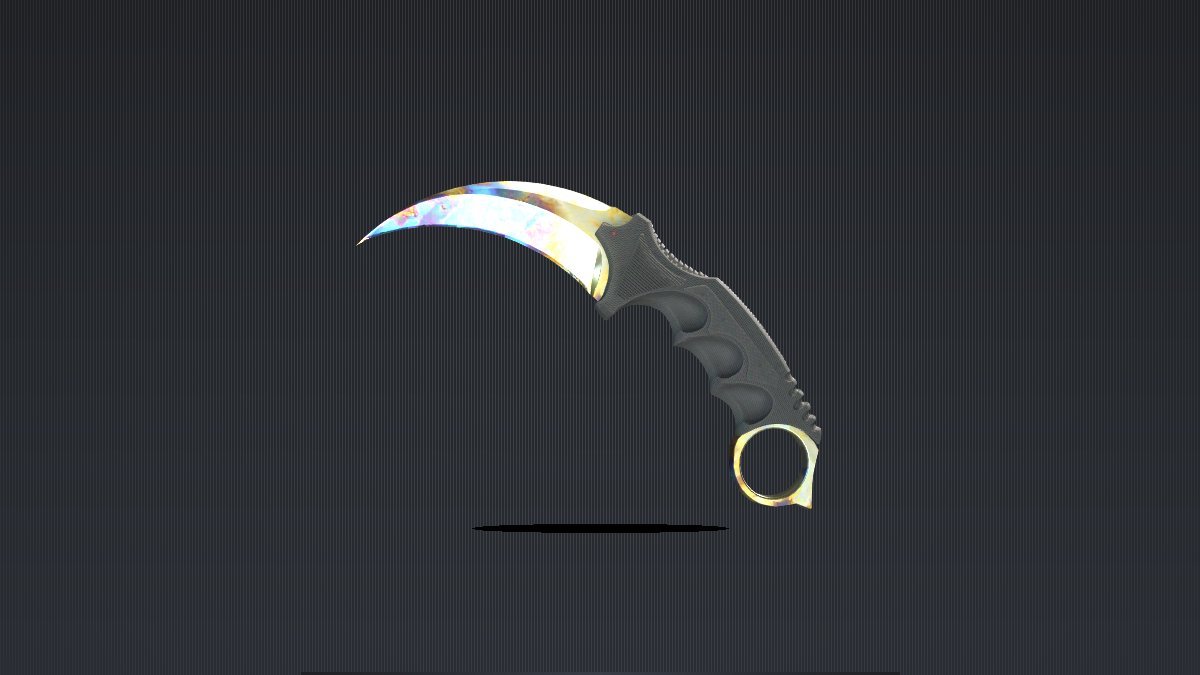
- Karambit: seed 387 is the reference pattern.
These are the top of the ladder, not the whole ladder. Between a plain Case Hardened and seed 661 there is a long tail of "good pattern" copies — heavy blue, but not the canonical one. Those trade at a multiple above a plain copy without reaching grail pricing, and they are where most realistic buying happens.
Know the reference seeds before you browse, because a seller listing "rare blue pattern" means nothing. Ask for the seed number and compare it against the list.
Step 3: Confirm the Pattern on the Actual Item
The seed is not printed on the market listing, but it is not hidden either. Open the item's detail page on a price aggregator or inspect the item in-game through the inspect link, and the pattern index appears alongside the float value. If a listing claims a blue gem and the seller will not give you an inspect link, that is your answer — walk away.
Two checks worth doing while you are there. First, confirm the wear: a Factory New, Minimal Wear, Field-Tested, Well-Worn and Battle-Scarred copy of the same seed are five different items, and wear affects how much of the blue reads clearly on screen. Second, confirm the StatTrak flag, because StatTrak Case Hardened is tracked as its own market with its own pricing.
Step 4: Price It Against a Plain Case Hardened
This is the step people skip, and it is the one that decides whether you are buying a premium or being sold one. There are 24 tracked Case Hardened skins and they run from $8.81 to $611.01 — an enormous band for what the labels call the same finish family. Current StatTrak floors look like this:
- StatTrak Karambit | Case Hardened — $611.01, -3% over 30 days, roughly 58 sales/day
- StatTrak Butterfly Knife | Case Hardened — $594.52, -6.7%, roughly 95 sales/day
- StatTrak M9 Bayonet | Case Hardened — $413.25, +3.2%, roughly 68 sales/day
- StatTrak Talon Knife | Case Hardened — $334.84, +3.5%, roughly 101 sales/day
- StatTrak AK-47 | Case Hardened — $162.54, -0.6%, roughly 639 sales/day
- Hydra Gloves | Case Hardened — $50.67, -8.4%, roughly 680 sales/day
Those are floors for ordinary patterns. A genuine blue gem is priced as a multiple of its baseline — not a percentage above it. If someone is asking 40% over the StatTrak Karambit floor for a "blue gem", either the pattern is not what they say it is, or you are looking at one of the many copies where the blue sits on the backside.
Use the multi-market floor as your anchor rather than a single listing. For reference on how far a single-listing anchor can drift: an M4A4 | Temukau that has a cross-market floor around $100 is listed on Steam at $160.43 — a 57% premium for the same item on the same day.
Step 5: Check Volume Before You Commit
A blue gem is a thin-market asset by definition. That cuts both ways, and only one of them is good for you.
Look at the daily sale counts above. A StatTrak AK-47 Case Hardened clears around 639 units a day, and Hydra Gloves around 680 — genuinely liquid. A StatTrak Karambit moves about 58 a day. Now consider what happens when you narrow that to only the copies with a grail seed: the count drops from hundreds to a number you can hold in one hand. The $611 floor belongs to the liquid end, not the grail end.
The practical test is not "will this go up" but "how many days would it take to sell". This week's market data is a useful warning here. Several tracked items printed weekly moves of +3,227% and -99.41% on zero volume — single stale asks being replaced, with no bid underneath. A percentage change computed on no sales is not a price. It is a listing.
Before you buy any Case Hardened copy at a premium, do this: find the item's 7-day volume. If it is zero, you are not buying a discount and you are not buying a bargain — you are buying the only offer in the room.
Step 6: Buy on the Venue That Actually Has the Price
Where you buy matters as much as what you buy. Across this week's tracked market, the cheapest quote for an item comes from Buff163 about 30.29% of the time and DMarket about 27.25% of the time. Steam sits at 13.85%. Widest cross-market gaps for tracked items reached roughly +74.9% this week — the same skin, the same wear, priced three-quarters higher on one venue.
For a blue gem this is amplified, because grail copies are listed on very few venues at once. If you find a seed 661 AK-47, assume the seller has already put it on the venue with the highest buying traffic, and compare across at least three others before you accept the number.
What You Are Actually Paying For
Strip away the terminology and the blue gem market is a provenance market. The tracked catalogue this week sits at about $22.4M, down 0.78% week over week — a flat overall market where the interesting movement is almost entirely in scarce, thinly-traded variants. The knife and glove tier that Case Hardened knives sit in is quiet and stable.
That is the honest framing. You are not buying a finish called Case Hardened, and you are not buying a rarity tier. You are buying a specific position on a 1000-pattern grid, on a specific weapon, at a specific wear, and you are paying a premium for the fact that only a handful of other people hold the same coordinates.
If you want the pattern hunt without the five-figure entry — and honestly, most people should start there — the same community-design selection that produces Covert and knife-tier pulls lives in the case pool. A Violet Vortex run is the cheap version of the same instinct: you are still chasing a rare roll on a fixed table, just with a much smaller stake. Learn the seed system on cheap items first. The 1000-pattern grid behaves exactly the same way at $200 as it does at $6,000, and the mistakes cost a lot less.