Is Valve's New Sticker Shop Killing CS2 Sticker Investing — or Saving It?
Is Valve's New Sticker Shop Killing CS2 Sticker Investing — or Saving It?
Here's a number that should make every CS2 investor pause: $19,447. That's what a complete set of the top 100 Cologne 2026 Major stickers cost under Valve's new demand-based pricing system. For context, a full sticker capsule set from the previous Paris Major would have set you back maybe $200.
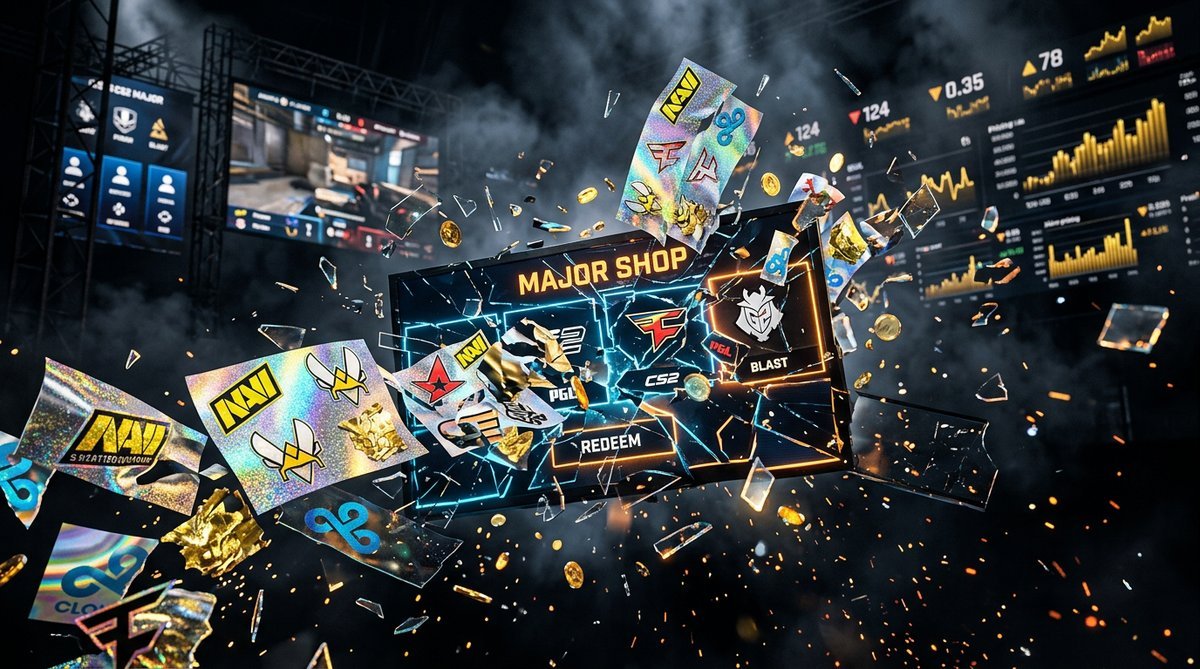
The sticker economy just got turned inside out. Valve didn't tweak the formula — they burned the playbook. No more capsules. No more random pulls. No more supply flooding from mass-openings. The IEM Cologne 2026 Major replaced everything with a token-based shop where prices shift with demand in real time, like a miniature stock exchange built into the game client.
Is this the end of CS2 sticker investing as we knew it? Or is Valve accidentally creating the most investable sticker market in Counter-Strike history?
The Old Way Is Dead — and Nobody Saw It Coming
For a decade, Major sticker investing followed a simple script. Buy capsules while they're $0.99 during the event. Hold for 6-12 months. Sell at a 3-5x markup as supply dried up. It was reliable, predictable, and — let's be honest — a little boring.
Valve shattered that model on May 21, 2026. The Cologne Major Shop doesn't sell capsules at all. Instead, you earn tokens through the Viewer Pass and Pick'Em Challenge — 300 tokens per coin upgrade — and spend them directly on the exact stickers you want. Player autographs, team logos, holos, golds — pick your target and pay the listed price. No gambling. No duplicates. No 3AM "just one more capsule" sessions.
The catch? That listed price isn't fixed. Popular stickers cost more. A Holo FURIA or Gold Donk doesn't have the same price as a lesser-known team's paper sticker. Demand determines cost, and demand shifts daily based on what the community is buying. It's dynamic pricing — the same mechanism that powers airline tickets and ride-share surge pricing, now applied to digital stickers.
The $19,447 Question
When gHacks ran the numbers in early June, the complete set of 100 Cologne 2026 stickers priced out at nearly $20,000. The top-tier Holo and Gold variants alone accounted for the vast majority of that total. A single high-demand Gold player sticker can run hundreds of dollars — from Valve's official shop, not a third-party marketplace.
Compare that to previous Majors where a capsule guaranteed at least one sticker and the base cost was uniform. The old system produced massive oversupply. Tens of millions of capsules were opened during the Paris 2023 Major, and you can still buy most Paris stickers at or near their original capsule price today. The market never absorbed the volume.
Cologne 2026 flips the equation. Supply is now gated by token generation, not cash. You can't buy unlimited stickers — you can only spend the tokens you earn. And since every token buyer is choosing exactly which stickers to acquire, popular items get scarcer faster while unpopular ones accumulate fewer buyers. The result? A naturally tiered market where rarity actually means something.
The Bookmark Bombshell
In mid-July, Valve added another layer: sticker bookmarking with 7-day price history. You can now save stickers you're watching and see the lowest and highest prices from the past week — all inside the in-game shop. This is unprecedented transparency for Valve.
Think about what this does to buyer behavior. A player sees that a particular Gold sticker bottomed at $180 three days ago and now sits at $240. That's not just a price — it's a price trend. It signals scarcity, demand momentum, and FOMO, all packaged in a clean UI that Valve built intentionally. They're giving every CS2 player a trading dashboard.
Combined with the Champion autograph stickers and highlight-reel keychain charms added in the July 1 refresh, the Major Shop is evolving from a simple storefront into a full-fledged collectibles marketplace inside the game.
Souvenir-O-Matic: The Sleeper Feature
Lost in the sticker pricing drama is the Souvenir-O-Matic, Valve's new crafting system that lets you turn any skin you already own into a personalized Major souvenir. Pick a match, pick a player, apply the souvenir treatment — the skin you chose gets tournament provenance stamped onto it.
This is quietly significant. In previous Majors, souvenir skins were random drops tied to specific matches. You couldn't choose the weapon, the wear, or the player. Now you can take a Factory New skin you already love and give it Cologne 2026 tournament history. For skin collectors and investors, this creates an entirely new category: curated souvenirs where both the base skin and the tournament context are deliberately chosen.
The supply of these crafted souvenirs will be tiny compared to traditional drops, and the best combinations — premium skins paired with championship-winning players — should command significant premiums on third-party markets.
What This Means for Skin Investors
The Cologne 2026 system fundamentally changes the sticker investment calculus. Here's what matters now:
Supply is token-gated, not money-gated. The biggest whales can't flood the market because tokens, not dollars, are the limiting factor. This naturally constrains supply far more effectively than the old capsule model.
Demand signals are public. The 7-day price history makes it obvious which stickers are gaining traction. Smart investors can track momentum — but so can everyone else. The information advantage that professional traders once held is shrinking.
Third-party market prices will diverge from shop prices. Once tokens run out (the Major shop closes after the event), the only way to acquire Cologne 2026 stickers is through Steam Market and third-party sites. The gap between "shop price during the event" and "market price after the event" could be enormous — especially for the stickers that were most expensive (and therefore least purchased) during the token window.
Collection building replaces mass speculation. The old strategy of "buy 1,000 capsules and forget about them" is dead. The new meta is curated collections — specific players, specific variants, deliberate scarcity plays. Quality over quantity, for the first time in CS2 sticker history.
The Verdict
Is the new sticker shop killing CS2 sticker investing? No — it's professionalizing it. The capsule era was a gold rush where anyone with a credit card could play. The token era requires strategy, timing, and market reading. It rewards people who study demand patterns and make deliberate choices rather than blind-hoarding thousands of capsules.
For third-party marketplaces, this is actually bullish. The premium stickers that emerge from the Cologne system — the ones everyone wanted but few could afford in tokens — will need a secondary market to find their true price. That's where platforms like skinvs.com come in.
Want to build your own curated Cologne 2026 collection? Start by opening a Phantom Cache case — the skins you pull today could become tomorrow's Souvenir-O-Matic masterpieces when the next Major rolls around.