Steam Market vs P2P Trading: Where Your CS2 Skins Are Really Worth More in 2026
Steam Market vs P2P Trading: Where Your CS2 Skins Are Really Worth More in 2026
Here's a number that should make every CS2 player pause: $200 million. That's how much value evaporated from the CS2 skin economy in a single week this July. Total market capitalization now sits at roughly $7.04 billion, down 3.11% in just seven days. If you're still doing all your trading on the Steam Community Market, you're not just missing out — you're actively losing money, every single transaction.
But here's the twist: while Steam Market volume continues to slide, peer-to-peer platforms are handling record-breaking numbers. Valve's removal of the 15% Steam tax on direct trades has fundamentally reshaped where skins change hands — and how much of their value actually reaches your wallet.
Round 1: The Fees
Let's start with the most obvious difference. On the Steam Community Market, every sale carries a 15% transaction fee — 5% to Valve, 10% to the "CS2 game fee." Sell a knife for $500, and you walk away with $425. That's $75 you'll never see again.
P2P platforms like Skinport, CSFloat, and DMarket typically charge between 2% and 8%. That same $500 knife nets you $460 to $490. Over the course of a serious trading year, the difference isn't pocket change — it's thousands of dollars.
But the fee gap is just the surface-level story. The real shift runs deeper.
Round 2: The Volume
Since Valve dropped the 15% tax barrier for direct trades in late 2025, billions of dollars in volume have migrated away from the Steam Marketplace. The CS2 skins market enters 2026 with record liquidity — but that liquidity doesn't live on Steam anymore. It lives on third-party platforms, Discord trading servers, and direct peer-to-peer deals.
Standard knives now trade with significantly higher daily volume than they did before October 2025. The bid-ask spread — the gap between what buyers will pay and sellers will accept — has tightened considerably on P2P platforms, while Steam spreads remain wide and slow to move.
The takeaway is clear: if you're looking for a liquid market where your skins actually sell at fair prices, Steam is no longer the default answer. P2P platforms now process over 70% of high-value skin transactions, with the average trade settling in under 30 seconds. Steam, by comparison, can take hours for a listing to attract its first serious buyer — and by then, the market may have already moved against you.
For traders regularly moving items worth $100 or more, the choice between platforms is no longer a matter of preference. It's a matter of whether you want to keep 85% or 95% of your sale price — and in a market where every percentage point represents real dollars, that gap compounds fast.
Round 3: The Crash Context
Understanding where to trade means understanding where the market has been. The CS2 skin economy has absorbed multiple body blows in the last nine months. The October 2025 crash wiped out $1.7 billion in a matter of days — market cap plunged from $5.90 billion to $4.20 billion. High-level traders liquidated inventories at panic speeds.
The bleeding didn't stop there. In our April-to-June 2026 snapshot, the median tracked item still fell 9%. The market briefly bottomed near $3.37 billion before stabilizing around the current $7 billion range — a recovery that's been uneven, fragile, and concentrated in high-tier items.
The key insight? Steam Market prices lag behind real market sentiment by hours or even days. During the October crash, P2P prices adjusted within minutes while Steam listings sat frozen at pre-crash levels. Traders who relied on Steam pricing got burned — some lost hundreds of dollars selling at prices that were already obsolete by the time the transaction cleared. This price lag isn't a bug; it's a structural feature of Steam's slower settlement system.
Round 4: The Convenience Factor
Steam's single biggest advantage has always been convenience. No KYC verification, no third-party account, no withdrawal delays. You list an item, it sells, the funds appear in your Steam Wallet. Done.
P2P platforms have closed this gap dramatically. Most now offer instant balance crediting, one-click listings with browser extensions, and mobile apps that rival the Steam experience. The trade-off is that you need to verify your identity on most platforms — a one-time friction that unlocks permanently better pricing.
For casual players selling a handful of skins, Steam's convenience still wins. For anyone moving more than $100 in monthly volume, the P2P math becomes impossible to ignore.
The Verdict
The CS2 skin market in mid-2026 is a tale of two markets: one that's convenient but expensive, and one that requires a little setup but rewards you with dramatically better prices. The data is unambiguous — P2P platforms beat Steam on fees, speed, and real-time pricing accuracy.
Steam isn't going anywhere. It's still the easiest place for a quick sale, and it's the only option for players who want to use skin proceeds to buy games directly. But treating it as your primary trading venue in 2026 is like paying full retail price for everything when wholesale is two clicks away.
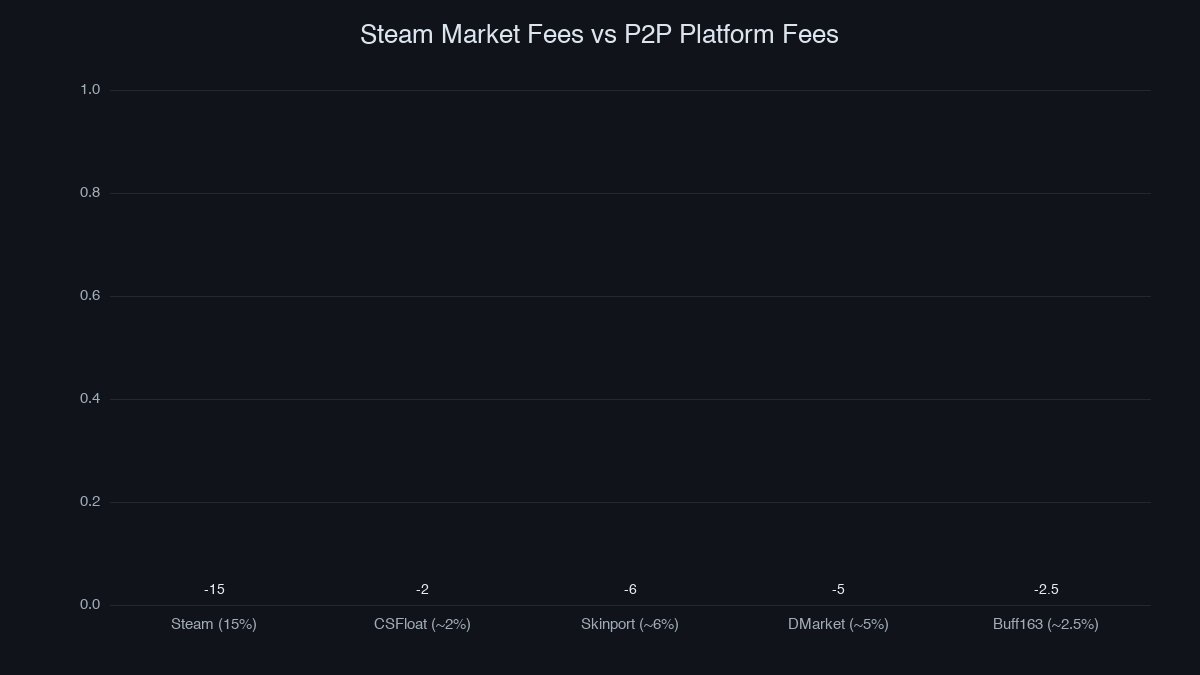
The chart above tells the story at a glance: Steam Market fees eat into your returns from day one, while P2P platforms keep more value in your pocket. When the market is already down 9% on median items and losing $200 million per week, every percentage point matters more than ever.
Whether you're holding a $50 play skin or a $5,000 knife collection, the platform you choose to trade on is no longer a minor detail — it's the single biggest factor in your real returns. The question isn't "should I use P2P?" It's "how much have I already lost by not switching?"
Ready to see what your skins are actually worth on a real marketplace? Try your luck with the Phantom Cache case — or browse the SkinVS market to price-check your inventory against live P2P data.