The $4.99 Music Kit Is Worth $2.36 the Second You Buy It
The $4.99 Music Kit Is Worth $2.36 the Second You Buy It
On 17 November 2026 Valve shipped eight new Monstercat music kits. In the in-game store they cost $4.99 standard and $7.99 StatTrak, and that price is the same for all eight. There is no case to open, no float, no rarity tier, no trade-up contract. You pay, you get the track.
Now look at what the same kind of kit resells for. One tracker's current listing for Music Kit | Repiet & Julia Kleijn, On And On shows $2.36 for the normal version and $4.42 for StatTrak — against the same $4.99 and $7.99 in the store.
That is a 53% drop on the standard kit and 45% on StatTrak, immediately, with no gameplay event in between. Music kits are the one CS2 cosmetic category where the store price is a ceiling instead of a starting line. Here is the data behind that, and what it means if you were thinking of buying.
The Raw Numbers
Across the whole category — 123 music kits tracked — the price span is $0.60 to $19.02 with an average of $3.60. Both ends tell you something.
- Cheapest: Music Kit | Humanity's Last Breath, Void — $0.60
- Average across all 123 kits: $3.60
- Standard store price (new Monstercat kits): $4.99
- StatTrak store price: $7.99
- Most expensive: Music Kit | Killer Mike, MICHAEL — quoted up to $12.69, with some guides listing higher
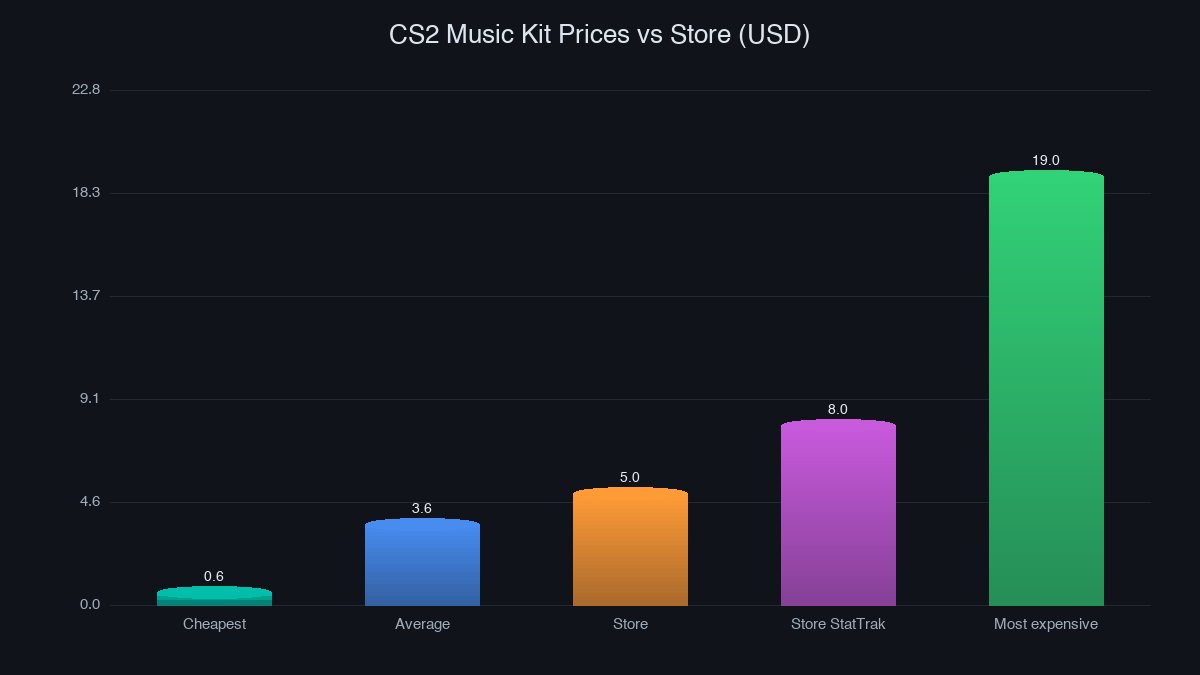
The average is the number that matters. If the mean of 123 kits is $3.60 and a new kit costs $4.99, then the typical new kit is born above category average and has to fall to get there. The $19.02 top is one outlier, almost certainly a discontinued kit with thin supply — not a target any buyer should model.
Category-level performance looks fine, on the surface: a 30-day index for music kits sits around +4.5%. But that is an average of a small, cheap, slow-moving category. It tells you nothing about what happens when you personally pay retail.
Why Music Kits Behave Differently
Every other CS2 cosmetic has a supply mechanism that can create scarcity. Cases stop dropping. Collections close. A specific wear or float gets used up. That is what lets a skin trade above its acquisition cost.
Music kits have none of that. They are unlimited, they are sold at a fixed price forever, and the only thing distinguishing one from another is whether you like the track. Supply is effectively infinite at $4.99. So the market cannot price above the store — why would anyone pay $6 for a kit they can buy new for $4.99 with no risk of a bad float?
The market can only price below the store, and it does, because sellers want liquidity and buyers know the alternative. Add the platform fee on top and the discount deepens: across thousands of skin and wear combinations, the cheapest cash listing is a median 73% of the Steam price, largely because Steam keeps 15% of every sale and pays out in wallet funds that cannot be withdrawn.
Run that on a $4.99 kit and the arithmetic is unforgiving. A 73% cash value is $3.64. The observed $2.36 is below even that, which tells you demand for any single kit is thin enough to push past the fee-adjusted level.
What Surprised Us: The Category Is Not Falling
Here is the part that breaks the obvious story. You would expect a category with a hard price ceiling to bleed value. It is not.
Music kits are up modestly over 30 days while the broad skin market is down. The main CS2 skin index closed at 65.6 on 20 November, −1.0% over seven days and −4.6% over thirty, and −34.4% since 6 May 2026. Cases and capsules were the weakest group in that window at −5.5% over 7 days and −10.1% over 30.
The reason music kits hold is boring and useful: almost nobody holds them as inventory. They are bought to be used, they cost a few dollars, and they do not sit in a trader's portfolio waiting to be liquidated into a falling market. A category with no speculators has no forced sellers.
That is the actual lesson. Music kits are not an investment with a bad return — they are a consumable that behaves like one. The −53% you take on day one is not a market failure. It is the difference between the price of a thing and the price of owning the thing.
The Monstercat Eight, and Why Track Recognition Beats Rarity
All eight new kits cost the same, which means the store has quietly told you that it does not rank them. The bundle includes a track from Noisestorm — the Crab Rave name — and material from Tristam & Braken, both long-standing Monstercat acts with audiences well outside Counter-Strike.
Valve also added a small quality-of-life feature the same day: an MVP Anthem preview button when you inspect a music kit in the store. That is an admission of what the product actually is. You are not buying a stat or a rarity tier; you are buying a 30-second clip that plays when you top-frag. The preview exists because the only differentiator is whether you like the sound.
One detail worth knowing before you pay the extra three dollars: on music kits, StatTrak counts Official Competitive MVPs. It is a counter, not a rarity upgrade. If you play mostly casual or Premier with friends, a StatTrak kit records very little and resells for less than the standard version's premium suggests.
The Smart Play
Three rules that follow from the numbers.
Wait two to four weeks if you can. New kits are listed in volume in the first days by people who bought them and changed their mind. That is exactly when the discount to store price is widest. The $2.36 example is a kit that has already settled; fresh listings tend to be worse before they get better.
Never buy a music kit expecting it to hold value. With unlimited fixed-price supply, there is no scarcity mechanism to bid against. The best-performing kit in the category is a single outlier at $19, and the average is $3.60. Assume you are buying a song, not a position.
Compare the cash marketplaces before the store. The store charges $4.99 and the resale market clears well under it, with the gap mostly explained by Steam's 15% cut and the wallet-only payout. If you are going to end up with a kit anyway, buying the one you want at the market discount is the only version of this transaction with a positive spread.
What This Says About the Wider Market
The interesting signal is not the eight kits. It is that a category with zero speculative appeal outperformed one with plenty of it over the last month. That is the same pattern showing up in the case data, where sealed containers fell 10.1% in thirty days while cheap, used cosmetics held.
When a market is falling, the things that hold up are the things nobody was holding to sell. Music kits are a small, unglamorous example of that rule — and it is worth remembering the next time a drop looks like an obvious hold.
If you want a kit, buy it to listen to. If you want something that can actually be priced, bought, and sold with a real spread on both sides, that is a different shelf entirely — the skinvs marketplace is built around items with a live bid and a live ask, not a fixed retail tag that halves the moment the transaction clears.