A CS2 Knife Costs $37.62 or $30,373. Both Are in the Same Market.
A CS2 Knife Costs $37.62 or $30,373. Both Are in the Same Market.
There is a StatTrak Navaja Knife | Blue Steel listed for $17,752. The cheapest plain Navaja in the same tracked catalog starts at $37.70. Same knife model, same factory, same drop pool, same Steam account requirement to own it. The gap between the two numbers is roughly 470 times.
That is the thing most knife guides never show you. "Knife prices" is not a number. According to SteamAnalyst's 21 November snapshot, 428 knife skins trade between $37.62 and $30,373.37, with an average of $539.80. The average describes almost nothing in that range, because the distribution is not a curve — it is a ladder with distinct rungs.
Here are the rungs, ranked from the floor up, and what actually separates one from the next.
#5: The $37 Entry Rung
Five knife models define the bottom of the market, and they are separated by loose change. Shadow Daggers start at $37.62 in Rust Coat Battle-Scarred. Navaja opens at $37.70. Kukri at $38.52, Survival at $39.47, Paracord at $39.65.
Under two dollars covers all five entry points. That is not a market with a price hierarchy at the bottom — it is a market with a price floor, and the floor is set by one thing: how many of these knives exist. Shadow Daggers and Navaja were never knife-tier prizes anybody chased. They dropped, they accumulated, and their cheapest wears now cost less than a decent pair of gloves.
The practical consequence is that budget knife ownership has almost nothing to do with the knife and everything to do with the finish. A Battle-Scarred Rust Coat is the cheapest because it is the least wanted combination of model and pattern, not because the steel is worse. If you want the model and not the look, this rung delivers it for the price of two cases.
#4: The $42–$52 Shelf
Six models cluster tightly here: Gut at $42.61, Bowie at $44.51, Huntsman at $47.74, Ursus at $50.05, Falchion at $51.64.
A ten dollar band covering six entirely different silhouettes is the clearest sign that entry price tracks supply, not desirability. Bowie is the most recognisable knife in this group — a huge, cartoonishly large blade — and it enters the market cheaper than Huntsman, which is a much smaller and less celebrated model. Nothing about that ordering reflects what players say they like. It reflects which case each knife came out of and how long it has been dropping.
This shelf is where the ladder stops being about the knife at all and starts being about wear and finish. The spread between the cheapest and most expensive version of any single model here is routinely ten times the spread between models.
#3: The $57–$65 Step
Only two models live in this band, and the gap above and below it is the largest in the entire ladder. Classic Knife enters at $57.04. Nomad enters at $65.00.
Then the market jumps. There is no knife model starting between $65 and $99. That empty band is the single most useful fact on this page, because it tells you the ladder is not continuous. It has a genuine structural break after the Nomad, and everything above that break is priced by a different mechanism.
Below the break, knives are priced as drops — supply-driven, cheap, interchangeable. Above the break, they start being priced as status items, and the entry price of each model becomes a statement about how the community ranks it rather than how many exist.
#2: The Mid Tier Jumps — $99 to $116
Four models open here and they are the first ones players actually name unprompted. Flip at $99.59, Skeleton at $104.14, Bayonet at $114.32, Stiletto at $115.51.
Notice how compressed this is. Four models, seventeen dollars of range, and every one of them carries a distinct animation and inspect identity. Flip and Bayonet are legacy CS:GO knives with enormous recognition. Skeleton is a newer model with a distinctive pull-out. Stiletto is the slim, fast one. They all enter within a rounding error of each other because they compete for the same buyer: someone with roughly a hundred dollars who wants a knife that reads as a knife.
Below this line, a knife is a placeholder. At this line, it becomes a choice.
#1: The Top Rung — $187 to $401
The top four models by entry price: Talon at $186.90, M9 Bayonet at $263.17, Karambit at $351.05, Butterfly at $401.31.
These are the four names that show up in every thumbnail. The spread between Talon and Butterfly is $214 — more than the entire entry price of five other knife models combined — and it is entirely reputation. None of these four is rarer in any mechanical sense that a buyer can verify. They are simply the four that the community agreed to want.
This is also where the ladder stops being useful as a buying guide and starts being a warning. Entering the Butterfly market at $401 buys you the least desirable finish on the least desirable wear. Getting a Butterfly that actually looks like a Butterfly is a four-figure conversation.
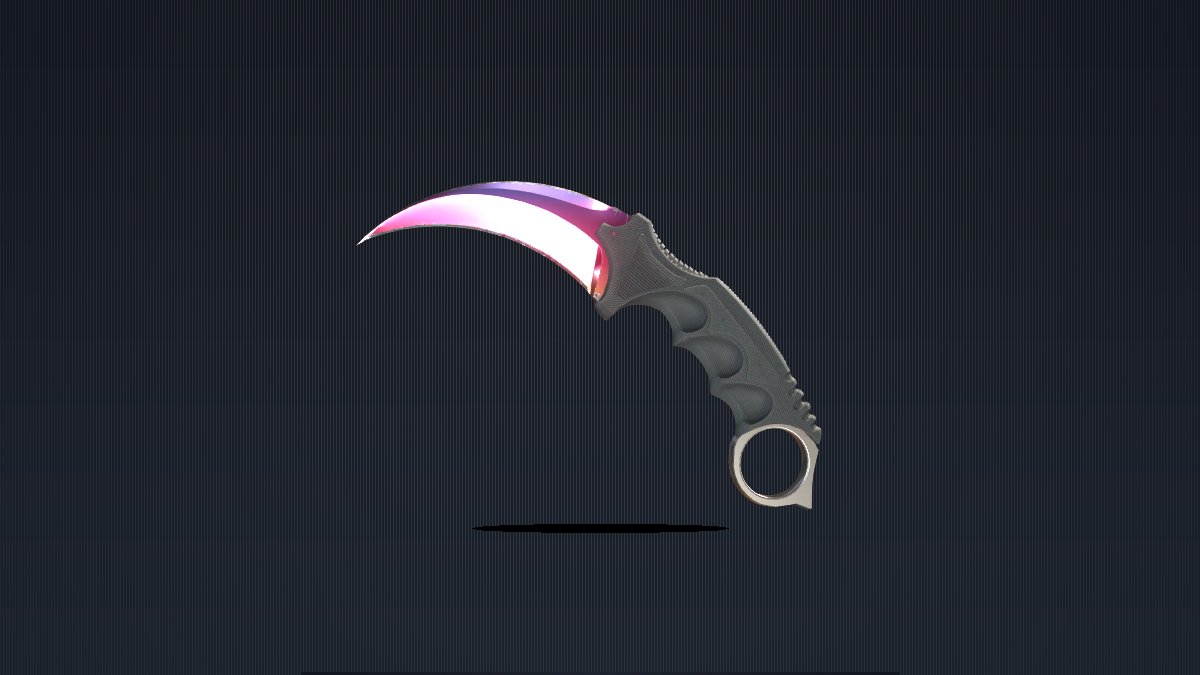
A concrete example of how the entry price misleads: the Karambit Fade enters the ladder at $351 in its cheapest form, but a Factory New copy on the skinvs marketplace carries an ask of $1,830.47 — five times the entry point. The knife name is identical. The number is not.
The Ceiling Is a Different Number Entirely
The published range tops out at $30,373.37 for a Bowie Knife | Crimson Web, a figure that depends entirely on exterior condition and float value. The next two are Butterfly Knife | Doppler at $13,266.45 and M9 Bayonet | Doppler at $12,434.05.
Now look at the top of the Week 47 expensive list, and the mechanism becomes obvious. The priciest single variant tracked that week was the StatTrak Navaja Knife | Blue Steel at $17,752 — starting from $41.37. A knife whose entry price sits on the bottom rung produced the most expensive variant in the entire catalog. Sport Gloves | Hedge Maze ran $13,170 from $1,824. Specialist Gloves | Crimson Kimono ran $12,000 from $993.48. Bowie Knife | Doppler Black Pearl ran $11,253 from $206.72.
Every one of those numbers is the same pattern: a cheap model, an extreme finish, a StatTrak or float multiplier, and a price two orders of magnitude above the entry point. The ceiling is not a different market. It is the same ladder, viewed from the top, where finish and pattern have completely displaced the knife model as the price driver.
Why 45.84% of the Market Sits on This Ladder
Knives made up 45.84% of total tracked catalog value in Week 47, more than weapon skins, cases, stickers, gloves and agents combined. That weight is why knife behaviour drives every headline index reading.
And it is currently the weakest part of the market. CSDB's Knife Index sat at 86.04 on 19 November, down 13.96% since its July inception — a smaller decline than SMGs but still a real one. CSGAIN measured knives at −4.0% for the week of 9–15 November, the worst of any category, against −1.3% for its whole index. SteamAnalyst showed 61% of tracked skins falling over the prior seven days.
Put those together and the ladder's shape explains the drawdown. The bottom rungs — the $37 to $65 knives — have almost no room to fall. There is a floor underneath them made of case prices and trade-up inputs. The top rungs have the entire decline concentrated in them, because that is where the speculative premium lives and where a 13.96% index move translates into hundreds of dollars per item.
So the honest reading of "the knife market is down" is narrower than it sounds. The floor held. The ceiling moved. If you are shopping the bottom rung, the decline is measured in single dollars. If you are shopping a Karambit Fade, it is measured in hundreds.
That is precisely why it pays to look at the actual ask instead of the model name. The skinvs marketplace lists each knife with its live price and wear, so the entry figure and the real figure are visible side by side. And if you would rather build up toward a knife than buy one outright, the Phantom Cache case is one of the routes that feeds the top rungs — every knife in the ladder above started as a drop somewhere.