10,331 Cases Opened Last Week. The Keys Cost Nearly as Much as the Cases
10,331 Cases Opened Last Week. The Keys Cost Nearly as Much as the Cases
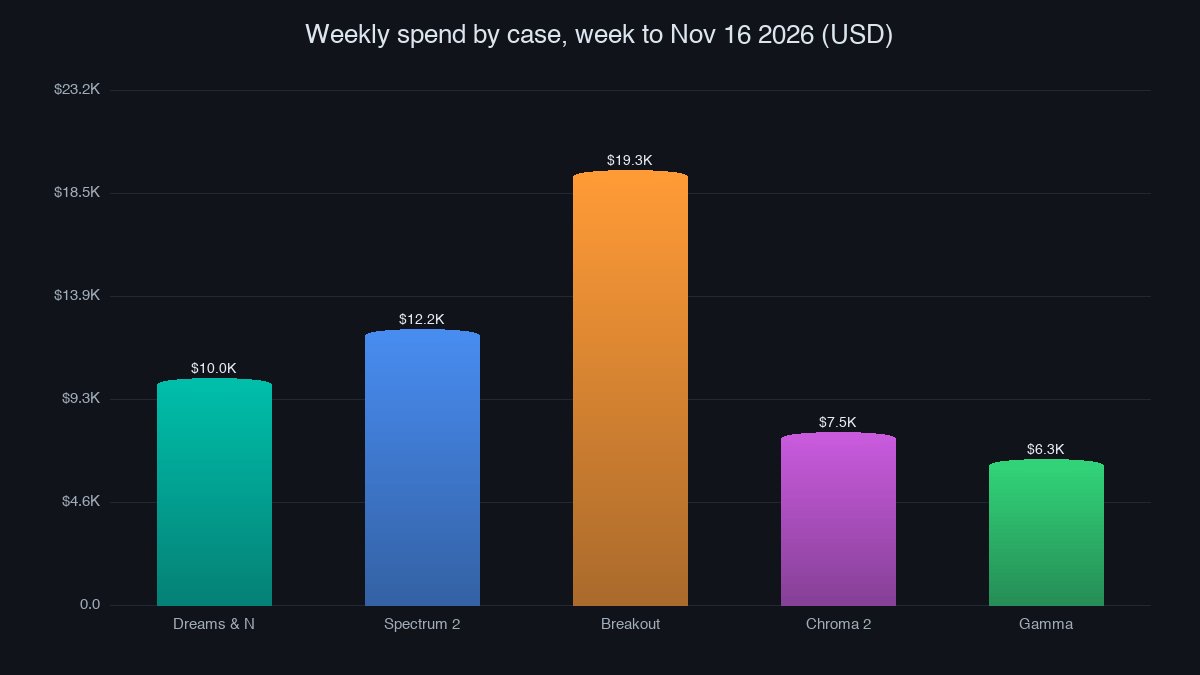
Five cases accounted for 10,331 sales in the week to November 16, 2026. Multiply each one by its price, add a $2.49 key for every opening, and the five containers took in roughly $55,279 — in seven days, on one marketplace's recorded sales.
The number that surprised us is not the total. It is the split. Of that $55,279, $25,724 was keys — 46.5% of everything spent went to Valve at a flat rate, before a single skin was rolled.
And that average hides a much sharper pattern. On the cheapest case in the top five, keys were 74.6% of the money. On the most expensive one, keys were 28.1%. The two cases sit eleven spots apart in price and the same place in the ranking table, which tells you something about how players actually decide what to open.
How These Numbers Were Built
The sales counts and prices come from a daily Skinport snapshot taken November 16, 2026 at 3:46 p.m. UTC, using seven-day median sale prices in US dollars. Only items with at least 10 listings and 10 sales in the week are counted, which is why the list is five cases and not fifty — most cases are too thin to measure.
Spend per case is sales multiplied by the seven-day median price. Key cost is the same sales count multiplied by $2.49, the US store price. Some buyers get keys cheaper through third-party markets and some get them free through trade-in schemes, so treat the key column as the ceiling rather than the literal invoice.
One more caveat worth stating plainly: these are recorded marketplace sales, not a count of every case opened in CS2. Steam Market volume sits outside this dataset entirely. What you are looking at is the third-party slice — the part where people buy cases to resell or to open somewhere other than Steam.
#5 — Gamma Case: 1,295 Sales, $2.38, $6,307 Total
The Gamma Case closed out the top five at 1,295 sales and a $2.38 median, for $3,082 in case value and $3,225 in keys. Half the money went to the key, half to the container.
There is an irony here. Independent ROI work published on November 5 that modelled all 42 key-opened weapon cases using Valve's published odds put the Gamma Case at the very top of the list — returning 50.3% of case-plus-key cost, the best of any case measured. It still lost half the money. It was simply the least bad of a set whose returns ranged from 20.6% to 55.0%.
So the fifth-most-opened case in the game happens to be the one with the strongest measured return. That is either the market being efficient once, or a coincidence. With 1,295 sales out of 10,331, it is also only 12.5% of the week's volume — the efficient choice is a minority position.
#4 — Chroma 2 Case: 1,369 Sales, $3.01, $7,530 Total
Chroma 2 moved 1,369 units at a $3.01 median for $7,530 all-in, with keys taking 45.3% of the total. Nothing dramatic: a mid-priced case, a mid-sized key share, a mid-table placement.
What makes Chroma 2 interesting is its shape rather than its size. It is one of the older cases still in circulation, priced at $3.01 — roughly 3.5 times the cheapest case on this list — and it still clears 1,369 sales a week. Cases do not have to be cheap to move volume. They have to be known, and Chroma 2 has had twelve years to become known.
#3 — Operation Breakout: 2,175 Sales, $6.38, $19,292 Total
This is the anomaly in the table. Operation Breakout cleared 2,175 sales at a $6.38 median — 7.5 times the price of Dreams & Nightmares — for $13,876 in case value and $5,416 in keys. All in, $19,292, the largest single line in the top five despite ranking third by unit volume.
Breakout is the only case on this list where the container costs more than the key. At $8.87 per opening it is 2.66 times the cost of an $0.85 opening, and yet 2,175 people a week accept that price rather than buying the cheap case next to it.
The reason is not sentiment. It is the gold pool. A case that is no longer in the drop pool has a fixed and slowly shrinking supply, and its knife contents are the thing buyers are paying the premium for. When players say a case "has good knives," what they are actually paying for is the right to roll a 0.26% slot against a specific set of finishes — and they will pay $6.38 for the ticket instead of $0.85 if they prefer that set.
#2 — Spectrum 2: 2,505 Sales, $2.37, $12,174 Total
Spectrum 2 was the second-busiest container of the week at 2,505 sales, a $2.37 median, and $12,174 all-in — $5,937 of case and $6,237 of keys, a near-perfect 51.2/48.8 split.
It is the most balanced line in the table and the best illustration of the structural point. A $2.37 case and a $2.49 key are within five cents of each other, so the container price a buyer agonises over is worth less than the fixed fee attached to it. On any case priced under roughly $2.50, the decision that actually matters is not which case — it is whether.
#1 — Dreams & Nightmares: 2,987 Sales, $0.85, $9,977 Total
The busiest case of the week was also the cheapest. Dreams & Nightmares moved 2,987 units at an $0.85 median for $2,539 in case value — and $7,438 in keys.
Read that again as a share: 74.6% of every dollar spent on the most popular case in CS2 last week went to the key, not the case. The container that everybody is buying is, financially, almost an afterthought. It is a $0.85 admission ticket to a $2.49 transaction.
That is the whole mechanic in one line. Cases get cheap as supply grows; keys never do. The cheaper the case becomes, the more completely the cost of opening is the cost of the key — which is exactly the direction the market has moved for years.
The Pattern Under the Ranking
Stack the five together and the arithmetic is unforgiving. 10,331 openings at an average combined cost of $5.35. At the published 0.26% gold rate — one in 385 — that volume should have produced about 27 knives or pairs of gloves across all five cases combined. Not 27 per case. Twenty-seven total, out of more than ten thousand openings, spread across everyone who bought in.
Now apply the return range from that 42-case study. At the top of the range, 55.0%, the $55,279 spent came back as roughly $30,404 of item value. At the bottom, 20.6%, it came back as $11,388. Either way the week's cohort lost somewhere between $25,000 and $44,000 in paper value — and paper value is the generous measure, because selling a pulled skin on the Steam Market costs roughly 13% in fees before the remainder lands in a wallet you cannot cash out.
None of this is a scandal. It is a disclosed structure: 79.92% Mil-Spec, 15.98% Restricted, 3.20% Classified, 0.64% Covert, 0.26% gold, no pity timer, every roll independent. The people opening 2,987 copies of an $0.85 case are not misinformed about that. They are paying $3.34 for the roll.
What to Take From the Table
One practical read: if you are going to open something anyway, know which line you are paying for. Buying the $0.85 case instead of the $6.38 case saves you $5.53 on the container and nothing at all on the key. That is a 62% discount on the wrong half of the bill.
A second read: the case that ranked third by volume was first by money. If you want to understand where the market's conviction sits, unit counts will mislead you — Operation Breakout drew 2,175 buyers who each put $8.87 on the table, and that is a different kind of belief from 2,987 people spending $3.34.
And if the goal is a specific skin rather than a specific roll, the arithmetic in this table argues for buying it. A $3.34 opening has a 0.26% chance of a gold and a 79.92% chance of a blue worth cents. The skinvs marketplace lets you skip the roll and pick the finish you actually want, and if you would rather open something with a price that reflects its contents, the Phantom Cache case shows its odds up front. The keys cost the same everywhere. Everything else in this table is a choice about what you are paying $2.49 to find out.