Your CS2 Chicken Has No Market Price - And That's the Interesting Part
Your CS2 Chicken Has No Market Price — And That's the Interesting Part
Valve shipped the Rush Hour update on September 22, 2026. The changelog promised a 3v3 mode, silent reloads, a Premier map-selection overhaul, new crosshairs, Clan Tags, and a Starjunk 95 music kit. It did not mention the egg. Players found that one themselves — a Chicken Egg sitting in the weekly care package where a case normally sits. By September 29, the first wave of those eggs began to hatch.
So here is the question worth a trader's time. Counter-Strike has spent a decade turning pixels into price tags — knives, gloves, patches, charms, even music kits trade like commodities. Why is the newest cosmetic category in the game completely untradeable?
What the Egg Actually Costs You
The Chicken Egg is not free. It appears as one of the four items in your Weekly Care Package — the reward Prime players unlock by ranking up once a week — and its card says plainly that it consumes both of your reward picks. Take the egg and you walk away with no case, no skin, and no graffiti that week.
That trade-off has a price, and the market data makes it visible. Community tracking puts the Sealed Dead Hand Terminal at roughly a 32% share of weekly container drops, with the other active containers at about 17% each. On a typical week, the case you are giving up clears somewhere between $0.20 and $1.60 on the open market — the Kilowatt Case hovers around $0.20, the Revolution Case around $0.30, and the Dreams & Nightmares Case — the single most traded case right now at 910,000 units moved in one week — runs about $1.62.
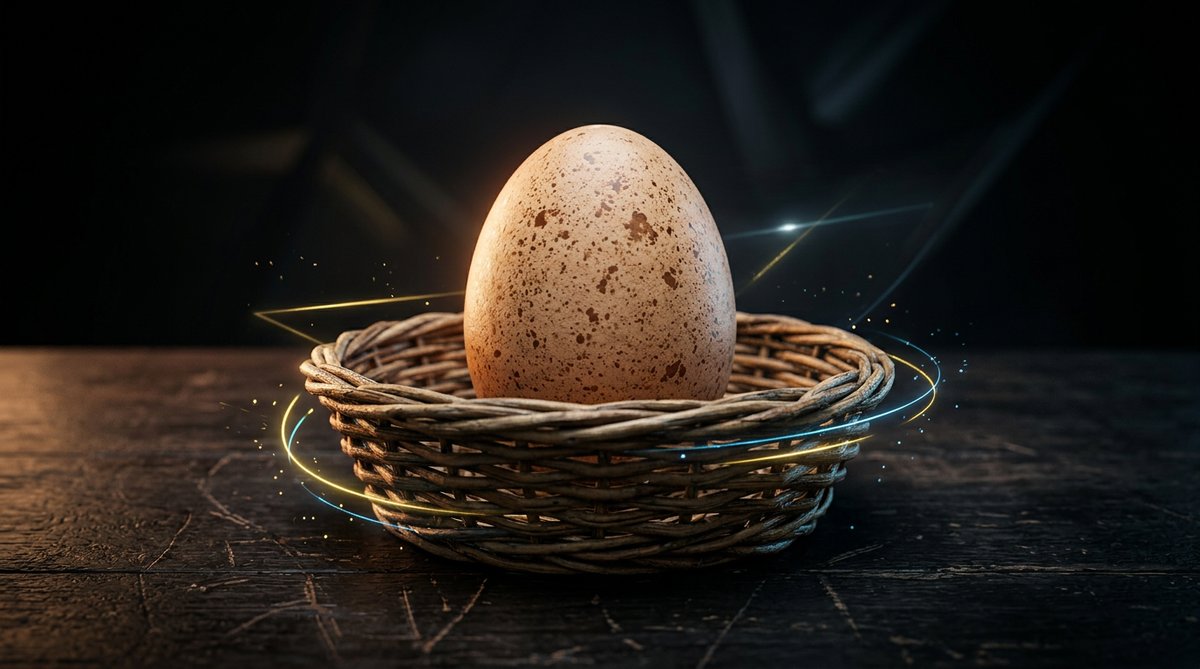
Add the skin roll you skipped and the egg costs you a couple of dollars of expected value. Then read the fine print: the egg never enters your Steam inventory at all. It sits in a wicker basket next to your character in the main menu, and the game allows one pet per account, so there is no stacking play here either.
No Market Means No Price — And No Scam Protection
Egg, feed, and the grown chicken are all flagged as untradeable. Nothing about them can be listed on the Steam Community Market, and nothing has a legitimate third-party price. That makes the current wave of "rare chicken" offers a straightforward red flag: if an item cannot be transferred, a seller cannot deliver it.
The system itself is more developed than the silence around it suggested. Data-miners and early owners have documented three adult breeds — Catalana, Polish, and Silkie — across roughly 34 colour variants, with about 35 chicken entries discoverable in the game files. Growth runs through four stages: egg, chick, pullet, hen. Hatching takes about a week, the exact date is printed inside your HatchBook, and feed comes from later care packages — which, like the egg, cost both of your picks.
What the files say is coming next
Two pieces of unpublished groundwork are worth noting. The first is a set of chicken accessories already present in the files — a Wizard Hat, Top Hat, Party Hat, a banana, a sprout. The second is a dormant code path for an Armory offer that would let players bid on a pet for stars; it hides itself with a message about already owning a pet. Neither is live. Both say the same thing: this is a system Valve built to grow.
There is also a precedent that collectors should sit with. Charms arrived in October 2024 as a purely decorative, initially modest feature, and ended up with a real secondary market. If pets ever take that road, the eggs claimed in the last week of September 2026 become the oldest examples in existence — the kind of detail this market has always paid for.
Why Valve Would Ship Something You Can't Sell
Look at the same patch and the contradiction becomes obvious. Rush Hour also added the ability to apply stickers to the C4 — a brand new consumable sink that removes stickers from circulation permanently. Valve's 2026 direction is not anti-trading. It is selective about which assets it lets players hold title to.
The reasoning is partly legal and partly behavioural. The same company spent this year replacing blind-buy Major sticker capsules with a transparent in-client shop, in part because random paid unboxings are restricted or banned in markets like Belgium and the Netherlands. An untradeable companion with no monetary value is a very safe thing to sell. And the chicken is built as a retention mechanic: you must log in weekly and spend picks to feed it, or the bird leaves. A tradeable version would have farms snapping up eggs; an untradeable one gives them no reason to bother.
The Real Market Effect: A Trickle, Not a Shock
None of this is a price event. Farms generate the bulk of weekly drops, and they will keep taking cases, because cases are the only pick with resale value. The one-pet-per-account rule caps how many real players can participate at all. The honest read is that a small share of weekly picks now leaves the item pool in exchange for something that will never be sold — and that over a span of months it hits the cheapest cases and drop-pool skins hardest, precisely because that is where genuine player supply is a visible slice of the total.
Put it next to the scale of the market and the effect shrinks further. In early September, one weekly snapshot tracked 28,107 items worth roughly $22.75 million, and a single case turned over $1.47 million in seven days. A few thousand players skipping a $0.30 case changes nothing measurable this month.
What it changes is your checklist. If you hold drop-pool cases, nothing in September's data justifies selling. If you were about to spend a week's picks on an egg, understand what you are buying: a companion with a story, zero resale value, and a weekly feeding bill. It is a collectible in the original sense — the opposite of an investment.
Two honest caveats
No egg has been documented completing the full run to hen yet, and the growth timings circulating online — 22 days as a chick, 28 as a pullet, 90 as a hen — could not be traced to any file. Treat every timeline you read as unverified for now. The same goes for shell colour: eggs arrive in cream, olive, mint, pale blue, and speckled brown, but nothing in the game files links a shell colour to the breed or colouring you end up with.
The Takeaway
The chicken is the first cosmetic category in years that Valve deliberately made illiquid, and the interesting part is what it tells you about everything else. The items that do have a market — cases, knives, gloves, and the stickers you can now weld onto a C4 — are the ones Valve still profits from when they change hands. That is where the liquidity is, and where your picks are better spent.
If this week's package offers you a choice between an untradeable egg and a case with a real bid, the arithmetic is not close. Compare live prices on the SkinVS marketplace before you redeem anything, and remember that a collectible nobody can buy from you is worth exactly what you paid in cases you did not open.