$25 in Gold for Buying a CS2 Skin: Inside the Cache Back Experiment

$25 in Gold for Buying a CS2 Skin: Inside the Cache Back Experiment
Buy a Counter-Strike 2 skin worth $20 or more on white.market, and the companies behind the marketplace will deposit $20 of Tether Gold into a WhiteBIT account within minutes. Buy something from the Gold Collection instead and the deposit climbs to $25. No coupon code, no lottery, no case odds.
The promotion is called Cache Back, it opened on October 14, and it closes on December 12, 2026. It is the first time a major CS2 marketplace has paid cashback in a token backed by physical gold, and that detail is doing most of the marketing work.
It also raises an obvious question. Nobody hands out $25 because they like your taste in rifle finishes. So here is what the deal actually pays, who is funding it, and where the sharp edges are hidden.
What Cache Back Actually Pays
The mechanics are unusually simple for a promo in this space. Spend at least $20 on a single skin purchase through white.market during the campaign window and you qualify. A standard skin earns $20 in XAU₮. A skin from the Gold Collection earns $25.
The reward is credited automatically, but it lands in a WhiteBIT account, not in Steam and not in your inventory. To withdraw it, trade it, or convert it to anything else, you need to complete KYC verification on WhiteBIT by December 31, 2026.
Two structural details matter more than the headline number. First, each participant can claim the cashback only once during the entire campaign — it is not a per-purchase rebate. Second, XAU₮ is not a points balance. It is Tether Gold, backed one-to-one by physical gold held in Swiss vaults to the London Good Delivery standard, with new tokens minted only when the equivalent metal is verified and stored.
At the time the campaign launched, Bybit market data put XAU₮ at roughly $4,160 per token with a market capitalization near $3.37 billion. That is a real asset sitting behind the reward, which is precisely why the wording works so well on a landing page.
Why a Crypto Exchange Is Paying for Your Skins
White.market and WhiteBIT are both part of W Group, and the logic only makes sense when you look at the size of the pool they are fishing in. Analyst estimates put the secondary CS2 skin market at $4.3 billion to $6 billion. SteamDB counts more than 400 million cases opened per year. White.market alone lists over a million skins.
Most of that money currently moves through Steam and independent marketplaces. Valve takes a 15% cut on Steam Community Market sales, and third-party platforms charge roughly 5% to 15%. That is an enormous, recurring stream of trading value sitting outside any single ecosystem.
In that context, $20 to $25 per new verified account is not generosity — it is a customer acquisition cost, and a fairly disciplined one. A fixed rebate per user rather than a percentage per order tells you what the company is optimizing for: new accounts, not repeat volume. If you already buy skins every month, you are not the target. If you have never opened a WhiteBIT account, you are exactly the target.
Running the Numbers on a Real Skin
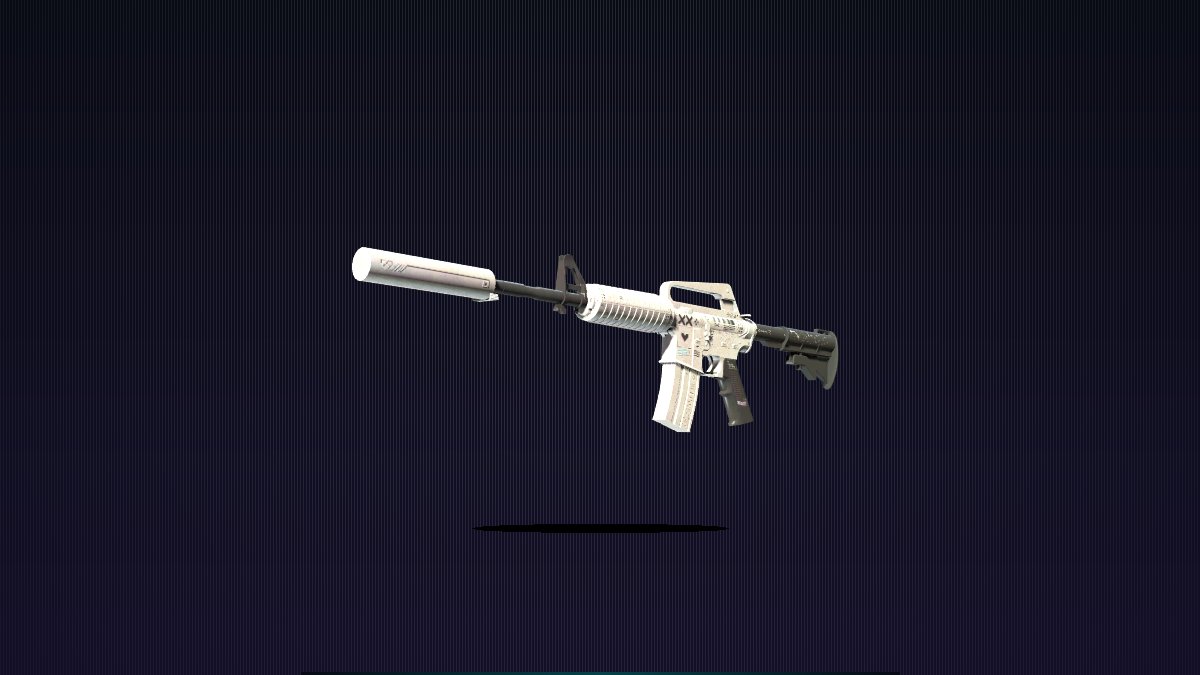
Abstract percentages hide how lumpy this deal is depending on what you buy. Take a genuinely popular Covert rifle. An M4A1-S | Printstream (Field-Tested) — the white-on-black geometric finish in the image above — trades around $210 on skinvs. The $20 rebate on a $210 purchase is an effective 9.5% discount.
That number is worth sitting with, because 9.5% is roughly inside the range that third-party marketplaces already charge in fees. On a big-ticket item, the gold rebate approximately cancels out the platform's own cut — which is a perfectly reasonable way to run a promo, and a much more honest framing than "free money."
Now take the opposite end. A skin priced at exactly $20 earns $20 back — a 100% rebate on the item, minus whatever you lose on fees and spread when you eventually sell the skin. Somewhere in between, a $100 Gold Collection item earning $25 returns 25%.
So the deal is worth the most when you spend the minimum, which is the opposite of how most discount structures work. That is the fingerprint of an acquisition subsidy: the reward is calibrated to the lowest purchase that still produces a verified account with a payment method attached.
The Part Buried in the Terms
The rebate is real, but a few conditions turn a "free skin" headline into a more ordinary transaction.
- It is one-time. One cashback per participant for the whole two-month window, so splitting a large purchase into five smaller ones gains you nothing.
- The reward is gated behind KYC. Complete verification by December 31, 2026 or the gold stays where it is. The campaign ends December 12 — that gap is where people forget.
- Your skin is locked for seven days. Items bought through the in-game store and most marketplaces carry Valve's re-trade restriction, so you cannot flip the purchase immediately to realize the rebate twice.
- Gold is not skins. $20 of XAU₮ tracks spot gold. It will not appreciate because a knife spiked, and it will not earn you a case drop.
None of that makes the offer dishonest — it makes it narrow. If you were already going to buy a specific skin this month and you do not mind a verification step, the $20 is genuinely free money. If the promo is the reason you are buying, you have just paid $20 for $20 of gold you cannot touch until you hand over identity documents.
Why This Kind of Promo Lands Right Now
Timing is doing a lot of the work. The broad CS2 skin index sits at 72.7, down 5.13% over 30 days and 12.68% over 90 days, and October 2026 marked a new low for the index. Knives are down 14.02% over three months, gloves 19.24%. Total market capitalization was around $4.71 billion in early October, down 0.6% in a single day.
In a market where prices are drifting lower, straight discounts read as confirmation that an item is weak. A gold rebate reads as a bonus. Same economics, completely different emotional payload — and it arrives at the exact moment when buyers need a nudge.
Whether it works is a 2027 question. The rebate buys a signup; retention has to be earned afterward, and this campaign will not tell us anything until the gold has been withdrawn, converted, and the account either stays active or goes quiet.
Where This Leaves You
Back to that Discord screenshot. The trade was real, the gold was real, and the trader got a $20 skin for the price of a KYC form. That is a good deal for him, and an even better deal for the company that now has him in its funnel.
If the verification step is not for you, the simpler version of the same instinct is to buy where the fee structure is already clean and skip the rebate entirely. You can compare live prices across the catalog on the skinvs marketplace, or skip the secondary market altogether and put the same $20 into a Phantom Cache case, where the only thing standing between you and a knife is the drop rate — no KYC, no exchange account, no December deadline.