Why CS2 Gloves Are Falling Faster Than Anything Else in the Market

Why CS2 Gloves Are Falling Faster Than Anything Else in the Market
Something strange is happening at the top of the CS2 economy. The most expensive category you can wear on your hands — gloves — is also the worst-performing one. Not by a little. Over 90 days, gloves are down more than any other item type, and the gap to the rest of the market is wide enough that it cannot be explained by a bad week.
Is it a buying opportunity, or the start of a structural repricing? The data points one way, and it is not the comforting direction.
First, the Numbers
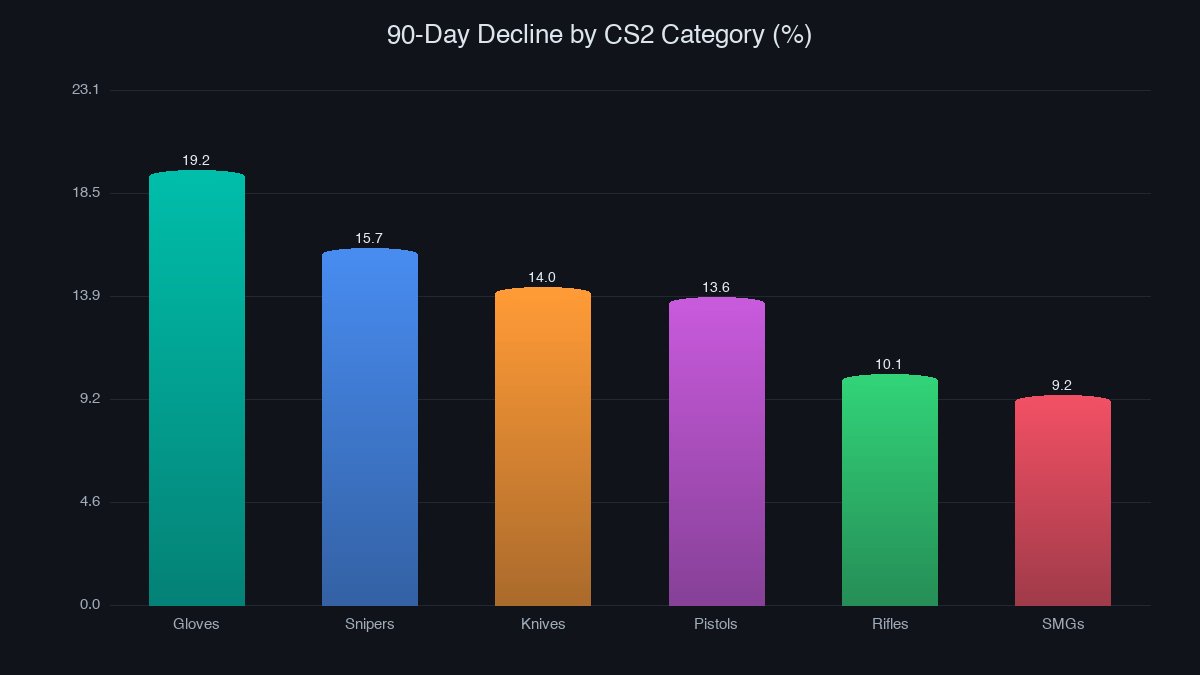
Across the eight weapon categories tracked by the Gamezod market index, gloves sit at an index value of 57.5 against a starting point of 100. The 30-day move is -6.97%; the 90-day move is -19.24%.
Compare that to the rest of the board over the same 90 days:
- Gloves: -19.24%
- Snipers: -15.74%
- Knives: -14.02%
- Pistols: -13.56%
- Rifles: -10.11%
- SMGs: -9.16%
The overall index sits at 72.7, down 5.13% on the month and 12.68% on the quarter. Its all-time low of 72.74 was set this month. Gloves are not just participating in a broad decline — they are leading it by roughly 6.5 percentage points over 90 days, which in a market this correlated means something category-specific is happening.
Gloves Used to Be One-Fifth of the Category Value
Step back three years and the picture is even starker. In March 2023, gloves held 10.7% of the total CS2 category value, with an index value around $0.36 million. By October 5, 2026, that share had fallen to 6.5%, and the glove index sat at $0.24 million — a 33.0% decline while the knife index was up 1.8% over the same window.
That divergence matters because it is not what a normal cycle looks like. When the whole market falls, it falls together. Gloves losing two-thirds of a share point per year while knives hold flat is a supply story, not a sentiment story.
What Changed: The Glove Terminal
On March 11, 2026, Valve shipped the Dead Hand update. It did two things that no previous update had done at the same time. First, it added 22 brand-new glove finishes — the first new glove finishes since 2020, ending a six-year supply freeze. Second, it put those gloves in the rare special item slot of a Sealed Terminal instead of a knife.
Then it made opening them nearly free. The Sealed Dead Hand Terminal drops to Prime accounts at an estimated ~32% weekly rate, and unsealing it costs nothing — you only pay if you claim the item you are offered. The result is a steady, free, weekly flow of glove supply into a market that had spent six years with essentially none.
You can watch the consequence in the trading volume. The Sealed Dead Hand Terminal moves about 26,300 units per day at a floor price around $0.25, making it the third most-traded container in CS2 — ahead of the Genesis Terminal (19,300/day) and the Fracture Case (12,500/day). Every one of those unsealings puts another glove offer in front of a player who did not pay for the privilege of seeing it.
Why the Top End Did Not Save the Average
Here is where the glove market differs from knives. The top of the glove market has never been more expensive in absolute terms: Sport Gloves | Hedge Maze sits around $28,000, Pandora's Box around $17,935, and Specialist Gloves | Crimson Kimono around $8,669 in the latest tracked snapshots. Across 72 glove skins, the average value per skin is roughly $1,746.92 — more than double the $759.76 average across 584 knife skins.
That average is exactly the problem. A category whose mean price is $1,746 is a category where almost all volume has to happen in the bottom 10% of items. When 22 new finishes arrive at once, they land almost entirely in that bottom slice, and the mean has no room to absorb them.
On the affordable end, the effect is visible in listings like ★ Sport Gloves | Violet Beadwork (Field-Tested) at around $276 — a premium-brand glove in a colourway that reads as modern, priced where a knife would have been three years ago.
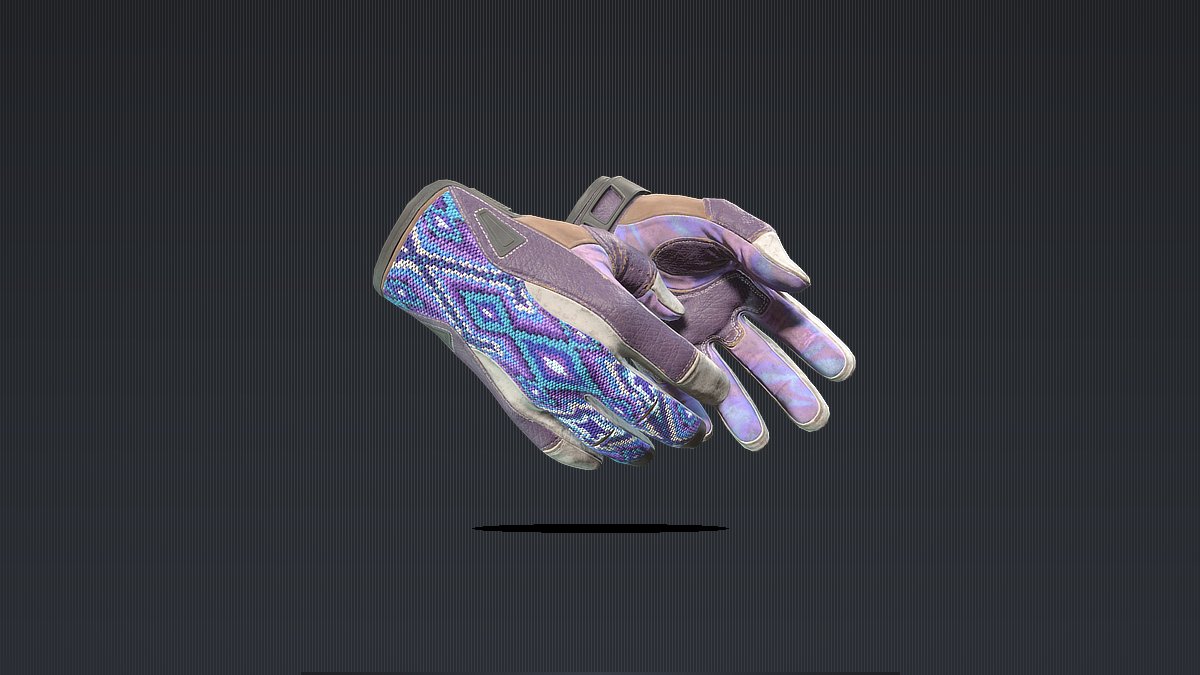
That price bracket is the one to watch. It sits above the floor where the terminal keeps adding supply, but well below the five-figure collector tier — which means it is the segment where the market's verdict on the new finishes will actually show up first. If Violet Beadwork holds near $276 through the next two terminal cycles, the supply shock is priced in. If it drifts toward $200, it is not.
The Bear Case, Stated Honestly
The bear argument is simple: gloves now have a permanent, free, weekly supply faucet. Every week the terminal rolls, it adds offers at the low end, and every claimed pair that gets listed pushes the floor down a little further. The 90-day number (-19.24%) is the market pricing that in.
There is a second-order effect too. Because the terminal is free to unseal, the "cost" of acquiring a glove is now mostly time rather than money. Players who would never have bought a $400 glove will happily claim a $90 one for free and then list it — which is precisely how a floor gets tested repeatedly.
The Bull Case, Also Stated Honestly
The counter-argument is that 22 new finishes do not create 22 new desirable gloves. Most of the Dead Hand finishes are unremarkable, and the ones that are not — the Specialist and Sport Gloves entries — trade in a bracket where supply is still fixed by how rarely anyone claims them.
Look at the broader market context: total CS2 skin value is $4.4 billion across 50,530 tracked items, and the broad market index at 632.4 is down 4.93% over 30 days. When everything is drifting lower, the category with a fresh supply faucet will always look worse than the category without one. That does not mean gloves are broken — it means gloves are being repriced against a new supply baseline.
If that reading is right, the current discount is mostly a base effect, and the top-tier glove finishes will recover before the floor does.
What To Actually Do With This
Three rules follow from the data:
- Do not buy the floor. The floor is where the terminal keeps adding supply. A cheap glove is now the item most likely to be re-underwritten by next week's free offer.
- Buy finishes, not models. A glove's price is driven almost entirely by its pattern family. The model (Driver, Moto, Specialist, Sport) sets the price band; the finish decides whether it holds.
- Watch the 30-day number, not the 90-day one. Gloves are down 19.24% over 90 days but only 6.97% over 30. The decline is decelerating, which is what a market does when it is finding a new floor rather than falling through one.
The honest summary: gloves are the worst-performing category in CS2 right now, and they are the worst-performing category for a specific, identifiable, ongoing reason. Whether that is a discount or a warning depends entirely on whether you are buying the part of the market the terminal actually impacts.
If you want to see what the other side of the trade looks like, Frost Vault is where knife and glove chasers go when they would rather pull the rare special item than pay the listed price for it — and right now, with gloves on a 19% slide and knife prices drifting 5.2% over the month, the case route is the only one where the floor does not move while you are thinking about it.