A Year After Knife Trade-Ups, the Market Still Can't Price a Knife
A Year After Knife Trade-Ups, the Market Still Can't Price a Knife
On October 22, 2025, Valve shipped a patch note most players skimmed. It said five regular Covert items could now be exchanged for one regular knife or one pair of gloves — and five StatTrak Covert items for a StatTrak knife. Within 24 hours, more than $1.7 billion had been erased from CS2 inventories, roughly 30% of the entire market, according to price tracker Pricempire.
Twelve months later the headline number has healed. Total market capitalization climbed back above $5 billion by mid-November 2025 and has traded in the billions since. Knife prices never fully came back, and the reason isn't sentiment or a slow patch cycle. That one line turned knives from a lottery prize into a manufactured good. Nobody has agreed on what the manufacturing cost should be, and until they do, every knife listing is a guess wearing a price tag.
What Actually Changed in One Line
Before October 2025, trade-up contracts only moved skins one tier at a time. Ten Classified items went in, one Covert item came out. That ladder stopped at red. Knives and gloves sat outside it entirely, reachable only through the rare special slot — a published 0.26% chance per case opening, or about 1 in 385.
The October patch added a final rung. Five Covert items in, one knife or one pair of gloves out. The result comes from the collection of one of the items you put in, which means the inputs you choose decide which knives are even possible. Coverts stopped being trophies and started being ore.
That is a supply-side change, and it is permanent. A 0.26% case drop is a rate you cannot influence. A crafting recipe is a rate you can farm, buy, or wait out.
The Crash, in Numbers
The first 24 hours were violent in a way CS2 had not seen. Pricempire recorded a drop from a record capitalization near $6 billion to roughly $3.5 billion, with the trough reported between $3.0 billion and $3.2 billion on October 24 depending on the tracker. A 20-year-old player in London reportedly lost almost $270,000 of inventory value overnight. Pro player Spinx publicly announced he was done with the skin market.
Then it bounced, hard and fast. Within 24 hours of the bottom, prices rose an average of about 47%. The market regained over $1 billion in a day and sat near $4.1 billion within a week — a 50% move off the low. By mid-November it was holding above $5 billion.
Case activity went the other way. October 2025 set a record of 31 million cases opened, the highest since CS2 launched. A market that had just lost a third of its value in a day opened more boxes than ever. That tells you what the panic actually was: not a loss of interest, but a repricing of the top end.
The Part Nobody Priced: a Ceiling Made of Red Skins
Here is the mechanic that never showed up in the panic headlines. A craftable knife has a soft ceiling built into it. If a knife sells for meaningfully more than the five Coverts needed to make it, someone crafts one, supply rises, and the gap closes.
That ceiling is not fixed. It moves with the price of the red skins in the relevant collections. Coverts rallied after the patch precisely because they became raw material, which pushed the crafting cost up. Knives fell because their old price was based on scarcity that no longer existed. The two curves met somewhere in the middle, and they are still finding each other a year later.
Rare finishes kept their premium, and the data backs the logic. A vanilla or low-tier finish on a common knife model is the easiest thing to manufacture — you need Coverts from a cheap collection and nothing else. A Gamma Doppler Emerald or a Fade pattern cannot be crafted into existence selectively, because the outcome is tied to the collection, not to your wish list. Scarcity survived where it could not be engineered.
The result is a market that looks flat on a chart and is anything but. Cheap knives compressed toward the cost of their ingredients. Expensive knives held. The middle of the knife market — the $150 to $400 band where most real buying happens — is where the confusion lives, because that band is exactly where crafting cost and collector demand collide.
Why Ordinary Knives Hated the Patch Most
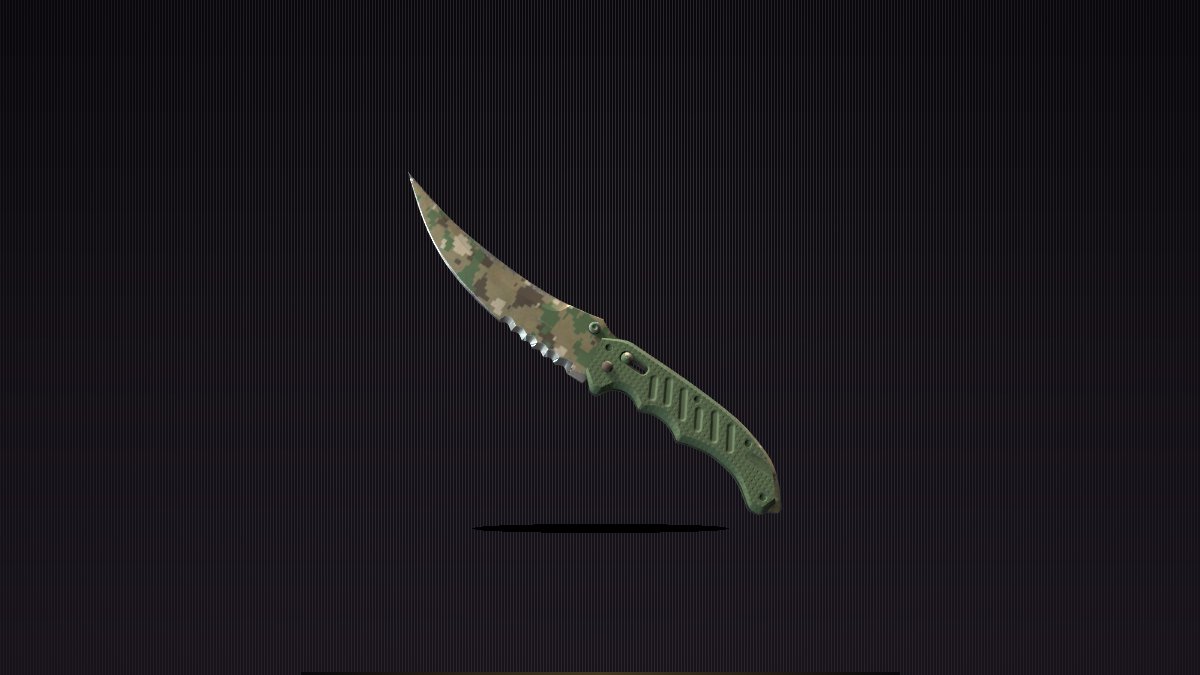
A Flip Knife in Forest DDPAT is the clearest example of what happened. It was never rare in the way a Karambit was rare, but it was still gated behind a 1-in-385 roll, and that gate set the price. Once five red skins could produce one, the gate stopped being the constraint. The constraint became the cost of five reds.
That reframing matters for anyone holding mid-tier knives. You are no longer betting on drop rates. You are betting on the price of Covert skins in a handful of collections, whether Valve keeps those collections in the active drop pool, and how many other people ran the same arithmetic before you did.
There is also the boring but decisive factor: liquidity. A crafted knife is functionally identical to an unboxed one. Buyers cannot tell, and aftermarket tools do not flag it. So the supply of "identical" knives expands quietly every time someone decides the math works, and price discovery gets noisier in exactly the segment where casual buyers shop.
The Real Damage Was Trust, Not Price
Prices recovered. The assumption that a knife is intrinsically scarce did not. A year on, community write-ups are still framing the patch as the moment the market's core promise broke — that the expensive thing would stay expensive because it was hard to obtain.
That promise was never a Valve guarantee. It was a belief traders held, and beliefs are cheaper to break than supply chains. The seven-day trade protection Valve added before the patch made every trade reversible for a week, which softened the panic but also made the market slower to clear. Slower clearing plus uncertain floors is a bad combination for anyone who needs to exit quickly.
Meanwhile the underlying economics of opening cases did not improve at all. A Kilowatt Case costs about $0.09 plus a $2.49 key — roughly $2.58 per opening — and returns an expected value near $0.72. That is about 28 cents back on the dollar before selling fees. The Dreams & Nightmares Case, at $0.87 plus the key, returns nearer $1.35 against a $3.36 cost. Still roughly 40 cents on the dollar.
So the honest read after twelve months is this: trade-ups didn't make knives cheap, they made knives priced. Whether that's good depends entirely on which side of the crafting math you sit on.
How to Actually Buy in This Market
Three habits carry most of the weight now. First, price the ingredients before you price the knife — if five Coverts from the same collection cost less than the knife you want, the knife is expensive and you should wait. Second, stay out of the middle band unless you have a reason: the sub-$100 knives are the most exposed to crafting supply, and the genuinely rare finishes are the least. Third, ignore the "recovered to $5 billion" headline. It describes the whole market, not the item you're looking at.
If you want to see where supply actually comes from, the fastest way is to watch a live case rather than a price chart. Phantom Cache shows you the drop tiers in real time, which is a more honest teacher than any index — you see what the 0.26% slot actually looks like when it lands, and how rarely it does.
The knife market will find a floor eventually. It just won't be the floor anyone memorized in 2024.