CS2's Real Money Isn't in Knives — Nearly 60% of the Market's Value Sits in Stickers
CS2's Real Money Isn't in Knives — Nearly 60% of the Market's Value Sits in Stickers
Ask ten CS2 players where the value in this game lives and nine of them will say knives. The tenth will say gloves, because gloves are the new knife. Almost nobody says stickers. And yet the most careful snapshot of the market we've got says stickers are, by a wide margin, the single largest store of value in the entire CS2 economy.
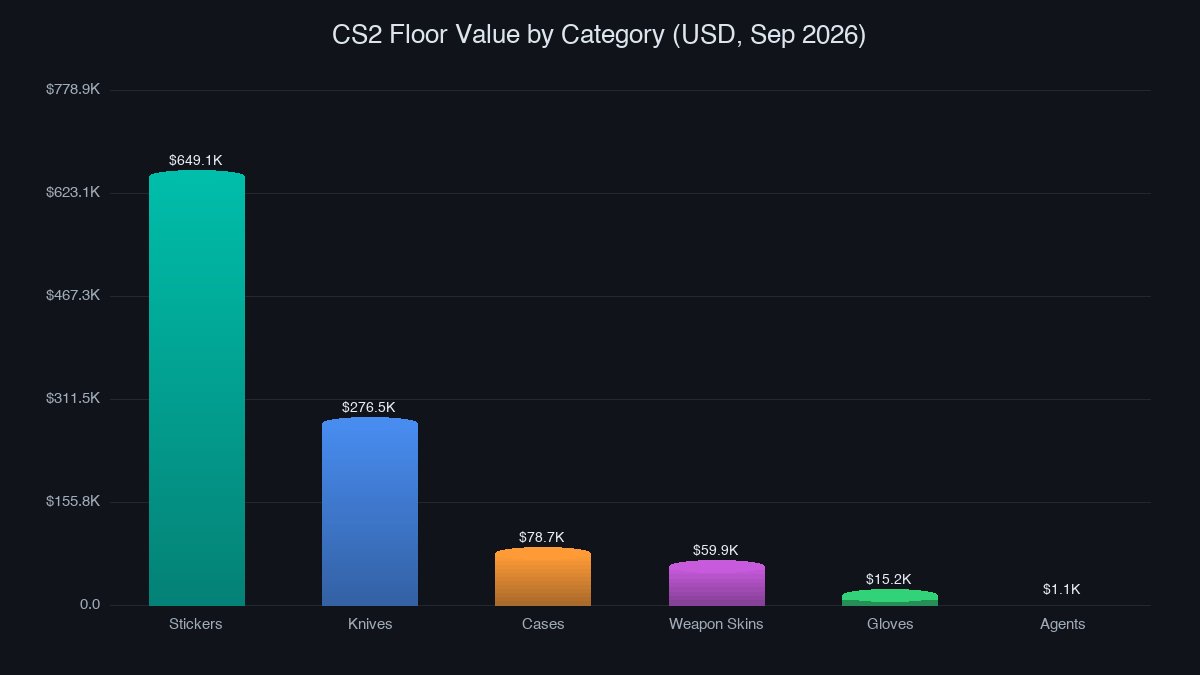
The number is $649,062. That's the combined floor value of every tracked sticker — 59.8% of the total across all item categories. Knives, the thing everyone actually dreams about, account for 25.5%. The category people obsess over is less than half the size of the category they ignore.
The Number That Stopped Me
The dataset behind this comes from a snapshot dated September 23, 2026, covering 13,736 concrete CS2 items priced across 36 marketplaces — roughly 60.2 million live listings in total. "Floor value" here means one unit of each item at its cheapest fee-included asking price, summed. It is explicitly not supply-weighted, which is an important caveat: nobody knows how many of each item exists, so the honest description is "what it costs to buy one of everything," not "the size of the economy."
Even with that caveat, the shape of the distribution is striking. Here's how the value splits by category:
- Stickers: 10,425 items — $649,062 — 59.8% of total floor value
- Knives: 604 items — $276,511 — 25.5%
- Cases & containers: 465 items — $78,745 — 7.3%
- Weapon skins: 1,427 items — $59,937 — 5.5%
- Gloves: 94 items — $15,204 — 1.4%
- Agents: 63 items — $1,149 — 0.1%
- Charms: 78 items — $416 — under 0.1%
Read that twice. Ten thousand four hundred and twenty-five sticker items collectively outweigh six hundred knives by more than two to one. And weapon skins — the actual thing the game is nominally about, the AK-47s and AWPs people play with every match — are 5.5% of the tracked value. The cosmetics you see are not where the money is stored.
How the Data Was Built, and What It Misses
Two things make this snapshot trustworthy and two things make it incomplete, and both matter if you're going to act on it.
In its favour: it's fee-inclusive. Many market comparisons quote the sticker price and quietly ignore the 15% Steam cut or the listing fees on third-party sites, which makes items look cheaper than they are. This data prices what you'd actually pay. It also spans 36 venues rather than defaulting to Steam, which means it captures the cheaper listings that exist off-platform.
Against it: the floor-value method counts one unit per item, so a sticker with 50,000 items in circulation counts exactly the same as a sticker with 200. Stickers win this measurement partly because there are 10,425 of them. That's not a flaw in the math — it's a real reflection of how fragmented the sticker market is — but it does mean "stickers are 60% of value" says more about breadth than about concentration.
And the concentration at the very top is extreme. The most expensive stickers in the game aren't tournament items from this year. They're relics: Titan (Holo) | Katowice 2014 at roughly $67,500, and Reason Gaming (Holo) | Katowice 2014 at about $43,851. A single 2014 holographic sticker is worth more than most players' entire inventories.
Why Stickers Won, and Where the Action Actually Is
The structural reason is simple once you see it: stickers are consumable. They get applied to weapons, scraped, worn down, and removed from circulation forever. Every sticker applied to a gun is a sticker that no longer exists as a tradeable item. Knives and skins are durable — they just change hands. Stickers have a one-way exit from supply, and the market has had twelve years to run that process.

The other reason is the Major cycle. New stickers arrive in event capsules, and the editions that matter are set by the event, not the artwork. Cologne 2026 stickers landed on May 21, 2026, and the early price action is exactly the kind of volatility the category is known for:
- Team Spirit (Gold) | Cologne 2026 — currently around $375, with an all-time high of $700 on July 7, 2026 and an all-time low of $49.23 on May 29, 2026
- Natus Vincere (Holo) | Cologne 2026 — about $12.74, down from an all-time high of $73.65 on May 26, 2026
- Falcons (Holo) | Cologne 2026 — around $88.30, up roughly 68.7% over 30 days
That Team Spirit Gold candle is the whole story in one line: from $49.23 to $700 inside six weeks, then back to $375. A sticker that moved more than 1,300% and then gave back nearly half its peak. If you want to understand why traders keep coming back to this category, that's the reason.
The mechanics behind that move are worth understanding, because they're what separates stickers from every other CS2 asset. Cologne 2026 stickers only exist inside event capsules, and those capsules are only sold while the Major is running. Valve's established pattern is to discount Major capsules heavily once the tournament ends and then pull them from the store entirely. From that point forward, supply is frozen forever — no reprint, no re-release, no drop pool. Every capsule that gets opened permanently destroys the stickers inside it.
That's a genuinely different supply model from anything else in the game. A retired case can still be opened for years, and the skins inside it stay tradeable. A sticker capsule consumed today can never be reconstituted, and the specific sticker pulls are gone with it. Combine a hard supply ceiling with a famous-player or famous-team premium and you get the kind of price tail that produced a $67,500 Titan Holo from a 2014 event nobody under 25 watched live.
What This Means for a Normal Inventory
The practical takeaway isn't "buy stickers." It's that the way most players think about their collection is inverted. You probably treat knives and gloves as the crown jewels, weapon skins as the substance, and stickers as pocket change you slap on a rifle and forget. The data says the pocket change is the deep end of the pool.
Two consequences worth sitting with:
- Applied stickers are destroyed value. Scraping or applying a genuinely rare sticker doesn't just lose you the sticker — it permanently removes supply that other collectors are still pricing. Before you slap a tournament Holo onto a $10 rifle, check what it trades for on its own.
- Liquidity is not the same as value. The most-traded items in the snapshot are things like AK-47 | Slate at 7,129 listings and $2.41, or Glock-18 | Shinobu at 7,116 listings and $2.90. Cheap things move constantly. Expensive things sit. Stickers concentrate at both ends at once — thousands of near-worthless filler items, and a thin tail of six-figure relics.
The broader market backdrop hasn't been kind either: across a 37-day window ending September 23, 2026, the median tracked listing moved -3.7%. Third-party trackers put total ecosystem value somewhere between $6 billion and $7.1 billion depending on methodology, so this is not a small pond. It's a big pond where most of the water sits in a category almost nobody opens their inventory to admire.
Knives are the trophy. Stickers are the vault. If you want to see what the sticker side of the market actually costs before you decide you don't care, browse the listings on the SkinVS shop and sort by price — the top of that list tells the story better than any chart.
One last thing to keep in mind before you reorganise your inventory around this. Floor value is a snapshot of asking prices, not of realised sales, and the same dataset shows a -3.7% median move across a 37-day window. Categories don't stay on top forever, and a market where stickers are 60% of the tracked value is also a market with an enormous amount of near-worthless filler. The point isn't that every sticker is a hidden gem. The point is that the ceiling of this game's collectible market sits in a category most players have never once opened their inventory to look at — and that's exactly why the good ones were cheap for so long.