Where CS2 Eats Your Money: The 33% Spread Nobody Warns You About
Where CS2 Eats Your Money: The 33% Spread Nobody Warns You About
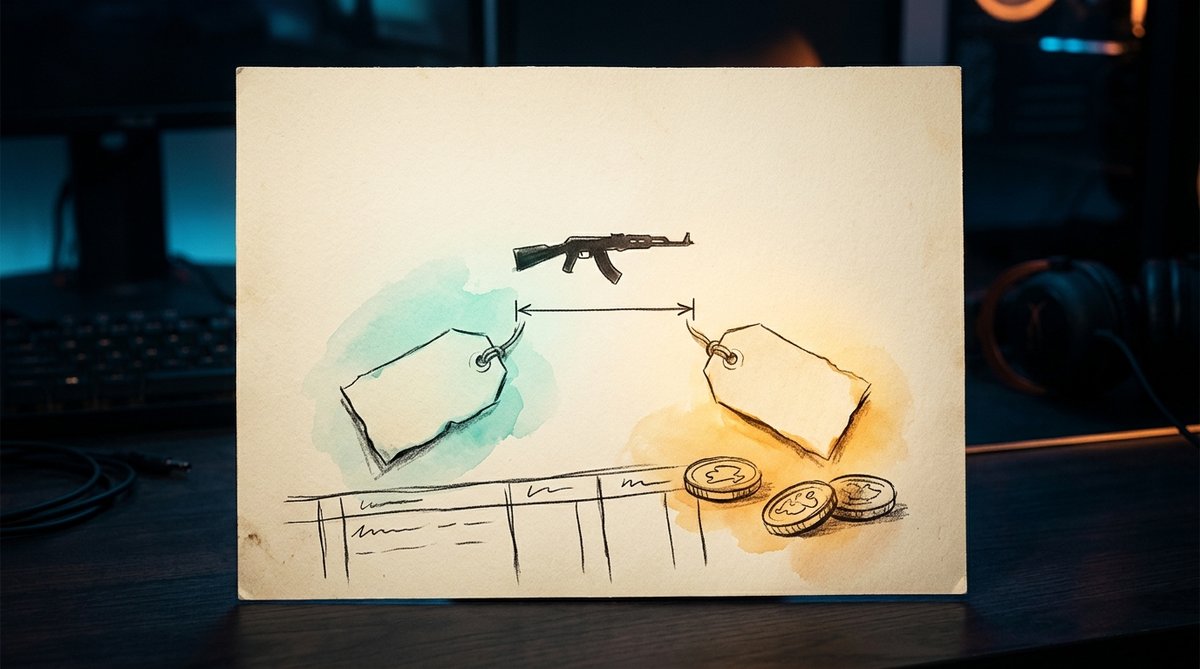
On September 23, 2026, a market snapshot covering 13,736 CS2 items, 60,236,582 listings and 36 marketplaces put the combined floor value of the entire tracked catalogue at $1,085,452. Same snapshot, same day: the median gap between the best buy price and the best sell price was 28.3%.
That number is the one almost nobody quotes. Traders argue about whether a knife is going up. The spread decides whether you make money either way.
Here is the four-step check to run before any CS2 purchase, using the categories the market actually reports.
Step 1 — Find Out What Your Category Charges You
The spread is not a marketplace fee. It is the distance between the lowest ask and the highest bid on the same item, expressed as a percentage. It varies enormously by category, and the variation is not random — it tracks how many venues actively quote the item.
- Agents — 1.0% median spread. The tightest market in the game.
- Gloves — 2.3%. Few finishes, deep order books, wide buyer attention.
- Knives — 2.4%. 604 items carrying 1,366,455 listings between them.
- Charms — 3.8%.
- Weapon skins — 6.5%. Roughly three times the cost of trading a knife.
- Cases and containers — 17.2%.
- Stickers — 33.2%. More than thirteen times the knife figure.
Read that list again with your own habits in mind. If you flip knives, a round trip costs you about 2.4% in theory. If you flip stickers, the same round trip costs about 33% — which means a sticker has to appreciate by a third just for you to break even. The categories people treat as "cheap fun" are the categories that eat the most.
The reason knives and gloves stay tight is competition between venues, not virtue. A knife finish is quoted on every major marketplace simultaneously, so any seller who drifts away from the consensus gets undercut within hours. Stickers rarely get that treatment: there are 10,425 tracked sticker items against 604 knives, and no serious market maker is going to police the order book on each of them. Thin categories stay expensive to trade because nobody is competing to narrow them.
Step 2 — Check Dispersion Before You Trust a Price
Spread is the cost of getting in and out. Dispersion is how far apart the listings are once you are inside. Both are reported per category, and dispersion is the more brutal of the two.
Knives show 36.2% median dispersion and gloves 43.6% — for a category with thousands of identical, interchangeable units, that is remarkably tight. Cases sit at 81.1%. Weapon skins jump to 154.7%. Stickers hit 243.8%. Across every measured item the figure is 196.7%.
What dispersion tells you is whether "the price" of an item is a real thing. A knife's price is a real thing: the market agrees within a third. A sticker's price is not — the same sticker can legitimately be quoted at wildly different numbers across venues at the same moment, and the quoted figure you happen to see tells you almost nothing about what you would actually receive.
This is also why single-listing screenshots mislead. One seller asking a high number creates a headline, not a valuation. If dispersion in your category is above 100%, treat every price you read as an ask rather than a value.
Step 3 — Only Trade Where Volume Actually Prints
The September market made this point three weeks in a row. Weekly tapes covering September 7, September 14 and September 21 all showed the same thing: every single item in both the top-five gainers and the top-five losers printed zero 7-day volume.
The examples are instructive. A Souvenir USP-S | Forest Leaves in Battle-Scarred condition showed a change of +22,439% at a listed price of $1,063.86 — on zero trades. A StatTrak Bowie Knife | Safari Mesh in Minimal Wear showed -99.95%, landing at $71.33 — also on zero trades. Neither move was a market event. The first was a single seller typing a fantasy number into an empty book; the second was that number being deleted.
Percentage change without volume is decoration. Before you act on any mover, ask whether the item traded at all in the last seven days. If the answer is zero, the price you are looking at is an opinion held by one person.
There is a second, quieter signal in the same snapshot. Between August 16 and September 23 — a 37-day window — the median comparable item fell 3.7%, with 10,577 variants dropping against 5,173 rising. Knives fell 3.9% with 2,396 decliners against 675 gainers. Gloves fell 6.2%. In a market like that, buying an illiquid item is a bet on direction you do not need to make: you are paying a wide spread into a declining tape.
Index data tells the same story. A knife index built from 40 tracked skins stood at 92.19 on September 27, down 1.56% across seven days, while a 100-skin composite index sat at 92.99, off 1.39%. One comparison set of 306 knives recorded zero gainers and 306 decliners against its March baseline. When breadth is that one-sided, liquidity is the only thing that lets you change your mind at a fair price — and illiquid items do not offer it at any price.
Step 4 — Price In the Seven-Day Lock
Costs do not stop at the spread. Everything redeemed from the Armory is trade-locked for 7 days before it can be listed. The same applies to items pulled from cases opened with a key — and a case redemption already costs you twice before you open it: 2 Armory credits for the container, then the $2.49 key to open it.
Add that up honestly. You pay credits, you pay for the key, the contents land locked, and then you pay a spread to exit — 17.2% if it is a case, 6.5% if it turns out to be a weapon skin, 33.2% if it is a sticker. The lock also removes your ability to react: when the tape moved 3.7% against holders over 37 days, a seven-day freeze on your inventory is a real position, not a technicality.
The Arithmetic, Applied
Run the four checks in order and most decisions resolve themselves without any price prediction at all.
- Category spread under 5% (knives, gloves, agents): the round trip is affordable, and you can think about direction.
- Category spread over 15% (cases, stickers): the item must appreciate substantially before you profit. Trade it like a collectible, not an instrument.
- Dispersion over 100%: stop trusting single prices. Compare multiple venues or walk away.
- Zero 7-day volume: the price is fiction until it prints.
- Any Armory or case pull: subtract the credits, the key and the seven-day lock before calling anything profit.
The gap between the best buy and the best sell is the only number in CS2 that is guaranteed. Direction is a guess; spread is arithmetic. The traders who last are the ones who get paid to guess and stop paying to leave.
If you would rather test the arithmetic than argue about it, the cheapest categories to actually own a piece of are the containers — a Frost Vault case on SkinVS gives you a fixed, known cost of entry, and the SkinVS marketplace gives you a second venue to compare against before you commit. Knowing what you are paying to get out is worth more than knowing what something is worth.