CS2 Skin Prices Are Falling Nearly Everywhere: What 1,186 Skins Tell Us About the Market
CS2 Skin Prices Are Falling Nearly Everywhere: What 1,186 Skins Tell Us About the Market
Here's a number that should make every CS2 trader stop scrolling: 1,128 out of 1,186 tracked skins lost value between March and mid-August 2026. That's 95% of the market sliding in the same direction. Only 50 skins managed to gain more than 1%.
This isn't a flash crash. It's a slow, grinding correction that has quietly reshaped the entire economy — and most players haven't noticed how deep it really goes. We pulled the data to show exactly where the damage landed, and which items are still worth holding.
The Raw Numbers
Market tracker CSDB.gg compared 1,186 skins with matched wear conditions between a March 2, 2026 baseline and an August 17 snapshot. The result is stark: the median skin fell 30.6% across that window.
That median matters because it isn't skewed by a few outlier listings. It means the typical CS2 skin — the one sitting in your inventory right now — is worth nearly a third less than it was five months ago. When nine out of ten items in a market are pointing the same direction, you're looking at a structural shift, not a temporary dip.
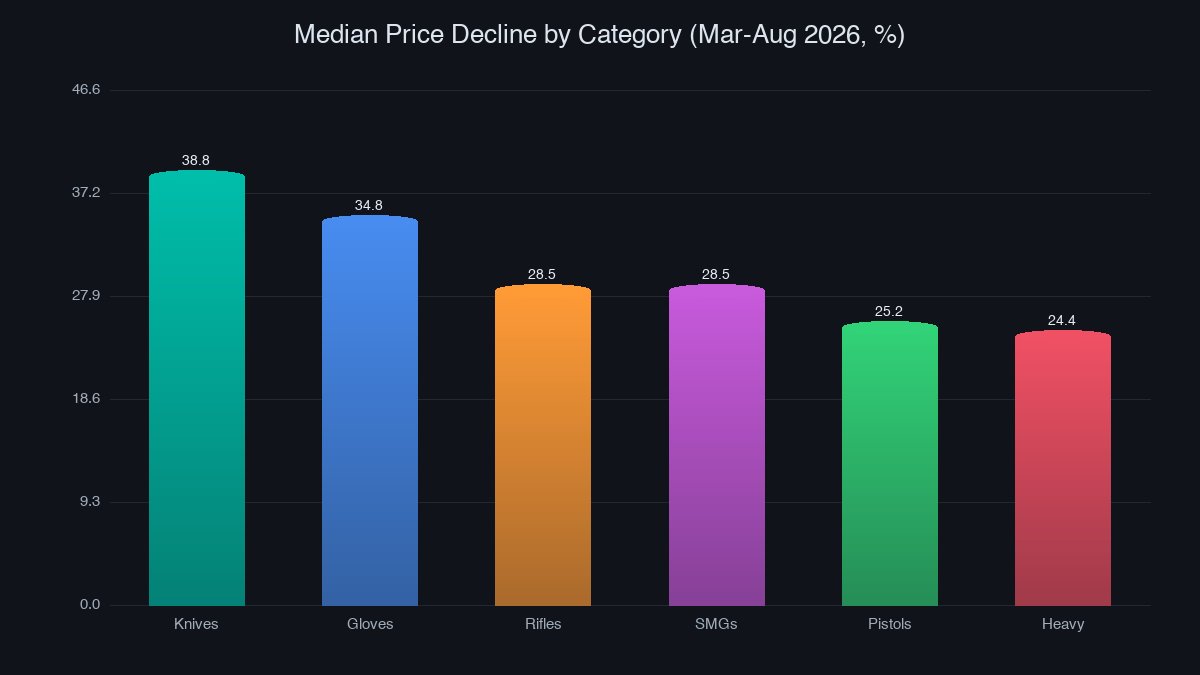
The decline isn't evenly spread. Every weapon category is down, but some have fallen far harder than others, according to CSDB.gg's category-level breakdown:
- Knives: -38.8% across 306 tracked skins — the worst hit
- Gloves: -34.8% across 72 skins
- Rifles: -28.5% across 312 skins
- SMGs: -28.5% across 142 skins
- Pistols: -25.2% across 248 skins
- Heavy weapons: -24.4% across 103 skins
Why Knives and Gloves Fell Hardest
The categories that lost the most are exactly the ones that used to be the safest. Knives and gloves sat at the top of the value pyramid for over a decade, and their decline is the clearest signal that something structural changed in how items are created.
The trigger was October 2025, when Valve expanded the Trade Up Contract to let players convert five Covert (red) skins into a knife or a pair of gloves. Overnight, the scarcity model that propped up premium prices broke. Analysts at Pricempire and EsportFire estimated $2 to $3 billion was wiped from player-owned value within days, with Pricempire posting a loss of roughly $3 billion in the first 38 hours.
The EsportFire 300 Index, which tracks a broad basket of knives, gloves, and Covert skins, dropped from just over $50,000 to $28,062.67 — a 45% decline in under two days. Individual gloves got hit even harder: the Bloodhound Gloves Charred (Field-Tested) fell 81.19%, and the Specialist Gloves Forest DDPAT (Field-Tested) dropped over 88% in the same week.
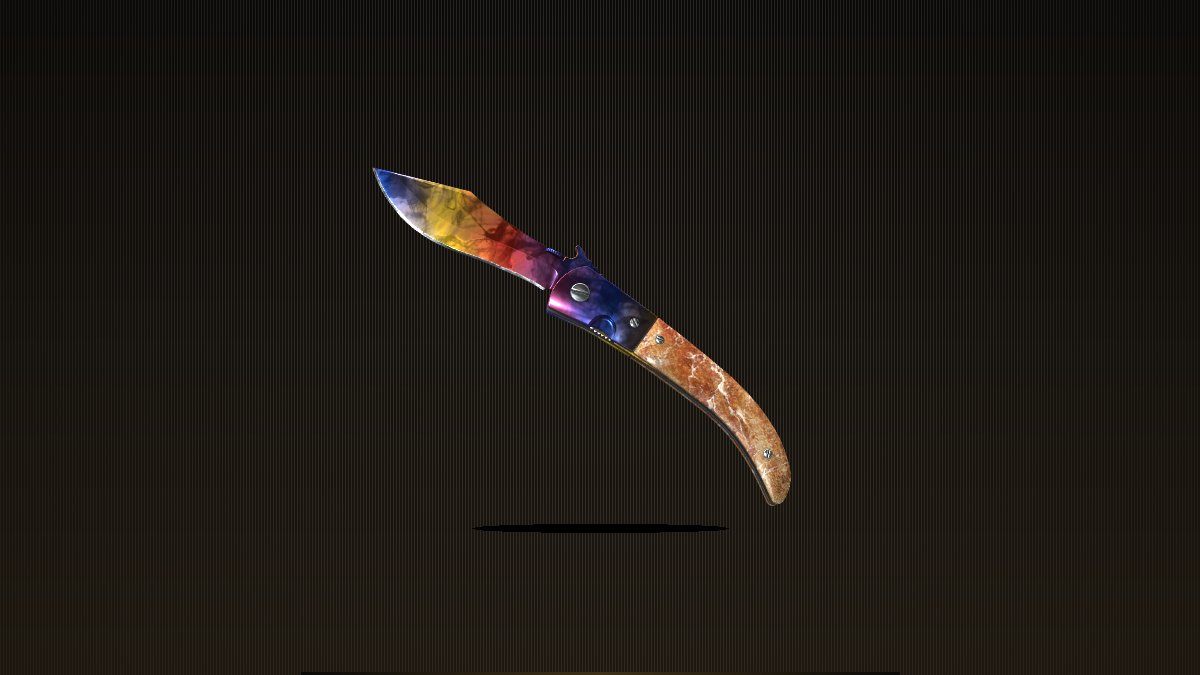
The Navaja Knife Marble Fade above is the kind of item that used to hold its price without effort. Today, even Factory New examples in sought-after finishes trade well below where they sat in March — a reminder that "premium" no longer means "safe" in this market.
Why this matters now: knives and gloves never recovered their old premium. The trade-up contract didn't get nerfed or removed — it got priced in. That's the real reason these categories are still falling eight months later.
The Recovery That Wasn't
The surprising part of this story isn't the crash — it's that the market briefly looked like it had bounced all the way back. By July 2026, total skin market capitalization climbed to roughly $7.1 billion, and some trackers called it a new high. The rebound happened because buyers who had been priced out of knives and gloves rushed back in at the new, lower price points.
But that headline recovery masked what was happening underneath. Today the tracked value sits around $5.0 billion across 50,528 items in 131 collections, according to cs2.sh's live index. The market is cooling again, and the categories that led the rebound — cheaper knives and mid-tier gloves — are now leading the slide back down.
There's a legal overhang making it worse. In February 2026, the New York Attorney General filed a lawsuit against Valve alleging that loot box mechanics in CS2 and other titles constitute illegal gambling. Nothing has been resolved, but the case adds a layer of uncertainty that traders now have to price into every high-ticket purchase.
The Two-Tier Market
A -30.6% median sounds catastrophic, but it hides a two-tier reality that matters more than the headline number. Pattern-based and uncraftable items have held their value far better than everything else, because no trade-up contract can reproduce a specific pattern or float.
Blue Gem knives are the clearest example. The Karambit Case Hardened Blue Gem pattern 387 is still valued in the $1.5 million to $2 million range, and its owner has famously turned down offers rather than sell. Souvenir items follow the same logic: when Dust2 left the active map pool, the Souvenir AK-47 Gold Arabesque jumped from under $2,000 to over $6,000 in Factory New, because no new souvenir packages for it could ever drop again.
Stickers tell the same story. A Titan (Holo) from Katowice 2014 is worth around $85,200, and single iBUYPOWER Holos trade above $100,000. These items went from literal cents to six figures over a decade, and they proved during the crash that they simply don't move with the rest of the market. The M4A4 Howl, a discontinued item with no drop source, behaves the same way.
Tournament stickers are the exception that proves the rule. During IEM Cologne 2026, the donk gold sticker demanded 122,972 tokens — roughly $1,217 — at its peak, and the full top-100 sticker set cost an estimated $19,447. Once the event closed, demand collapsed: the Falcons Holo settled near $44. Tournament items hold up during the hype window, then fall hard when it ends — which is why timing matters more for them than for anything else.
Float value has also become a bigger factor than before the crash. With knife prices lower overall, the gap between a 0.01 float and a 0.06 float on high-value skins has widened in percentage terms. Buyers who couldn't previously afford the top tier now pay meaningful premiums for the cleanest examples, and pattern hunting on Case Hardened and Fade finishes has followed the same logic.
The rule of thumb: if an item can be created on demand through a trade-up or an active case, it's a commodity now. If it's finite and can never be produced again, it behaves more like a collectible.
The Smart Play
If you're buying right now, the smart move isn't to time the exact bottom — it's to understand which side of that two-tier line your target sits on. A standard knife or glove is a commodity, and commodity prices answer to Valve's next update and the next Major's hype cycle.
The categories with real, verifiable demand are still moving volume. Case opening remains the strongest demand signal in the whole market — the Phantom Cache case alone has been opened tens of thousands of times, and that kind of activity is what keeps the economy circulating even while prices drift lower. When player confidence is up, open counts accelerate before prices do.
Position around the calendar, not the daily chart. Tournament windows move stickers and souvenirs; the quiet weeks between them are when knives and gloves consolidate. And above all, remember the one certainty this market keeps teaching: Valve can change the rules whenever it wants, and the only items that shrug that off are the ones nobody can make more of.