The 40% Tax: What You Actually Pay for the Same CS2 Skin
The 40% Tax: What You Actually Pay for the Same CS2 Skin
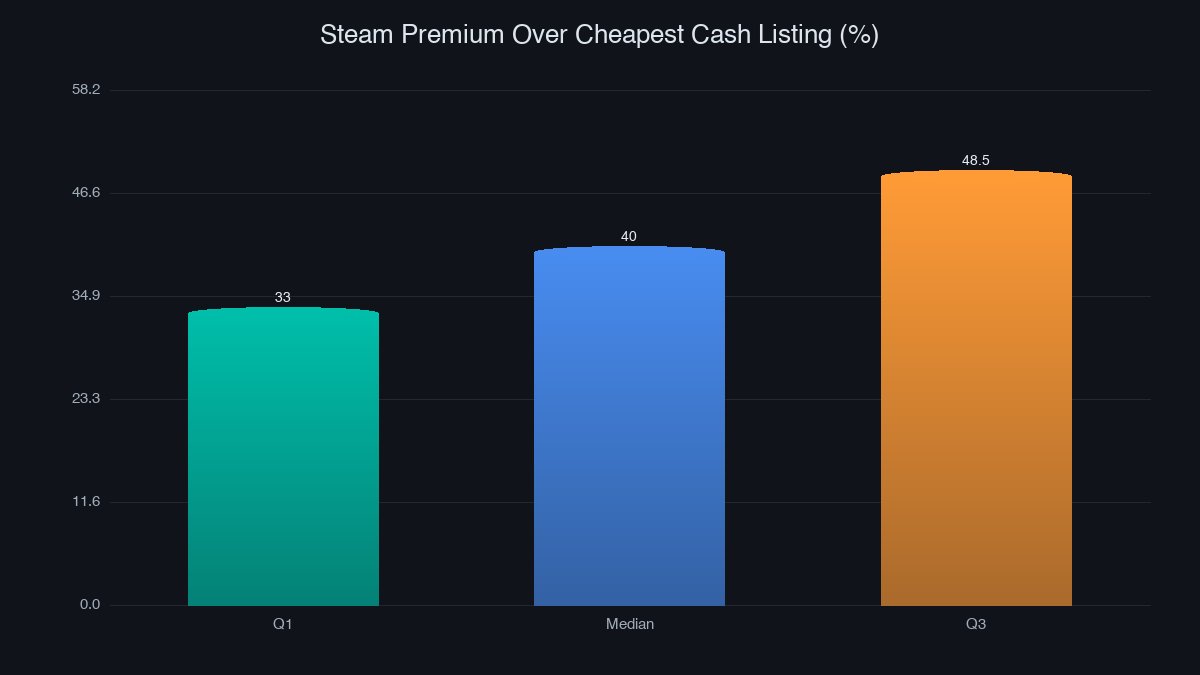
On October 4, 2026, an index built from 3,674 CS2 skins produced a number that should bother every buyer in this hobby: the median skin cost 40.0% more on the Steam Community Market than the cheapest listing on a marketplace that pays out withdrawable cash. Steam was the more expensive option in 99.3% of cases.
Forty percent is not a rounding error. On a $500 knife that is $200 — enough to buy a second skin. And unlike the 15% fee everyone complains about, this gap is almost invisible, because most players only ever look at one price.
This is the three-step method for closing it. No secret sites, no grey-market risk, just the arithmetic that the platforms are hoping you never run.
Step 1: Price the Same Item in Three Places
The reason the 40% gap survives is that players compare items instead of comparing prices for the same item. Those are different exercises.
Take a real pair quoted on October 4, 2026: an AK-47 | Redline (Field-Tested) on one side, an AWP | Redline (Field-Tested) on the other. Same collection, same wear tier, comparable demand. Priced three ways, the numbers diverge hard.
- Instant cash bids — you give $25.09, you receive $29.72. Net: you are ahead by $4.63.
- Lowest ask across tracked markets — you give $25.30, you receive $29.98. Ahead by $4.68.
- Steam Community Market, last crawl — you give $45.86, you receive $52.30. Ahead by $6.44 on paper.
Look at what happened. The trade outcome looks best on Steam, because the spread in dollars is widest there. But the entry cost is nearly double. If your plan is to hold that AWP and eventually turn it into money you can spend, the Steam version costs you $52.30 of wallet funds to acquire an asset whose instant cash bid is $29.72. You started $22.58 underwater before the price even moved.
That is the trap in one paragraph: paying in Steam wallet credit feels free because the credit was never cash. It is not free. It is credit that cannot be withdrawn, priced at a 40% premium over the thing it buys.
Step 2: Separate Float From Finish
Once you accept that the same skin has three prices, the next question is which version of the skin you are actually buying — because a name like "AK-47 | Redline (Field-Tested)" describes a range, not an item.
Float is generated at the moment a case is opened, not chosen in advance. Two Field-Tested copies of the same finish can sit at opposite ends of the wear band, and the difference is worth real money. The same applies to pattern: a Karambit's finish spans $531.08 for Safari Mesh to $1,874.11 for Fade, with a median finish at $868.77. That is a 3.5× range inside a single knife type, and it is set by which finish you got, not by how good the knife is.
Practically, this means three checks before you pay anything:
- Check the float number, not the wear label. "Factory New" covers a band. The low end of that band sells at a different price than the high end, and listings rarely make the distinction obvious.
- Check whether the finish is trade-up producible. Since October 2025, five Covert skins convert into a guaranteed knife or gloves. Any finish that can arrive through that pipeline has a soft ceiling on its price, because supply is no longer gated by a 0.26% case roll.
- Check the sticker and name-tag premium separately. Applied stickers are frequently priced at full value in a listing and worth a fraction of it on resale. Strip that line out before you compare two listings.
The point of step 2 is not to become a float snob. It is to stop comparing a good copy against a bad copy and concluding that one marketplace is cheaper. Price the same float band or the comparison is meaningless.
Step 3: Time the Case, Not the Key
If you open cases, the arithmetic changes completely depending on which container you buy — and this is where most of the money actually leaks.
Keys are fixed. Valve sells them at $2.50, with no discounts, no bundles, and no third-party resale since keys were trade-locked in 2019. That fixed cost means the case itself is the only variable, and the spread between cases is enormous: at the September 10, 2026 refresh, the Kilowatt Case listed at $0.13 while the Chroma 3 Case listed at $2.55 — a 19.62× gap between two containers that hold similar-quality skins and both need the same key.
Why the gap? Drop status, almost entirely. Kilowatt still drops to Prime players every week. Chroma 3 stopped dropping years ago.
Now run the cost per open:
- Kilowatt: $0.13 case + $2.50 key = $2.63. The case is about 5% of what you spend.
- Chroma 3: $2.55 case + $2.50 key = $5.05. The case is about half of what you spend.
Two opens of Chroma 3 buy you nearly four opens of Kilowatt.
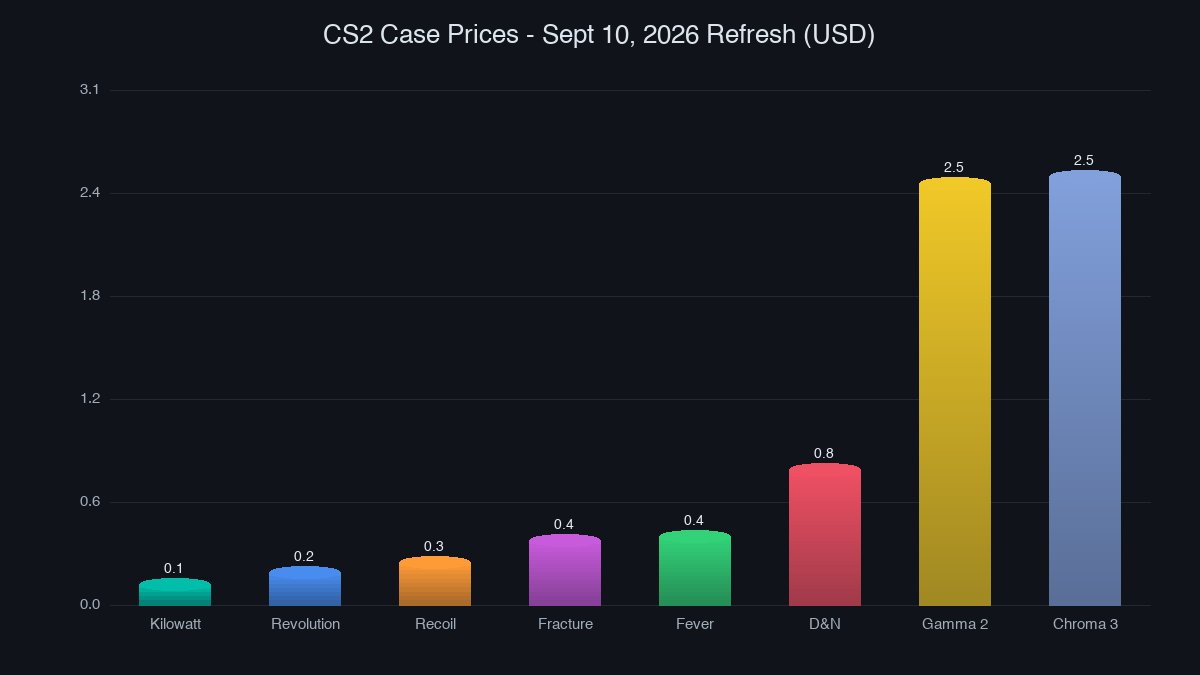
Since the odds are identical — 79.92% Mil-Spec, 15.98% Restricted, 3.20% Classified, 0.64% Covert, 0.26% gold — the only thing your extra $2.42 buys is a different skin pool. It does not buy better odds. Anyone opening discontinued cases "for the knife" is paying a collector premium on the container and getting the same 0.26% roll.
The 22-day price movement data makes the same point from the other direction. Kilowatt fell 33.8% over that window while Gamma 2 sat flat at 0.0% and Chroma 3 moved -1.1%. Cheap active cases are volatile because supply keeps arriving. Discontinued cases are sticky because supply has stopped. Neither is "better" — but they are different instruments, and you should not be buying one while reasoning about the other.
Step 4: Watch the Clock, Not Just the Price
There is a fourth step most guides skip, and it is the one that decides whether the 40% saving survives contact with reality: quote freshness.
In the same October 4 dataset, the median age of a Steam price quote was 4 hours 25 minutes, with the oldest at 23 hours 56 minutes. Skin prices move faster than that. A comparison built on a day-old Steam price and a live cash listing can show a 30% gap that has already closed — or the reverse.
Practically: refresh both sides within the same hour before you commit, and treat any price older than a few hours as a directional hint rather than a number. Add the seven-day Trade Protection window into that calculation too — anything you receive is locked for a week, so a price you are arbitraging today has to still be there on day eight.
The Only Number That Matters
Strip away the platforms and the fees and the float charts, and there is one comparison worth making: what you pay versus what someone will actually hand you for the same item today.
Across 5,167 skins listed on at least four marketplaces, the median gap between the cheapest and the most expensive listing of the identical skin was 16.4%, and for the top 10% of skins it reached 32.9%. That is free money sitting between listings — not because anyone is scamming, but because buyers do not cross-shop.
The habit that captures it takes ninety seconds: pick the skin, pull the float, check whether it is trade-up producible, then compare the same float band across at least three listings before you pay. Do that consistently and the 40% Steam premium stops being a tax you pay and becomes a discount you collect.
Start on the SkinVS marketplace with a specific finish in mind rather than a category, compare the float band, and keep your case budget separate from your skin budget — because those two are priced by completely different mechanics, and treating them as one number is how the 40% gets paid without anyone noticing.