The CS2 Skin Market Has Fallen for a Year. Here's Where the Value Actually Went
The CS2 Skin Market Has Fallen for a Year. Here's Where the Value Actually Went
In August, a collector opened his inventory tracker and sat there for a minute. The same items he had been proud of in the spring were now worth 60% less than the tracker had shown him. A portfolio he valued around $200,000 was reading closer to $80,000.
He is not unusual. What is unusual is how few people can say clearly why it happened. So let's walk through it the way a trader would — one number at a time.
The Number That Started It
Start with the size of the thing. Pricempire recently revalued CS2's total skin market, and at its peak the figure crossed $10 billion. That revaluation is where the shock came from: when you suddenly see the real ceiling, you also see how far the floor is.
The current picture, tracked across roughly 42,000 items and 41 marketplaces, is a market cap of $5.464 billion. The 30-day change is -2.84%. Over 90 days, the median tracked skin index is down 5.0%, ranging between 94.4 and 100.0.
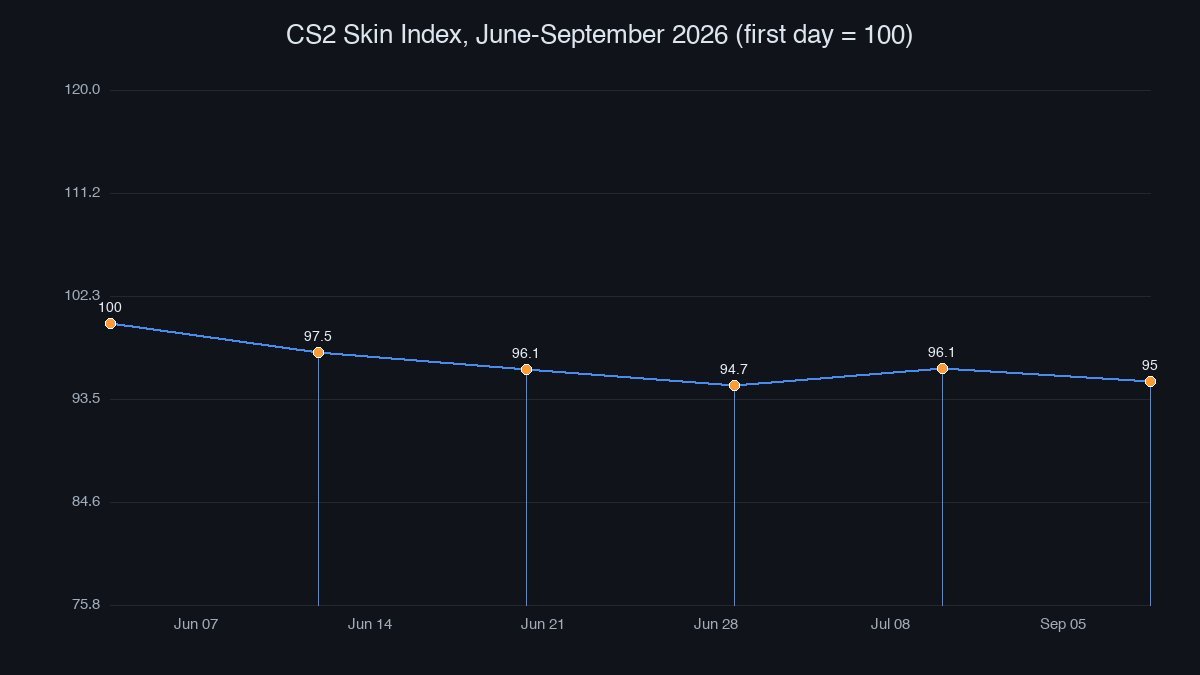
None of those numbers are a crash. That is exactly the point. This has not been a crash — it has been a slow, grinding slide that has now run for roughly a year, and slow slides are harder to notice than single-day headlines.
Three Updates, Three Hits
Traders who have watched this longest blame a short list of patches, and the order matters.
The first landed in October 2025, when Valve allowed players to craft gold items — knives and gloves — from covert-tier skins. Before that, a knife existed only if someone unboxed it or bought it from someone who did. After the change, supply could be created on demand. That single decision caused what is still referred to as the biggest skin market crash in CS2's history.
The second came in May 2026, when players were given the ability to craft souvenirs. Streamer Arrow put a concrete number on it: an AWP | Dragon Lore that had sold for $50,000 before the change, sold for $20,000 as a crafted example afterwards. Forty percent of a flagship item's value, gone in one mechanic.
The third is the one still playing out. At IEM Cologne 2026, Valve removed sticker capsules entirely and replaced them with a token shop selling autographs at demand-based prices. Separately, traditional cases have stopped arriving: the last classic-style case came more than a year ago, and Valve has been routing new cosmetics through the Armory and terminals instead. Dead Hand shipped in March 2026, the Armory's Fever Case before it, and no conventional case since.
There is also a regulatory clock ticking underneath all of this. Cases are outright banned in Belgium and the Netherlands. France has run a system since 2019 where you buy an "X-ray" package that reveals a case's contents before you commit, and that model is being enforced in Germany from March 16. Two lawsuits against Valve targeting loot boxes and gambling practices were filed in the United States in February and March 2026. None of that has changed drop rates yet, but it is the main reason traders are unsure whether the classic case ever comes back.
Where the Pain Is Concentrated
Here is the part most people get wrong. The decline is not evenly spread — the categories are moving in opposite directions at the same time.
Over the same 24-hour window, tracked by category:
- Weapons — up 0.77%, with a category cap around $5.4 billion
- Crates — up 1.42%
- Stickers — down 3.26%
- Agents — down 3.25%
- Charms — down 3.01%
- Keys — down 1.30%
Weapons — the actual skins people play with — are holding. The pain is sitting in the speculative layers bolted on top of them: tournament stickers, agent models, and the newer charm category. Those are precisely the items bought by people hoping to resell them rather than equip them.
Market breadth confirms it. Across roughly 10,500 priced skins in a recent seven-day window, about 4,200 were up and 4,800 were down — a mixed market, not a rout. Trading volume has not dried up either: nearly 298,600 confirmed sales cleared in that week, split between roughly 200,600 on Steam and 97,900 on CSFloat. People are still buying and selling. They are just paying less.
Two smaller categories deserve a mention because they tell the same story in miniature. Agents — the playable character models — are down 3.25% in a day, and graffiti, the least interesting item type in the game, is down 4.83%. Both sit at tiny market caps relative to weapons: agents around $8.2 million, graffiti about $63,600. When a $63,000 category moves nearly 5% in a day, that is not sentiment shifting. That is a thin market with very few buyers left.
The Part That Surprised Traders
If you read the last section and thought "so just avoid stickers and charms," the next set of numbers complicates that.
Case prices are also drifting down. The Fracture Case, which sits in the active weekly drop pool, is at roughly $0.41 — down 7.5% over 32 days. The Recoil Case is at about $0.26, down 10.4% over 27 days. Both keep dropping into the pool every week, so supply keeps growing, so the floor keeps sliding.
But the keys have gone the other way. The Spectrum Case Key has climbed to $13.65, up 11.2% across 58 days of tracked floor prices, and it has moved fast recently: +29.2% in nine days and +21.2% over 32 days. Steam is asking $18.40 for the same key, a 35% premium over the cheapest third-party venue.
Put those two facts side by side and you get the story of the last year in one line: the contents got cheaper while the cost of getting in went up. Cases are near their historical floor, keys are climbing, and the rare-special odds that make opening interesting have not moved — Fracture and Recoil both still put a knife or glove in your hands on roughly 0.26% of openings, about one in 385.
What This Means If You Own Skins
Two groups are having very different years. Traders holding speculative tournament items, agents and charms are the ones feeling this. Casual players holding ordinary skins and cheap cases have barely noticed, because those categories never inflated the way the premium ones did.
That split is also the most useful signal in the data. A market that reprices the speculative layer while leaving the playable layer intact is not dying — it is deflating back toward what people actually want to use. TDM_Heyzeus made this argument directly: a return to natural prices is healthy for the game even when it hurts the people who were holding inventory as an asset.
Whether that recovery comes next quarter or next year, nobody can tell you honestly. What you can control is the price you pay. Our Phantom Cache shows the full drop table with the current market value of every pull before you spend anything, and the live skin market lets you check what an item is actually clearing at rather than what someone is asking for it. In a market sliding this slowly, knowing the real number is most of the edge.