The CS2 Skin Market Has Lost $3.6 Billion. Where Did the Value Go?

The CS2 Skin Market Has Lost $3.6 Billion. Where Did the Value Go?
As of August 21, 2026, the entire Counter-Strike 2 skin economy is worth roughly $6.77 billion. That sounds like a lot of money — until you learn it was worth $10.4 billion less than a year ago.
The difference, about $3.6 billion, didn't vanish because of a bug, a hack, or a mass exodus of players. It evaporated in slow motion across a single Valve update, and the full story is sitting in the market data right now for anyone willing to read it.
Here's the math, the source, and what the numbers actually tell us about where CS2 skins are headed next.
The Raw Numbers
PriceEmpire, the most widely quoted CS2 market-cap tracker, put the peak at $10.4 billion on October 15, 2025. By November 1 of that year, the figure had already slipped to $8 billion — a $2.4 billion drop in a matter of weeks.
Then came a partial bounce. The market clawed its way back to $9.5 billion in December 2025 and held near that level through March 2026. Optimists called it a recovery; the chart called it a dead-cat bounce.
The decline resumed in the spring, and by August 21, 2026, the total had sunk to $6.77 billion. Net result: a loss of $3.63 billion from the peak, or roughly one-third of the market's total value.
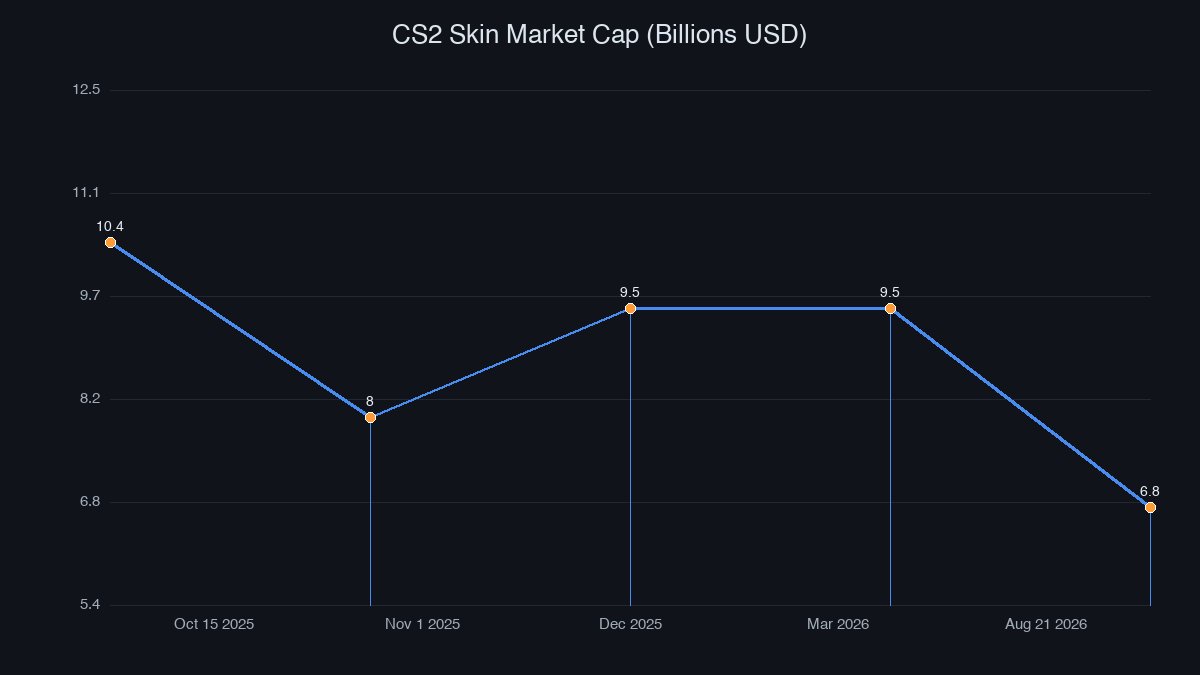
The key detail isn't the headline number — it's the shape. This wasn't a single crash. It was a crash, a false recovery, and then a second, quieter slide. Traders who bought the December dip are now underwater again, and that's the group driving the current sell pressure.
What Broke It
The original shock came on October 23, 2025, when Valve shipped what it described as a "small update" that quietly expanded Trade Up Contracts. For the first time, players could exchange five Covert-grade ("red") skins from a single collection for one knife or one pair of gloves.
Before that day, knives and gloves could only come from case openings — an extremely low drop rate that functioned as a hard supply constraint. That scarcity was the entire foundation of knife pricing. Overnight, a second supply channel opened, and the market repriced violently.
- Knife prices fell 20% to 65% across the board, with Karambits down roughly 52%.
- Covert skins spiked — Fracture-case Covert items jumped as much as 187% — because every knife trade-up now consumed them as inputs.
- Bloomberg reported the market lost $1.75 billion in a single day, pegging the 24-hour drop at nearly 30%.
The human stories were just as stark. Ars Technica documented one Redditor whose collection of over 600 "worthless red skins" was suddenly worth £3.3 million (about $4.4 million) if liquidated — while a Chinese trader posted his collection dropping 6.4 million yuan (about $900,000) in under a day.
The lesson that still holds a year later: Valve controls supply, and no chart pattern survives a supply change. A skin treated as a slow-appreciating store of value became an input cost in an afternoon.
The Data Behind the Headline
Independent trackers confirm the correction wasn't just a knife problem. csdb.gg's market-trend tracker, which compares 1,186 skins with matched wear conditions between March 2 and August 10, 2026, found a median price change of -28.8%.
Roughly 95% of comparable skins are now cheaper than they were at the baseline. The declines are broad-based, and knives and gloves — the exact categories whose supply mechanics changed in October — sit among the weakest medians in the window.
SteamDB's snapshot adds a second layer of texture. Across 13,588 tracked items and 49.8 million listings spread over 36 marketplaces, the combined floor value is about $1.16 million. Knives account for 25.2% of that floor value — but stickers now dominate at 60.8%.
Its 32-day price index (July 13 to August 14) shows the bleeding is still steady: knives -4.6%, gloves -10.2%, weapon skins -8.7%, stickers -6.9%, for an overall -6.8%. The market isn't crashing anymore — it's grinding lower.
What Surprised Us
The market didn't fall evenly. Blue-chip staples like the AK-47 | Redline and AWP | Asiimov barely moved, which is exactly what you want to see in a correction — the liquid core held up while the froth got wiped out.
The gainers, by contrast, skewed toward older, discontinued-collection skins where supply genuinely cannot grow. No active case or collection drops them anymore, so even modest collector demand pushes prices up. That split — abundant recent supply drifting down while scarce legacy supply holds or climbs — is the defining texture of the current market.
The sticker boom has been violent in both directions. A single player sticker can post a five-digit percentage gain on near-zero volume one week and collapse the next. When a percentage move hits six digits, the underlying liquidity is usually thinner than a Factory New P250 Sand Dune, and chasing it is how retail money gets trapped.
The Smart Play
If you're holding skins right now, the honest answer is that this is a waiting game. The smart money has rotated out of speculative fluff and into liquid blue-chip items with deep order books — factory-new knives with consistent volume, not stickers with a null volume readout.
If you're buying, don't chase the headline crash. A correction of this size usually needs a catalyst to reverse, and the most likely candidates are a new case release or a tournament announcement that brings volume back. Until then, price without volume is a number, not a market. Watch for volume to return to the liquid core before you commit fresh capital — that is the signal, not the price tag.
The broader point for anyone watching the space: CS2 skins proved they can lose a third of their value in under a year. They are not a stable store of value, and treating them like one is how collections get wiped out. Spend only what you can afford to see drop 30% or more.
And if you're going to open cases anyway — because sometimes the itch beats the math — at least pick a case with a skin pool worth the key. The Fan Favorite case is a solid current-generation pick with a modern skin pool and a realistic special-item chase. Whichever way the market tips next, the rules haven't changed: know the odds, check the spread, and never bet money you can't afford to watch evaporate.