CS2 Skin Market Surpasses $8 Billion in 2026: The Data Behind the Rise

CS2 Skin Market Surpasses $8 Billion in 2026: The Data Behind the Rise
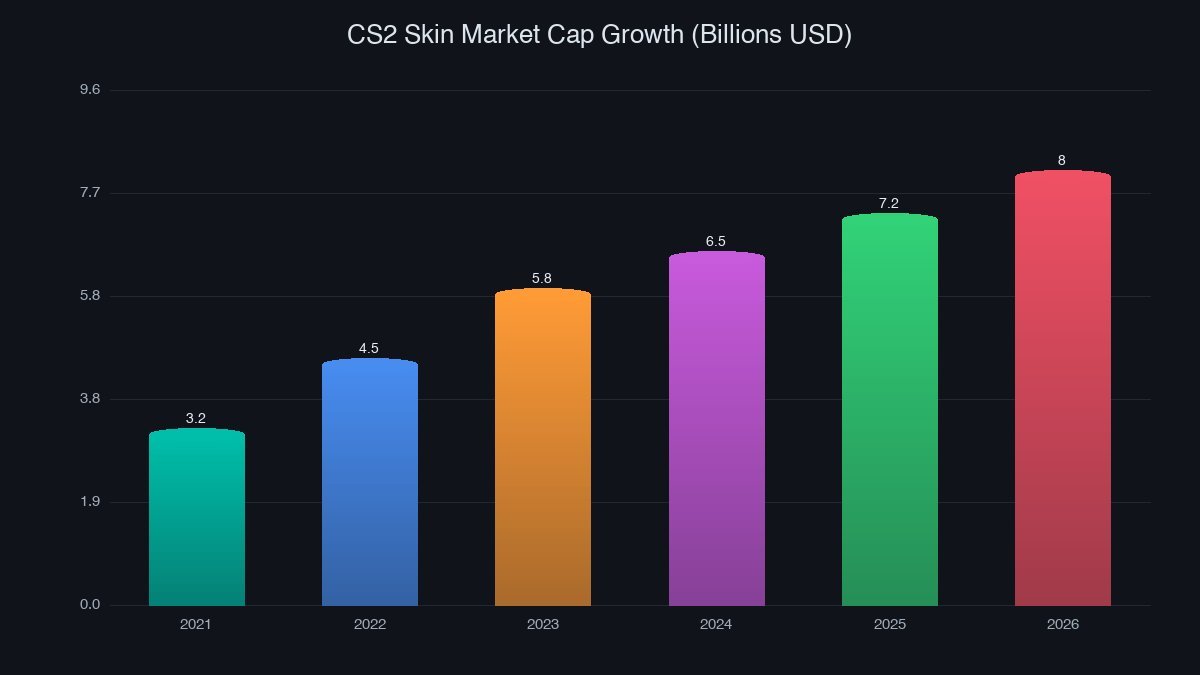
The CS2 skin market just crossed a threshold that would have been unthinkable five years ago. As of mid-2026, the total market capitalization of Counter-Strike 2 skins has surpassed $8 billion, up from an estimated $6.5 billion at the start of 2025. That's a 23% increase in roughly 18 months — growth that outpaces most traditional collectibles markets over the same period. Let's look at what the numbers actually say.
The Raw Numbers
SteamAnalyst's 2026 market report pegs the total CS2 skin market at over $8 billion, with year-over-year growth accelerating rather than plateauing. To put that in perspective: the global trading card market was valued at approximately $12.5 billion in 2024, meaning CS2 skins alone now represent roughly two-thirds the value of the entire physical trading card industry. Digital cosmetics for a single video game are approaching the total market size of an established 150-year-old collectibles category.
The growth trajectory tells its own story. The market sat at around $3.2 billion in 2021, climbed past $4.5 billion in 2022, jumped to $5.8 billion when CS2 launched in 2023, reached $6.5 billion through 2024, crossed $7.2 billion in 2025, and now sits north of $8 billion in Q3 2026. That's a compound annual growth rate of roughly 20% over five years — a number that would make most venture capital firms pay attention if this were a startup rather than a video game economy.
The average daily trading volume across major marketplaces now exceeds $15 million, with peak days during major updates or tournaments pushing past $25 million. For comparison, the total daily volume of the CS2 skin market now rivals the trading activity of some mid-cap stocks on public exchanges.
What Drove the $1.5 Billion Jump
Three structural forces drove the market from $6.5 billion to $8 billion between early 2025 and mid-2026. The first is institutional participation. What started as players trading skins among themselves has attracted portfolio investors who treat rare CS2 items as alternative assets. The Skin.Club community notes in its July 2026 most-expensive-skins ranking that certain items now reach prices "comparable to luxury watches" and "rare automobiles" — the language of a market that has outgrown its hobbyist roots.
The second force is supply-side maturity. Valve's release cadence has stabilized — major updates like the Premier Season 5 Armory refresh (July 2026, adding 34 skins across Arabesque and Spy Tech collections) inject controlled supply that stimulates rather than dilutes market activity. The 2026 Gamespace analysis observed that the CS2 market has become "more mature and structured," with hype-driven spikes giving way to sustained, fundamentals-based growth. New skin releases now function more like IPOs than lottery tickets — they create tradable assets that expand the total addressable market rather than just redistributing existing value.
The third force is the platform layer. Third-party marketplaces like SkinVS have built infrastructure that makes CS2 skin trading accessible to people who have never launched Counter-Strike. Instant price discovery, mobile-friendly interfaces, secure P2P escrow, and integrated case-opening experiences lower the barrier to entry for non-gamers who simply see CS2 skins as an investable asset class with demonstrated historical returns.
Skins as Digital Collectibles
The framing has shifted decisively. In 2021, calling CS2 skins "digital collectibles" was a stretch. In 2026, it's a market reality. SkinsMonkey's 2026 investment guide states that rare CS2 skins are now "treated like digital collectibles, with some items reaching prices comparable to luxury watches." This isn't just marketing language — it reflects genuine buyer behavior where provenance, float value, pattern index, and rarity tier are evaluated with the same rigor that art collectors apply to edition numbers and condition reports.
The most expensive CS2 skins in July 2026 include factory-new StatTrak knives with rare patterns that trade hands for $10,000 to $40,000, and certain souvenir items with tournament provenance that have reached six-figure valuations in private sales. The Skin.Club July 2026 ranking lists 16 skins that individually exceed $5,000 — a list that grows longer with each passing quarter. These aren't outliers; they're the top of a deep curve where the median Covert skin in factory-new condition still commands a $150-$500 price range depending on weapon type and collection age.
What Market Maturity Means for the Average Player
An $8 billion market isn't just an abstract number. It changes the incentives of every participant in the ecosystem. For Valve, a multi-billion-dollar secondary market creates a powerful argument for continued investment in CS2 — the skin economy functions as a retention mechanism that keeps players engaged long after the competitive novelty of a matchmaking rank wears off. For scammers, it's a bigger target — which is why platforms investing in security infrastructure and verified trading have a structural advantage as the market grows.
For regular players, market maturity means more predictable pricing. The wild 300-400% swings that characterized the 2020-2022 period have moderated. The CGMagazine analysis from May 2026 observes that launch prices for new skins "often reflect scarcity more than real demand" and advises patience — a stance that would have been contrarian during the FOMO-driven runs of earlier years but now reflects a market where participants have learned through repeated cycles.
The $8 billion milestone also matters because it changes the conversation around CS2 skins in mainstream financial media. When a market crosses the $5 billion threshold, it stops being "those weird video game items" and starts being covered alongside sneakers, trading cards, and whiskey as an alternative asset class. The SteamAnalyst guide frames the market's $8 billion valuation alongside data on individual skin appreciation rates, creating the kind of analytical infrastructure that institutional capital looks for before entering a market.
Whether you're a long-term holder tracking your portfolio on SteamAnalyst, a player who just wants to know if your knife skin has held its value, or someone discovering CS2 skins for the first time, the numbers tell a clear story. This market isn't going away. It's growing, maturing, and developing the infrastructure of a legitimate asset class. The Fan Favorite case on SkinVS is a direct gateway to participating in one of the most remarkable digital economies of the decade — with full price transparency and no hidden fees.