Valve Just Admitted Its CS2 Sticker Pricing Experiment Failed — What Changes Now

Valve Just Admitted Its CS2 Sticker Pricing Experiment Failed — What Changes Now
When Valve replaced the entire CS2 major sticker system with "demand-based" pricing in May, collectors braced for chaos. By June, a full set of Cologne 2026 major stickers cost $19,447. By late July, Valve quietly admitted the system "didn't produce reasonable prices" and shipped a fix. So what actually happened — and what does the new Ranked Series mean for anyone who collects or trades stickers?
Why Did Valve Change Sticker Pricing in the First Place?
The old system was simple: sticker capsules had fixed odds, and you bought as many as you wanted. A capsule cost a few dollars, every sticker in it had a published drop chance, and the market did the rest — popular stickers rose on the Steam Community Market, unpopular ones sat at cents. It was boring, predictable, and it worked.
Then, on May 21, 2026, Valve killed sticker capsules entirely and introduced dynamic pricing — the price of every sticker would float based on demand, updated in real time. The same update also changed how souvenirs and tournament drops worked, and the community reaction was immediate confusion: nobody knew what a sticker "should" cost anymore, because the price was whatever the algorithm said at that moment.
The intent was to mirror how the community actually values stickers. The result was the opposite of subtle. Famous players and teams instantly became expensive, and the pricing swung hard enough that a complete set of the tournament's stickers hit $19,447 in early June, according to GamesRadar and gHacks coverage at the time.
For context on what stickers can be worth, check skinvs' own market data: a Titan (Holo) | Katowice 2014 sticker is listed at $212,769.83, with iBUYPOWER (Holo) at $89,923.96 and Vox Eminor (Holo) at $71,754.93. The 2014 tournament sticker economy is a multi-hundred-thousand-dollar market — which is exactly why collectors care how new majors price their stickers.
The Numbers Didn't Work
Here is the key sentence from Valve's official announcement on July 29, 2026: "The original dynamic pricing system determined the relative interest in players and teams, but it didn't produce reasonable prices."
That is a remarkable admission for Valve to make in an official post. It means the demand signals the system was reading — primarily trading volume and interest — produced sticker prices that even Valve considered unreasonable. When a brand-new sticker set costs nearly $20,000, the system has stopped being a marketplace and started being a barrier.
Valve's fix is a new line of stickers called the Ranked Series, which indicates a team's final standing in the tournament in the design. Crucially, the Ranked Series stickers carry a lower price while keeping "the same relationship between players and teams as the Event Series stickers." In other words: the hierarchy of prices stays, but the absolute numbers drop.
There is also a blunt economic read of this move: a sticker system that prices a full set at nearly $20,000 fails as both a product and a marketing tool. The whole point of major stickers is that fans slap them on guns to support teams. At $19,447 per set, that support mechanism had become a luxury purchase — and Valve's own wording confirms the system had drifted away from what sticker buyers actually wanted to pay.
What Ranked Series Actually Changes
Three concrete things change with this update:
- Lower entry prices. The Ranked Series is deliberately priced below the Event Series, so a full collection no longer requires a five-figure budget.
- Royalties stay at 50%. As with all items in the Cologne 2026 Shop, half of the royalties are shared with players, teams, and the tournament organizer — the sticker purchase is also a direct contribution to the teams you support.
- A hard deadline. Everything in the Cologne 2026 Shop, including the Ranked Series, is available for purchase only until September 29. After that, these stickers become limited-supply items.
The update also quietly fixed a collection XP bug for the Dead Hand Collection and a VACnet exploit in the same patch window — a reminder that sticker economics sit inside a much larger game-economy machine.
What This Means for the Sticker Market
The long-term lesson is already visible in the data: scarcity + history is what creates six-figure stickers, not pricing algorithms. The Katowice 2014 holo stickers that now trade for five and six figures were never "priced" by a system — they simply ran out.
If you are thinking about the Cologne 2026 stickers as an investment, the September 29 deadline matters more than the current price. Once the shop closes, supply is fixed, and the Ranked Series becomes the kind of tournament-memento item that collectors chase in later years — the same pattern that turned Paris 2023 and Budapest 2025 capsules into steady gainers. Tournament stickers follow a reliable lifecycle: chaotic while the shop is open, quietly appreciating once it closes, and spiking years later when a player's career or a team's legacy makes the item historically significant.
One more angle worth watching: the sticker market is not just about majors. The skinvs database lists hundreds of stickers from $0.01 up, and the community sticker scene — Capsule-style releases like the Jackass Sticker Capsule from July — keeps feeding new supply into the market. The difference is that community stickers rarely appreciate the way major stickers do, because majors carry team and player narratives that compound over time.
For players who just want a sticker on their AK, the Ranked Series is the rare Valve move that actually lowers the barrier: cheaper prices, same team support, and a cleaner design line than the chaotic early days of dynamic pricing. And for traders, the Ranked Series adds something the market had been missing since May: a stable reference point. When every sticker price was algorithmic, price discovery was impossible — there was no "normal" to compare against. A fixed-price series with a clear end date restores that anchor.
Where We Go From Here
Valve has shown it will correct course when its own experiment produces bad prices — that is a useful signal for anyone trading in tournament items. The next test comes September 29, when the Cologne 2026 Shop closes and the market starts pricing these stickers without Valve's intervention.
While you wait, the rest of the CS2 item market keeps moving. If you want a piece of the action without chasing a $200,000 sticker, cases remain the most accessible entry point — try your luck on a premium case like the Violet Vortex case, or browse the full market at skinvs.com/market to see live sticker and skin prices before you buy anything.
The sticker market has survived worse than a bad pricing algorithm. The question is whether the Ranked Series will be remembered as the fix — or as another chapter in CS2's longest-running experiment.
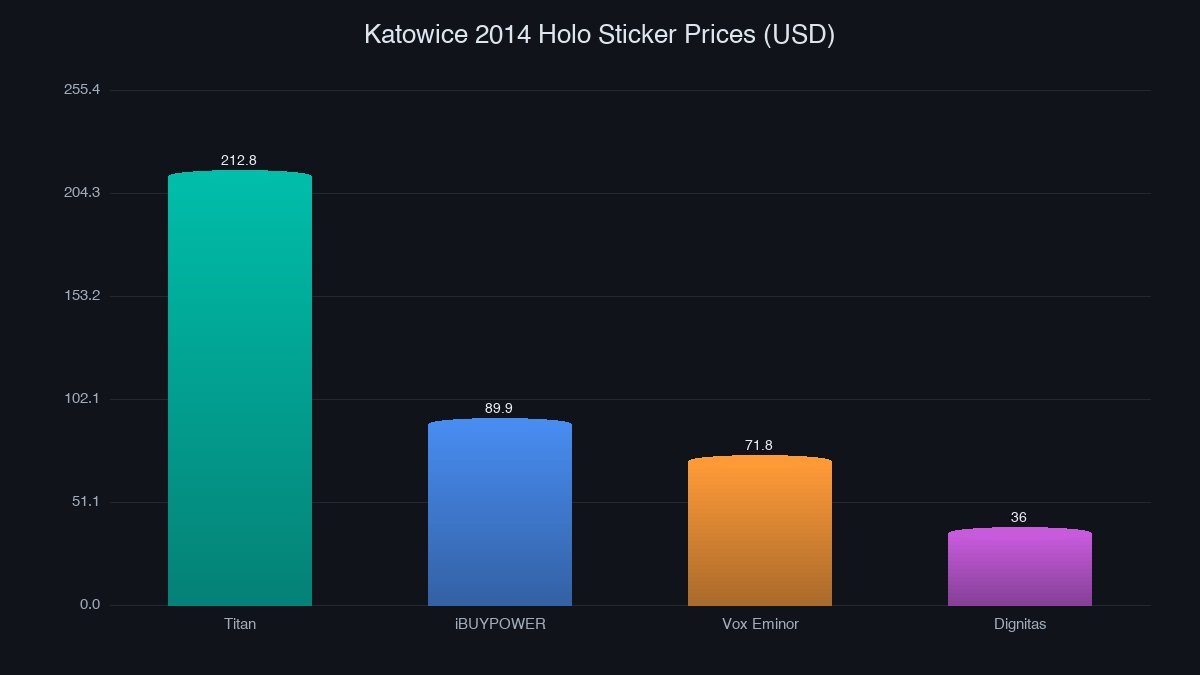
Chart: listed prices for four legendary Katowice 2014 holo stickers, from skinvs market data. The gap between these and brand-new tournament stickers is the whole story.