CS2's Five Case Tiers, Ranked by What They Actually Pay

CS2's Five Case Tiers, Ranked by What They Actually Pay
There is one number in Counter-Strike 2 that has been public since 2017 and still gets argued about every single day: 0.26%. That is the disclosed chance of pulling a knife or a pair of gloves out of a weapon case — roughly 1 in 385 openings.
It became public because China's Ministry of Culture required loot box odds to be published, and Valve complied through its Chinese publishing partner. The rates have not moved since — not through CS:GO's end, not through the CS2 launch, not in the nine years of cases that followed.
So let's do the unglamorous thing and rank the five tiers by what they actually pay you, using the disclosed numbers rather than the highlight reels.
#5: Mil-Spec — 79.92% of Everything You Open
Four out of every five items you pull will be blue. At 79.92%, Mil-Spec is not a reward tier, it's the default state of opening a case. A typical weapon case carries 12 Mil-Spec skins, which puts any single one of them at roughly 6.66% per opening.
In money terms, most of these sell for under a dollar, and a large share sell for literal pennies — Battle-Scarred versions of unpopular finishes routinely list near $0.14–$0.20. This is the tier that makes every case-opening session feel like nothing happened, because statistically nothing did.
If you open 50 cases, expect around 40 of them to land here. That isn't bad luck. That's the design.
#4: Restricted — One in Six, and Still Usually a Loss
Restricted sits at 15.98%, or roughly 1 in 6.25. A case carries about 5 Restricted skins, so any specific one lands at about 3.20% — the same odds as the entire tier above it.
This is where prices start to look like money. Popular Restricted finishes trade in the $2 to $15 band, and a few carry premium paint seeds that push them far higher. But at 1 in 6, the math still doesn't work: a $2.49 key plus the case price buys a tier that mostly pays back a couple of dollars.
The trap with Restricted is that it feels close. Sixteen percent is a number your brain reads as "soon." Across 1,000 openings you will see it about 160 times, and the vast majority of those 160 will not cover the keys that produced them.
#3: Classified — 3.20%, the Tier That Feeds Trade-Ups
Classified, the pink tier, lands at 3.20% — about 1 in 31. Cases hold around three of them, putting each individual Classified skin at roughly 1.07%.
This is the economically interesting tier, because it is the raw material for trade-up contracts. Classified skins are what you feed in when you're chasing a Covert outcome, which means the tier has a floor under it that the two tiers below don't: someone is always buying pinks as inputs.
The market data reflects that. The most-traded Classified skins move 9,000 to 12,000 units a day, with the highest-volume examples trading in the $3.35–$3.45 range — cheap, liquid, and constantly consumed. At the top end, Classified finishes like an AK-47 Hydroponic sit at $774.91 and an M4A1-S Hot Rod at $1,410, though the tier as a whole was down 4.4% to 14.6% across the last 30 days depending on the item.
#2: Covert — 0.64%, and the First Real Money
Covert is 0.64%, roughly 1 in 156. Cases carry about two reds, so a specific Covert skin lands at 0.32% — one in 312.
This is the tier that pays for the story. The disclosed Covert rate is exactly 5x rarer than Classified, and the prices step up accordingly: redeeming Coverts regularly clear the hundreds and occasionally the thousands. But note how rarely it appears. In 1,000 openings you should see around six reds. Not sixty. Six.
There's a second roll hiding here. Covert at 0.64% multiplied by the Factory New share of the float distribution — about 7% — puts a Factory New Covert at roughly 0.019%, or 1 in about 5,200. Wanting a specific skin in a specific wear is a meaningfully smaller ask than wanting any red at all.
#1: Rare Special (Gold) — 0.26% and the Only Tier That Changes Your Year
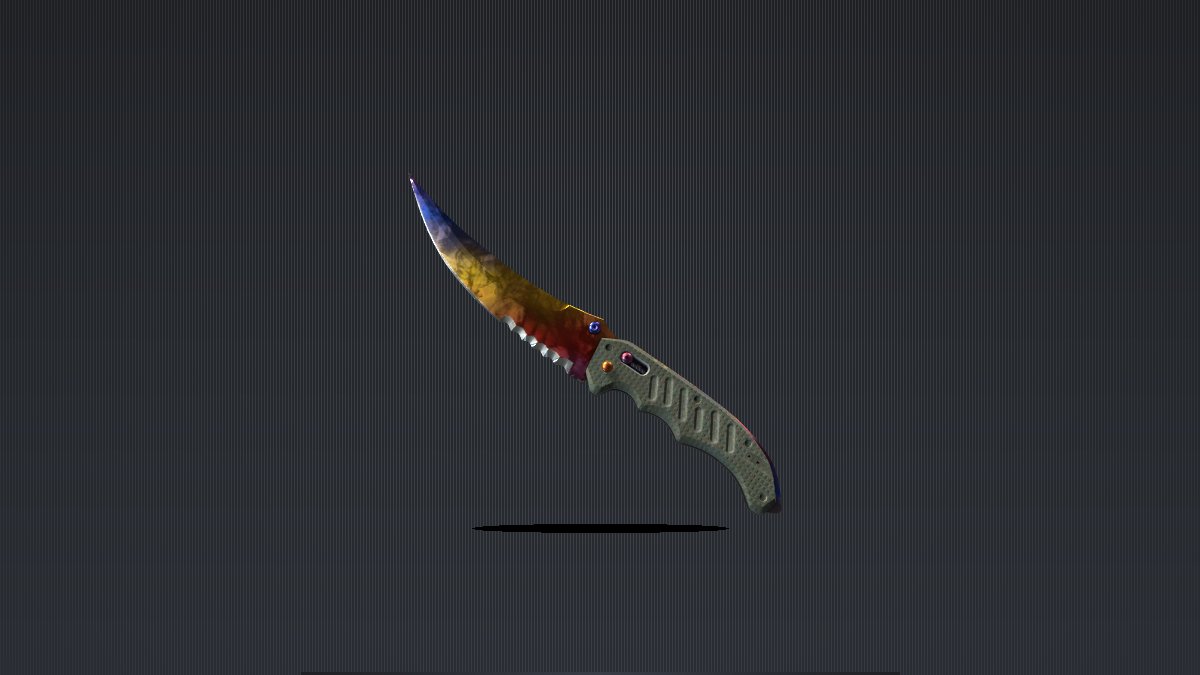
Gold is 0.26% — 1 in 385 — and it is not the same kind of number as the tiers above it. Every other tier steps down by a factor of five. Gold steps down from Covert by a factor of about 2.5, which is why the knife rate lands at 1 in 385 rather than the 1 in 780 a clean five-step ladder would produce.
Gold is also the only tier where the item is worth multiples of everything you spent to get there. A knife pull typically indexes 50 to 500 times the case-plus-key cost. It's the reason the whole system exists and the reason the other four tiers are priced the way they are.
And it's the only tier with no mercy mechanics. CS2 has no pity timer and no bad-luck protection of any kind. Every opening is an independent roll at the same 0.26% — opening 384 cases gives you exactly zero statistical advantage on case 385.
Want a sanity check on whether the published number is real? Community trackers logged 8.2 million case openings across 2024 and 2025 and measured a Special-tier rate of 0.255%, a deviation well inside the noise you'd expect at that sample size. In June 2021 a streamer opened 4,000 cases for roughly $10,000 and landed within a hair of the same figure.
The Second Roll Nobody Prices In
Two multipliers sit on top of every tier, and both are easy to forget.
The first is StatTrak: an independent ~10% flag on any eligible drop. Apply it to gold and a StatTrak knife lands at 0.026% — about 1 in 3,846. Same tier, ten times the wait.
The second is the knife pool itself. A case typically spreads its gold tier across 19 knife types with roughly 5 finishes each, which is about 95 combinations chosen with uniform probability once a gold roll happens. Any specific knife-finish therefore sits near 1 in 36,500. Stack that with Factory New and StatTrak and you arrive at figures like 1 in 5.2 million for a Factory New StatTrak Karambit Doppler. Pattern-sensitive finishes cut deeper again — pattern indices and rare phases inside the same knife can turn one outcome into a one-in-ten-million event.
If you buy only one idea from this article, make it this one: the 0.26% everybody quotes is the price of admission, not the thing you were trying to buy.
What 1,000 Openings Actually Looks Like
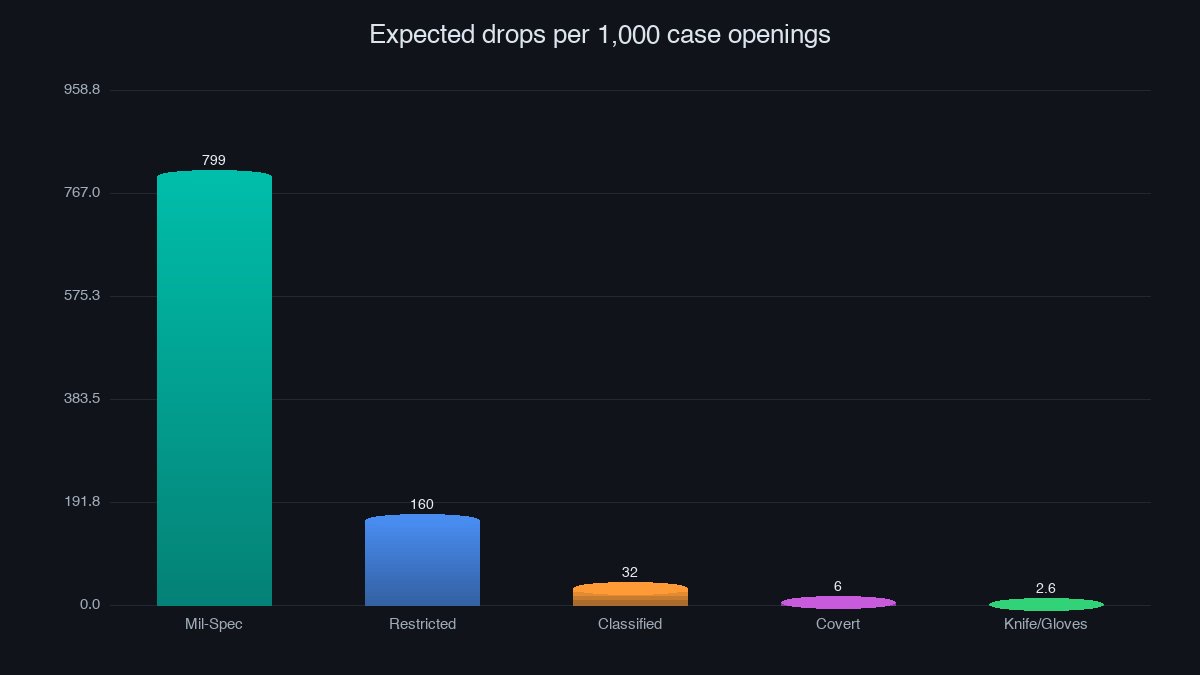
Run the disclosed rates across 1,000 cases and the shape of the session is obvious before you spend anything: about 799 blue, 160 purple, 32 pink, 6 red and 2 to 3 gold — and that last figure is an average, not a promise. You could open 1,000 cases and land zero knives. You could land five.
Cumulatively, the wait is steeper than it looks. Roughly 267 cases gets you a coin-flip chance of at least one gold. Getting to a 90% chance takes somewhere in the region of 886 to 1,000 cases. At a $2.49 key, just reaching the statistical expectation of one gold means around $958 in keys alone before you've paid for a single case.
That's the arithmetic behind the expected-value line everyone quotes. Across the case population, contents are typically worth 25% to 45% of the case-plus-key cost, and typical sessions return somewhere between 50% and 85% of what was spent. No tier changes that — the tier ladder only decides how the loss is distributed.
Souvenir packages are a different curve entirely, and worth knowing if you're comparing: Consumer 79.87%, Industrial 15.97%, Mil-Spec 3.33%, Restricted 0.67%, Classified 0.13% and Covert 0.03%. If your goal is a specific trophy, the container you pick matters more than the number of cases you buy.
Reading the Ranking Like a Buyer
Ranked by what they pay, the tiers run bottom-up: blue is noise, purple is a rounding error, pink is an input, red is the story, gold is the reason anyone opens anything. Ranked by how often you'll actually see them, that order runs exactly upside down.
Which leaves the only decision that matters. If you want a knife, buying 385 cases is a very expensive way to get a random one, and buying the specific knife you want outright is cheaper than the statistical path to it in almost every scenario. If you want the experience of opening, price it like entertainment, set a limit, and remember that the 0.26% is fixed — it will not get warmer because you've been patient. Where you open matters for that side of the ledger too: Phantom Cache keeps the same disclosed odds with the rest of the math laid out where you can see it.