Every CS2 Case Loses Money — the 10 That Lose the Least
Every CS2 Case Loses Money — the 10 That Lose the Least
Ask ten players which case is worth opening and you will get ten answers, almost all of them wrong. The usual mistake is costing an opening at the $2.49 key and ignoring what the case itself costs. That is fine for a container worth twenty cents. For a discontinued case trading at $150, it is off by a factor of sixty, and it turns the worst cases in the game into apparent bargains.
Price every outcome at its published drop rate, cost every opening at case price plus key, and one uncomfortable fact falls out: not a single CS2 case returns more than it costs. The only real question is which ones waste the least, and by how much.
Two Numbers Set Every Price
Valve has disclosed the same drop table since 2017, and it is identical for every standard weapon case in the game.
- Mil-Spec (blue) — 79.92%, roughly 1 in 1.25 opens
- Restricted (purple) — 15.98%, 1 in 6.3
- Classified (pink) — 3.20%, 1 in 31
- Covert (red) — 0.64%, 1 in 156
- Special — knife or gloves (gold) — 0.26%, 1 in 385
Four out of five openings hand you a blue skin worth less than the key you just spent. Separately, any weapon skin has a 10% chance of rolling StatTrak, and gloves have no StatTrak version at all.
The practical consequence is that the average is carried by a sliver of outcomes. Reaching a 50/50 shot at a single gold item takes 267 openings, which is about $833 in keys alone. Getting to a 95% chance of at least one knife takes 1,153 cases. And because each open is an independent 0.26%, opening more does not improve the odds of the next one — there is no pity system in CS2.
#10 → #6: The Bottom Half of the Best
Ranked by how much of each dollar comes back in raw market value, using Steam medians and published drop rates:
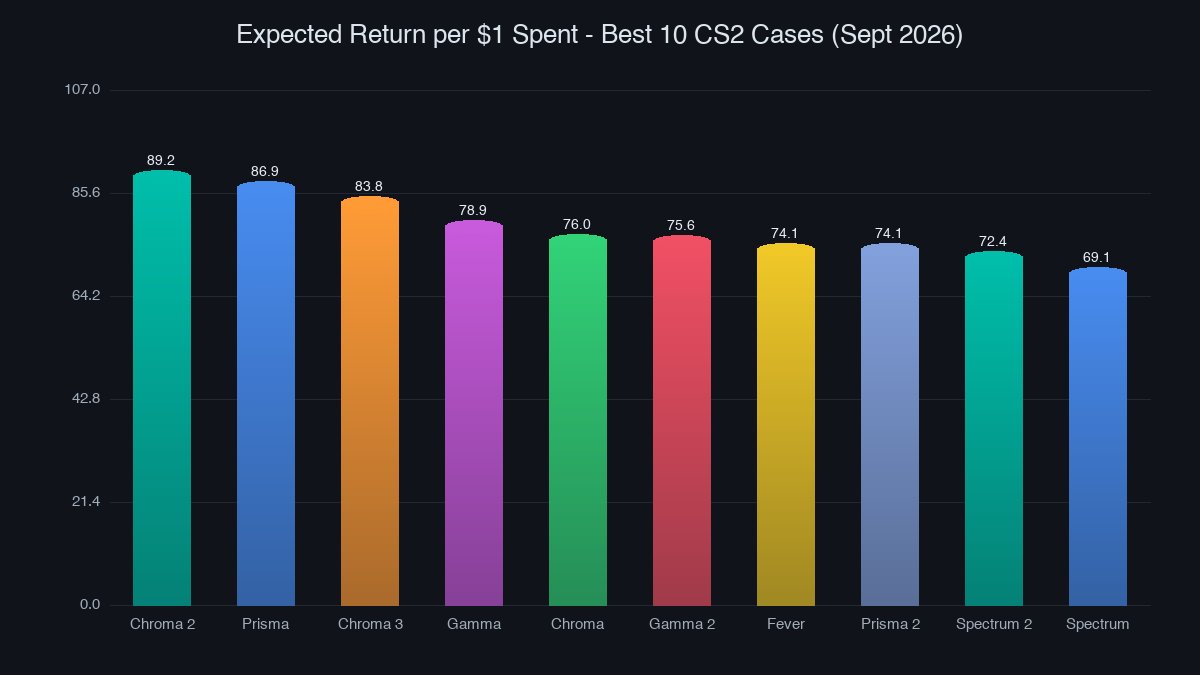
- #10 Spectrum Case — 69.08%. The weakest of the top ten. Cheap items and a knife pool that only occasionally produces a headline finish.
- #9 Spectrum 2 Case — 72.44%. A wide return spread, stretching from about $0.14 to $17,340, which tells you the whole number rests on the rare tail.
- #8 Prisma 2 Case — 74.06%. Frequently cited as a good opener; it is mid-table once you pay for the case.
- #7 Fever Case — 74.13%. An Armory container, currently the most-opened case in the game — which is also why its contents are so heavily supplied.
- #6 Gamma 2 Case — 75.63%. Classic finishes, decent liquidity, and a return range topping out near $11,730.
Notice how compressed that band is. Between the tenth-best case and the sixth-best case there is barely six percentage points of difference. That is the signature of a system where the odds never change — what moves the ranking is the price of the contents, not the probability of getting them.
#5 → #2: Where It Tightens
- #5 Chroma Case — 76.01%. Older generation, thin supply, and a return range starting around $0.43.
- #4 Gamma Case — 78.91%. The strongest of the Gamma family, helped by Coverts that have held their value for years.
- #3 Chroma 3 Case — 83.75%. Part of a remarkable run of three consecutive CS:GO-era containers at the top of this list.
- #2 Prisma Case — 86.89%. Return spread from about $0.20 to $4,370. Three of the top five are Chroma-family containers.
There is a real pattern here worth naming. Decade-old cases outperform new ones, and it is not because their odds are better — the odds are byte-identical. It is because their interiors have been repriced by scarcity while the container itself is still cheap relative to what is inside it.
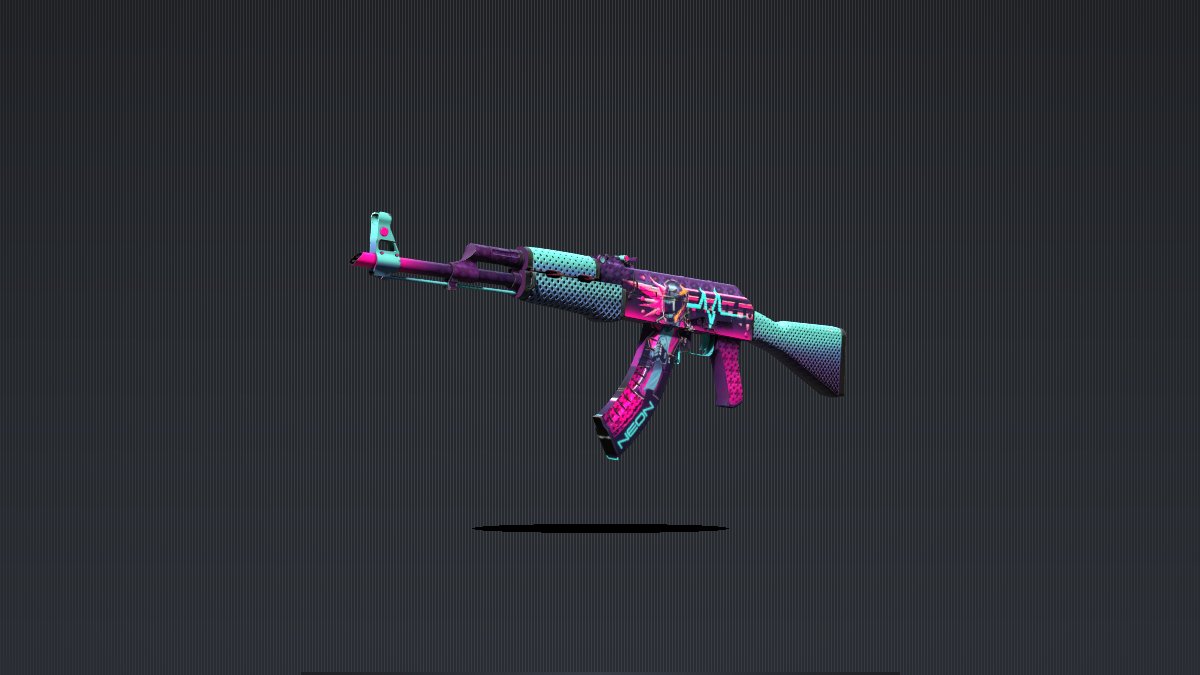
And it is worth remembering what the top of the ladder actually looks like, because that is the item the percentages are quietly built on. A Covert rifle is where most of a case's expected value lives, and it is also where the wear tier does most of the work — the same finish in Factory New and Field-Tested can be twenty times apart in price, which is part of why your own result rarely matches the table.
#1 Chroma 2 Case — 89.16%
Released in April 2015, the Chroma 2 Case tops the ranking at 89.16%, meaning every dollar spent returns roughly $0.89 in skin value before any selling fee is applied.
Its rare-special pool covers five classic models — Bayonet, Flip Knife, Gut Knife, Karambit and M9 Bayonet — and hidden inside the Doppler finish are the Ruby, Sapphire and Black Pearl phases that sell for multiples of a standard phase. Both of its Coverts have held value for a decade, which is unusual for a container this old.
Even so, read the number correctly. An 89% return is not a 89% profit and not an 11% loss. It means that across thousands of openings you hand over more than you receive, rather than less. The best case in the game is the one that loses money slowest.
Here is what a realistic session looks like, using the same method. Take the Chroma 3 Case: it costs $2.99 and the key costs $2.49, so an opening is $5.48. Average return is $4.41. That is a net of -$1.07 per open, or -19.5%. Run that same math down the table and the weakest containers reach -47.2%. Ten openings is a fifty dollar outlay for about thirty dollars of skins, and there is nothing unusual about that result.
Why Two Sites Disagree About the Same Case
You will find other trackers naming completely different winners. One widely cited table crowns the Prisma Case at 69.1% with a cost of $4.44 per open — $1.95 for the case plus the key — and an expected return of $3.07. Another picks the Chroma 3 Case as the least-bad option at around 80%.
None of them are lying. They are answering slightly different questions. Some cost the opening at key-only because the case dropped into the player's inventory for free; others charge the market price of the case because most people buy it. Some use the cheapest listed ask, some use the median of completed sales, and they snapshot prices on different days. Change any one of those assumptions and the ordering shuffles.
That is worth internalising before you trust any single ranking, including this one. The reliable facts are the ones that do not move between methodologies: the drop rates, the 1 in 385 gold rate, the 10% StatTrak rate, and the direction of every return figure in every table — below cost.
There is a separate category worth flagging, because it is where most confusion comes from. Third-party opening sites publish their own return percentages, and in September 2026 a review of 72 cases across five such platforms found live-verified averages clustered around 88.4%, with one platform at 90.08%. Those numbers describe entirely different products with custom contents and their own house edge — they are not Steam cases and they are not comparable to the table above.
What a Percentage Actually Means at the Counter
If the goal is a specific skin, no case is the right tool. The percentage tells you how efficiently a container converts money into random items; it does not tell you whether the item you get is the item you wanted. Most opens land in the bottom tier, and the bottom tier is worth less than the key.
If the goal is the experience — the countdown, the roll, the possibility — then the ranking above is the honest way to choose between containers, and the useful move is to pick from the top of it and size the session so that a normal, unremarkable outcome does not sting. Budget the session as entertainment, not as a purchase.
If the goal is a specific finish, compare the two numbers side by side: what a case costs per open, against the flat listing price of the skin itself. The Prisma Shards case is a fine place to start on the opening side, and the SkinVS marketplace is where you can see the alternative priced out plainly. Nine times out of ten, buying the gun you actually want beats opening for a chance at it — and the tenth time is the one where you got lucky, not the one where the math changed.